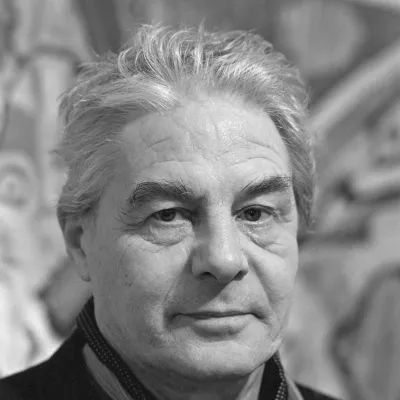
Photo: Wikimedia Commons
Michel Tournier
Human Design Chart
Biography
He won important awards such as the Grand Prix du roman de l'Académie française in 1967 for Friday, or, The Other Island and the Prix Goncourt for Le Roi des Aulnes in 1970. In 1993 he won the Goethe Medal. His works dwell on the fantastic, his inspirations including traditional German culture, Catholicism, and the philosophies of Gaston Bachelard.
His books have been translated into dozens of languages.
Michel Tournier as a Manifestor 5/1 in Human Design
Manifestor 5/1 — Design at a Glance
Michel Tournier revealed himself as a pioneer and visionary whose Human Design type was that of a Manifestor. This role is akin to an emperor in ancient Rome: He had the vision for a grand whole but did not lead the necessary wars himself; instead, he sent others to conquer foreign lands on his behalf. This configuration came with a specific pain point: Michel Tournier was often misunderstood and polarized his environment. Because he thought further ahead than many others, some people loved and followed him, while others hated or rejected him precisely because of his vast visions. To find the right followers, it was essential for him to inform others in good time and accurately about his plans. This strategy of informing was key to his inner balance. If Michel Tournier lived according to this guideline and his authority, he was rewarded with a feeling of inner peace. When he deviated from this path and lived against his design, he instead felt a persistent, deep anger within him. His life was thus marked by the tension between the necessity to clearly communicate his visions to avoid misunderstandings and the resulting emotional reward or punishment through his own system.
Emotional Authority
Michel Tournier was subject to an emotional wave that showed itself in a constant up-and-down of his feelings. His inner authority carried the defined Emotional Center; this position always took precedence over all other defined centers in his design, regardless of further configurations. He saw the world colored by his current mood: In one moment totally enthusiastic, in the next the same thing negatively evaluated. However, his immediate feeling was only a snapshot, a first impression that did not necessarily correspond to his truth yet. Quick, spontaneous decisions based on emotion often had negative consequences for him. The more time he took to let a decision mature, the deeper and more comprehensive could he perceive something. This required patience and repeatedly sleeping over decisions. He should take pride in himself and ask himself several times. Over time, intense feelings subsided, he gained emotional distance, and clarity as well as calmness set in. Only then had he gone through the process. This mechanism was particularly important for long-term decisions that could have a significant impact on his life course.
The 5/1 Profile — Heretic / Investigator
Michel Tournier revealed himself to be someone who initially gathered profound insights in secrecy before making them available later as solutions for others. This profile of the 'Hero/Researcher' (5/1) laid out a tension: On one hand, the need for withdrawn research and dedication to his own experience (Line 1), on the other hand, the almost magnetic attraction that drew other people in search of advice.
The Line 1 emphasized the value of art and creative effort even without immediate recognition. Happiness consisted in being true to his own experience. At the same time, Line 5 with its philanthropic orientation: In times of crisis, philosophical ideas developed for the general public. But this openness carried risks. Without clear boundaries, he faced overexertion through constant inquiries from others, similar to an expert exhausted after long consultations.
Protection here was provided by withdrawing from direct contact. Through writing books, Michel Tournier could preserve his ideas and shield himself from too much personal interaction. Thus a balance emerged: The deep, hidden work served as the foundation while shared insights helped others solve problems – provided he maintained control over when and how to share these treasures.
Single Definition — Defined & Open Centers
Michel Tournier's Human Design revealed a tendency towards emotional depth and reliable communication. His defined Solar Plexus Center acted as an inner authority, making decisions not in the moment but patiently waiting until the emotional wave had clarified itself. This mechanism shaped him as someone who recognized truths only after going through various emotional phases, thus cultivating a deep, sensitive intelligence. Simultaneously, his defined Throat Center provided a stable channel for expressing these insights; it directed messages from his emotional system into clear speech or action without being impulsive.
This firm foundation contrasted strongly with his open centers. His open Head and Ajna Centers made him receptive to mental inspirations and concepts from the environment but tended to get stuck in doubts or foreign questions if he did not trust his emotional clarity. He could feel the pressure to find answers that were not his own. Similarly, his open G Center lacked a fixed identity; it reflected the directions and personalities of others, leading him to adapt himself into relationships and environments to sense where he truly belonged. His open Heart Center lacked consistent willpower, so he was not driven by competitive urges but learned not to have to prove his worth. Finally, his open Sacral and Root Centers absorbed energy and stress from the environment, making him vulnerable to exhaustion when taking on others' boundaries instead of listening to his own strategy.
Channels for emotional openness and romantic passion.
Michel Tournier showed himself as someone whose social presence and communicative impact were strongly guided by inner emotional waves. His design set a tendency towards a moody but profound expression that did not follow constant availability but was based on the right timing.
This dynamic was shaped by the Openness Channel 22-12, connecting the Solar Plexus Center with the Throat Center and enabling him to creatively articulate passion, melancholy, and romance. Here, Gate 12 acted as a regulating factor: His caution limited the openness of Gate 22 to those interactions offering high mutational potential. Michel Tournier used not only his voice for information but also to evoke emotional transformation in others. This was successful only when he followed his own mood; forced social contacts at the lower end of his wave led to misunderstandings and withdrawal.
Additionally, Gate 11 shaped his way of perceiving through visual memories and a harmonious assessment of the situation before acting. His ideas served more for analysis than direct action. In the background, Gate 46 emphasized dedication to the process and nurturing the body as a temple, while Gate 25 with its mystical stance of innocence also played a role. Emotional depth and friction were provided by Gate 6, whereas Gate 49 promoted principled loyalty in familial or tribal contexts. Finally, Gate 30 contributed to recognizing that freedom is often an illusion and limitation must be accepted as fate. This constellation created a person who could unfold his unique mutative power through patient waiting for the right emotional resonance.
Individual Circuitry — Circuit Signature
Michel Tournier showed himself as someone whose inner emotional waves directly translated into his expression. For him, the Solar Plexus Center – the source of emotional intuition and feeling rhythm – was connected to the Throat Center via the Openness Channel (Gates 12 and 22), the organ of articulation and speech. This direct link meant that his feelings did not remain internally or muted but found a natural, pulsating path outward. He spoke from the gut; his words were immediate translations of his emotional states.
This mechanism belonged to the Knowledge Circuit, generally describing the development of a unique identity and transformation through new knowledge. For Michel Tournier, however, only this specific segment was active: the connection between feeling and voice. Other aspects of this circuit, such as creative flashes or inspiring impulses from other centers, were not energetically bound in him. His focus lay less on intellectual construction of something new than on authentically conveying what was alive within him through emotional bearing. The energy flowed pure and unfiltered from sensation to expression, giving his expression a particular directness and emotional truth. It was a simple definition where this power worked clear and without internal fragmentation: feeling became speech without other disconnected energy centers influencing or hindering the process.
Left Angle Cross of Education 2
Michel Tournier's design points to a tendency for deep, often confrontational engagement with the mechanisms of education and imprinting. His chart shows the configuration of the left cross of education, implying that he did not simply conform to prescribed structures but questioned and broke through them. This specific Human-Design mechanism describes a process where outdated teaching methods or authoritarian educational styles are experienced as obstacles to true growth. Michel Tournier thus emerged as someone who saw the necessity of deconstructing established norms to create space for more authentic development. It was not destructive behavior per se, but rather a necessary step towards liberating oneself from rigid doctrines. His inner drive lay in exposing the discrepancy between what is taught and what can actually be lived. Through this approach, he acted as a catalyst for change in his environment by encouraging others to examine their own beliefs. The energy of this cross fosters a critical distance from tradition, yet always serves the goal of opening up new, more vibrant paths of self-discovery and learning. Michel Tournier consistently lived this tension between respect for inherited traditions and the drive towards individual autonomy.
Saturn Return · Uranus Opposition · Chiron Return · 2nd Saturn Return — Life Cycles
Michel Tournier revealed himself as someone whose creative power took a decisive turn in the middle of his life. In 1967, at the age of 43, his first novel *Vendredi ou les Limbes du Pacifique* was published. This coincided with a Uranus opposition: an astrological aspect that often marks unexpected breaks or radical realignments. For Tournier, this was no mere coincidence but rather the trigger for a profound creative opening that broke through his previous life path and allowed him to enter new narrative spaces.
Three years later, in 1970 at the age of 46, *Le Roi des Aulnes* followed, which won the Prix Goncourt. This timing corresponded with his Chiron return. In Human Design mechanics, this is not a moment of emotional healing but rather a cycle of fulfillment and bloom. Here it becomes clear whether the person has followed their strategy; if so, the incarnation cross—the deepest meaning of life's design—becomes experientially real. Tournier’s success was thus no external reward but visible confirmation that he had followed his inner compass and allowed his essence to fully unfold in life. The mechanics of his design suggested that it was only through these specific temporal windows that his true voice became audible.
Manifestor · Emotional Authority — Synthesis
Michel Tournier was a Manifestor whose life was marked by a deep inner drive towards initiation and transformation. His Profile as Hero/Researcher (5/1) indicates a natural aptitude for recognizing underlying patterns, which he developed through intensive learning and analysis. He then made this knowledge base available to others – a process that bore tangible results, such as winning a prestigious award after the publication of a novel. The emotional authority, coupled with the open Channel of Openness (22/12), allowed him to perceive the world through a fluctuating emotional landscape and communicate it authentically, which could both attract and repel.
A central paradox in his design lay in the tension between the manifesting impulse towards change and the necessity for emotional maturation. As a Manifestor, he possessed visions and the drive for new paths, yet his emotional authority required time to test these impulses and shape them into viable forms – a process that was amplified by the melancholy and moodiness of the open Channel. This interplay of initiatory power and emotional depth shaped his path, leading him both to generate innovative knowledge and adapt its expression to prevailing conditions.
1 Defined Channel
Incarnation Cross - Left Angle Cross of Education 2
Solar Return
The Solar Return shows the moment when the sun returns to its exact birth position - your personal solar year.
Life Cycles
Discover the life cycles with a detailed triple view (birth chart, cycle chart, composite).
Human Design Profile
- Type
- Manifestor
- Strategy
- To inform others before acting
- Authority
- Emotional Authority
- Profile
- 5/1 - Heretic / Investigator
- Definition
- Single Definition
- Incarnation Cross
- Left Angle Cross of Education 2
- Date of Birth
- 19.12.1924 06:00
- Place of Birth
- Paris, France
Frequently Asked Questions
What was Michel Tournier's Human Design type?
What profile did Michel Tournier have in Human Design?
What authority did Michel Tournier have?
What incarnation cross did Michel Tournier have?
When was Michel Tournier born?
Discover your own Human Design
Are you also a Manifestor? Find out in a personal reading how to use your initiation power peacefully and dissolve resistance.
More Personalities
Back to overviewAlain-Fournier
Angeli
Christian-Jaque
Juninho

Kesha

Lucebert