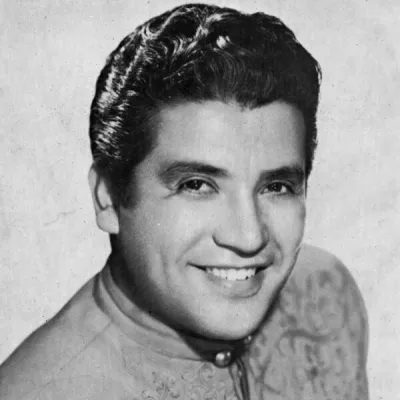
Miguel Aceves Mejía
Human Design Chart
Biography
Originally part of a travelling theatre company, Aceves began recording for the first time in 1938 with the trio Los Porteños. At the beginning of his career he interpreted mainly boleros, and Afro-Cuban rhythms. During his career he recorded more than 1600 songs on 140 discs and starred in 64 films.
Aceves died on 6 November 2006, aged 90, in Mexico City.
What does Projector 4/6 mean for Miguel Aceves Mejía?
Projector 4/6 — Design at a Glance
Miguel Aceves Mejías design showed a tendency towards a focusing aura that immediately recognized errors in other systems. He acted like a bright flashlight, illuminating the dark and pointing out where things were not functioning properly within his environment. However, this immediate perception was a double-edged sword: When Miguel Aceves Mejía directly addressed these deficiencies, he encountered resistance, comparable to a blinding light beam directed at someone else.
The mechanics of his Projector type require restraint. Instead of criticizing, his true strength lay in his own harmony and pleasant glow. This behavior naturally attracted others who then sought out his insights. His strategy was to wait for an honest, appreciative invitation before bringing forth his knowledge or leadership skills.
Since Projectors do not have a defined Sacral Center, Miguel Aceves Mejía lacked a constant intrinsic energy source. He moved through phases of high activity and needed mandatory rest periods to avoid burning out. Ignoring this necessity or the strategy of waiting for an invitation led sooner rather than later to his Non-Self theme: Bitterness. However, living according to this design rewarded him with success by effectively guiding and inspiring others without depleting himself.
Self-Projected Authority
Miguel Aceves Mejía was characterized by a special openness that made him vulnerable to being distracted by external motoric energies. His design pointed towards the risk of getting lost in this receptivity and constantly seeking energy instead of following inner truth. This dynamic stems from his Projector Self-Authority, which is unique to Projectors and brings heightened sensitivity to environmental influences.
His decision-making foundation lay in his identity, accessible through two paths. First, through spontaneous expressions: Miguel Aceves Mejía could express his true nature through self-talk or dialogues when invited to do so. Crucial was the distinction between impulsive self and reflective mind; only unreflected speech mirrored his uniqueness and made him recognizable to others.
Secondly, a physical pulling sensation guided him geographically or thematically in a specific direction. By following this inner orientation faithfully, Miguel Aceves Mejía could become a directional guide for others. This particular success potential did not arise from active striving but through alignment with the authentic self-expression that served as his compass.
The 4/6 Profile — Opportunist / Role Model
Miguel Aceves Mejías design was marked by a pronounced tension between an early, experimental drive towards community and a later, isolated search for deeper meaning. In the first three decades of life, he acted like a pure experimenter, intensively using relationships and friendships to test his position. This aligned with Line 4 in the profile, which through censorship and selective memory protected the status quo of the tribe; it allowed him to filter information purposefully to avoid negative consequences for the collective.
After Saturn's return, his stance fundamentally shifted. The internal conflict between heart seeking belonging and head striving for distance and wisdom became dominant. Line 6 grants the ability to recognize cyclicity and distinguish sense from nonsense but carries the risk of complaining or depressive states if this clarity is lacking. Miguel Aceves Mejía now faced the expectation of functioning as a wise role model. His task was to maintain an overview of the entire process and pragmatically deal with challenges without getting lost in futile complaints. The great heart of Line 4 remained cautious throughout, to avoid injuries from false allies, while Line 6 provided the necessary distance to observe and understand these dynamics from a higher perspective.
Single Definition — Defined & Open Centers
Miguel Aceves Mejías design pointed towards a tendency for consistent, independent identity and clear communication. With the defined centers of Ajna (mental consciousness), Throat (communication), and G Center (identity/direction), he had a stable aura that reliably translated conceptual thoughts into language. This triple definition created a trustworthy mental function, independent of external influences, with the G Center providing a firm sense of personal direction and self-love.
This inner stability was in contrast to his open centers: Head, Heart, Sacral, Solar Plexus, Spleen, and Root were undefined. The open Head Center made him vulnerable to mental pressure and the temptation to adopt foreign questions or inspirations as his own, leading to confusion if he did not trust his internal authority. An open Heart Center meant a lack of consistent willpower; he tended to feel driven by the need to prove his worth through promises or competitive behavior, often ending in cycles of self-doubt.
The open Sacral Center led to inconsistent energy availability. He was sensitive to the life force of his environment and risked overexertion by using borrowed energy rather than listening to his own rhythms. Additionally, the open Solar Plexus Center absorbed foreign emotions, making him emotionally vulnerable and causing him to avoid confrontation to maintain stability. The open Spleen Center amplified fears of inadequacy or health issues, while the open Root Center took on external stress that was not his own. His challenge lay in interpreting these open fields not as personal deficits but as mirrors reflecting the environment without identifying with them.
Channel 31-7: The Alpha — Channels & Gates
Miguel Aceves Mejía demonstrated a leadership style that did not rely on command but rather on logical categorization and storytelling. His design inclined towards collective guidance based on trust and pattern recognition.
This leadership approach was significantly influenced by the Alpha Animal Channel 7-31, connecting the logical role of self (Gate 7) with the voice of leading (Gate 31). This channel is about a form of leadership that only becomes effective when invited by the community. Miguel Aceves Mejía had to earn their trust and demonstrate competence before he could lead; his authority was based on understanding current trends and serving the collective, not on absolute rule.
Parallel to this, the Curiosity Channel 11-56 also played a role. It links seeking ideas (Gate 11) with the ability to inspire through stories (Gate 56). This gave him a magical presentation power: he took abstract information, filled in gaps and formed parables that emotionally resonated with people. While the logic of the Alpha Animal provided rational security, he used this story to impart wisdom and stimulate his listeners – less by dry facts than by the power of imagination.
The process culminated with the Lost Son Channel 13-33, connecting listening and storing experiences (Gate 13) with reflective withdrawal (Gate 33). Miguel Aceves Mejía collected life stories and secrets, then withdrew to grasp their deeper meaning before sharing this condensed wisdom when it was ripe. This cycle of experience, reflection, and transmission created continuity and stability for his environment.
Additionally, Gates like 26 (innovation in the stem), 45 (stem energy) and 15 (collective rhythm) enabled him to integrate innovations into established structures by respecting the natural flow of society while also pointing out new paths.
Collective Circuitry — Circuit Signature
Miguel Aceves Mejías design inclined towards a dual way of sharing: once through cool, future-oriented logic and once through emotional reflection on the past. These two energies existed side by side, separate from each other but both oriented towards connecting insights with the collective.
The Understanding Circuit connected his Throat Center to his Identity Center via the channel 'The Alpha Animal'. This created a direct line for communicating strategic, rational structures – free of emotional influence and focused on what is visually and structurally possible in the future.
Parallel to this, the Meaning Finding Circuit linked Ajna, Throat, and Identity Centers. Here flowed the channels 'Curiosity' and 'The Lost Son'. This energy was cyclical and wave-like: it reflected past experiences to draw emotional significance from them. Miguel Aceves Mejía showed himself as someone who also shared these felt insights, though not as strategic planning but as shared learning from what had already happened.
While both circuits included the Throat and Identity Centers, impulses came from different directions: The left side of his design sought a better future through reason; the right side processed the past through emotional waves. Both streams converged into the same expression channel – sharing – yet each contributed a distinct quality: once clear and strategic, once deep and experience-based.
Right Angle Cross of Rulership 4
Miguel Aceves Mejías Human Design shows a tendency towards strategic alignment and recognizing his life purpose within the framework of the 'Authority of the Governing Cross'. This configuration defines the archetypal dynamics of leadership, authority, and responsibility for the whole. It is a specific structure that does not seek external validation but establishes an inner order to guide others and stabilize systems.
The mechanics of this cross imply that Miguel Aceves Mejía was predestined to exercise authority – not through coercion or dominance in everyday terms, but by his ability to keep the big picture in mind and make decisions that strengthen the community or organization as a whole. His focus lay on bringing structure out of chaos and setting clear directions. The responsibility for the well-being of all involved was thus not a burden but the natural expression of his energetic alignment.
This design supports an attitude where leadership is understood as service to the whole. Miguel Aceves Mejía therefore demonstrated himself as someone capable of overseeing complex situations and acting strategically to ensure long-term stability and progress. The energy of governing here does not operate in isolation but integrates various aspects of his personality into a coherent whole designed to exert influence and take responsibility.
Saturn Return · Uranus Opposition · Chiron Return · 2nd Saturn Return — Life Cycles
Miguel Aceves Mejías life journey followed the structural rhythm of the four classical astrological cycles. These phases did not mark arbitrary events, but defined the timing of maturation, letting go, and deeper integration of his personality. His design shows a clear sequence of these archetypal turning points.
The first Saturn Return cycle initiated the process of identity formation. Here early life energy condensed into a sturdy structure that made self-responsibility and real boundaries tangible. It was a phase of laying foundations where Miguel Aceves Mejía learned to carry his own weight.
Subsequently, the Uranus Opposition entered. This cycle demanded rebellion and transformation. It forced him to break free from outdated bonds and patterns to make room for a more authentic expression. It was a necessary phase of liberation that broke old structures so new ones could emerge.
With the Chiron Return cycle, Miguel Aceves Mejía reached a phase of spiritual integration and fulfillment. This was not a process of healing past wounds in a clinical sense but an experiential space where his individual life purpose increasingly unfolded. Meaning and significance were directly experienced here if he had followed his inner authority previously.
The second Saturn Return cycle crowned this development. It brought renewed depth to the structure, now based on the wisdom and letting go gained. Miguel Aceves Mejías path demonstrates how these four cycles work together not to define character but to time its maturation and anchor it.
Projector · Self-Projected Authority — Synthesis
A central thread runs through the design: the ability to recognize patterns and communicate this information. This manifests in the combination of defined mental center (Ajna) and throat center, enabling clear thinking and expression power. This is reinforced by channels such as that of the Alpha animal and curiosity, emphasizing the discovery of developments and their communication with others. The openness to emotional influences (undefined solar plexus) and stress (undefined centers root & sacral) indicates that this person processes information not only intellectually but also absorbs and reflects collective mood – a gift that requires self-protection.
A central paradox lies in the tension between the need for connection and the ability to distance oneself. The design shows an acute ability to recognize patterns and communicate information (Alpha animal channel), implying that this person can attract others. At the same time, however, central centers like sacral, root, and solar plexus are open, indicating a vulnerability to external influences and the need to protect against overstimulation. This duality requires sensitive navigation between the desire for exchange and maintaining inner peace.
3 Defined Channels
Incarnation Cross - Right Angle Cross of Rulership 4
Solar Return
The Solar Return shows the moment when the sun returns to its exact birth position - your personal solar year.
Life Cycles
Discover the life cycles with a detailed triple view (birth chart, cycle chart, composite).
Human Design Profile
- Type
- Projector
- Strategy
- Wait for the respectful invitation
- Authority
- Self-Projected Authority
- Profile
- 4/6 - Opportunist / Role Model
- Definition
- Single Definition
- Incarnation Cross
- Right Angle Cross of Rulership 4
- Date of Birth
- 13.12.1915 08:30
- Place of Birth
- Chihuahua, Mexico
Frequently Asked Questions
What is Miguel Aceves Mejía's Human Design type?
What are Miguel Aceves Mejía's Profiles?
What authority does Miguel Aceves Mejía have?
What incarnation cross does Miguel Aceves Mejía have?
When was Miguel Aceves Mejía born?
Discover your own Human Design
Are you also a Projector? Find out in a personal reading how to unfold your leadership qualities and recognize the right invitations.
More Personalities
Back to overviewSissy Spacek

Alain-Fournier

Anémone

Ann-Margret

Arletty

Arno