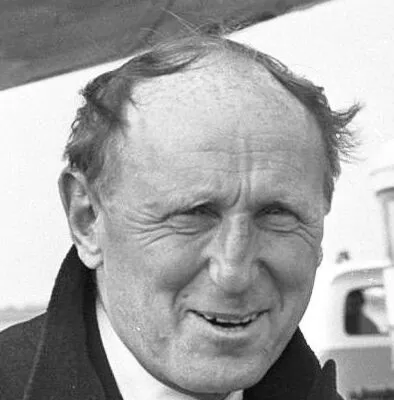
Photo: Wikimedia Commons
Miguel Torga
Human Design Chart
Biography
What does Projector 6/2 mean for Miguel Torga?
Projector 6/2 — Design at a Glance
Miguel Torga revealed himself as someone who could quickly identify weaknesses in systems and relationships. His design inclined him to bring light into the dark for others, much like a bright flashlight that focuses on hidden areas. As a projector, he did not have an intrinsic source of life energy through his undefined Sacral Center. Instead, he experienced phases of high activity and rapid workability, followed by necessary rest periods to prevent burnout. This rhythmic distribution of energy conflicted with the demands of the educational system and most job descriptions of his time, which required continuous performance.
His aura appeared dense and focused, sometimes making those around him feel uncomfortable when he addressed mistakes directly. A more elegant approach was to maintain a harmonious presence himself. Through this quality, he attracted others who then sought his insights. The appropriate strategy for him was to wait for a genuine invitation from others before taking on the role of sharing knowledge or leadership. If Miguel Torga lived according to this design, he was rewarded with success. However, if he did not adhere to this logic, there was a risk of bitterness as an expression of his feeling of non-self. His path lay in shining and waiting for the invitation rather than independently entering systems.
Self-Projected Authority
Miguel Torga revealed himself as a projector with rare authority within Self. This configuration marked him by extreme openness, making him vulnerable to being distracted by external motoric energies. His greatest danger was getting lost in this vastness and constantly chasing after energy.
His inner truth lay in his identity. Torga made decisions through self-talk or dialogues with others when invited. Crucial was listening to his own speaking and distinguishing between the spontaneous expression of his true nature and the considerations of reason. This spontaneous self-expression made his uniqueness recognizable to others.
The second path was a physical feeling that geographically or thematically pulled him in a specific direction. By recognizing this inner pull and following it faithfully, he could become a guide for others. There lay his specific potential for success. This mechanism emphasized the necessity of trusting his internal identity, whether through spoken expression or being physically drawn into a direction.
The 6/2 Profile — Role Model / Hermit
Miguel Torga revealed himself in his youth as someone who learned through trial and error. His design, Profile Line 6/2, determined that before the age of thirty he acted like a Three-line: He intensely experimented with various roles and withdrew after failures to try new paths. This phase served for gathering raw life experience through direct confrontation with failure.
Parallel to this, the dynamics of the second line strongly influenced him. It created a powerful impulse to defend his individuality. Miguel Torga had to learn that it could be dangerous to be different or speak new truths. The survival of his personal identity depended on rigorously defending against outside interference and setting boundaries precisely where his individual essence was threatened.
After the age of thirty, this attitude fundamentally changed. The sixth line became active and called for a phase of distancing. Miguel Torga metaphorically retreated into his 'cave' to reflect with great calmness on earlier experiments. This period was not passive but a process of healing and deep self-knowledge. From this isolation, he developed wisdom based on the ability to distribute power justly and delegate rather than exercise it himself. He became an example for others showing how introspection can lead to clarity.
Single Definition — Defined & Open Centers
Miguel Torgas design was characterized by a constant, trustworthy mental function. His defined Ajna Center ensured that he always created concepts and theories in the same specific way, regardless of external influences. This mind served as a processing center for data and creativity and shaped his mental field's environment. In conjunction with his also defined Throat Center, he could directly translate these thought processes into communication; his voice became an expression of what his mind conceptualized. This configuration allowed him to clearly articulate his truths, as the energy found a direct path from thinking to manifestation.
Furthermore, Miguel Torga had a defined G Center, which gave him a firm sense of self-identity and a clear sense of direction for his personal life. He knew who he was and where his life was leading him without being dependent on others. This inner security allowed him to support others on their path without restricting their freedom or forcing them to follow.
In contrast, his Head, Heart, and Sacral Centers were open. The open Head Center made him vulnerable to mental pressure and the temptation to take on questions from others as his own. He tended to get caught in thought whirlpools of doubt when he did not trust his inner authority. His open Heart Center lacked consistent willpower; he was not designed to give promises or prove his worth through performance, making him vulnerable to conditioning by societal expectations. Similarly, his open Sacral Center meant that he did not have a constant energy flow. He absorbed the vital energy of his environment and amplified it but risked overextending himself with borrowed power if he did not pause. This openness in areas of inspiration, willpower, and vitality contrasted sharply with the consistency of his thinking, voice, and identity.
Channels for reflection, structuring and clear communication.
Miguel Torga was someone who collected experiences and only spoke about them after careful consideration. His design tended towards deep reflection before sharing insights. The Lost Son Channel 13-33 connected his G Center to his Throat Center. Gate 13 listened and stored information as well as secrets, while Gate 33 withdrew to reflect on these experiences. This allowed him to recognize hidden connections beneath the surface and practice patience as a witness of his own development. He learned from the past rather than drawing hasty conclusions for the future.
Furthermore, he had the ability to structure complex thoughts into clear frameworks. The Channel of Structuring 23-43 connected his Ajna Center with his Throat Center. Gate 43 received spontaneous insights and breakthroughs that were then assimilated and expressed through Gate 23. This helped him formulate innovative perspectives in a way that others could understand and accept. His thinking often felt forward-looking; he had to learn to trust the natural development of his ideas rather than forcing them.
This mechanism was complemented by additional gates. Gate 7 projected patterns for the future and showed a need for leadership as well as testing hierarchies. Gate 56 enabled the abstraction of mental processes into visual representations and stories, important for collective narratives. Gate 12 emphasized the influence of emotional mood on communication and was connected to poetry as well as individual mutation. Finally, Gate 45 expressed willpower and tribal level in material life while Gate 62 through logic, details, and patience built a framework for pattern recognition. Together these elements shaped his way of observing, structuring, and communicating the world.
Collective Circuitry — Circuit Signature
Miguel Torgas design tended towards structured, authentic expression. His energy flowed as one continuous group through the Ajna, G, and Throat Centers. This created a direct flow from mental structuring over emotional identity to verbal articulation.
The Knowledge Circuit worked here through the Channel of Structuring (Gates 43–23). It connected the Ajna Center with the Throat Center. This allowed for clear formulation and carrying inner thoughts and plans into the world. The energy was pulsing and acoustic, driven by the will for individual confirmation.
Parallel to this, the Meaning Circuit worked through the Lost Son Channel (Gates 33–13). It connected the Throat Center with the Identity Center. Here it was about cyclical processing of past and emotions. Miguel Torga shared these felt insights to learn from past experiences. The emotional wave was descending, indicating deep reflection.
Both circuits met in the Throat Center but were energetically separate from each other as they connected different centers. The Ajna and G Centers formed a unit with the throat while the Identity Center was separately connected to the throat. This shaped his way of expressing both rational structures and emotional depth layers without mixing them. His communication was thus logically structured yet emotionally colored, each in their own frequencies.
Left Angle Cross of Masks 2
Miguel Torgas Design carried the signature of the left cross of masks. This configuration shaped an attitude where the visible served as a curtain behind which deeper, often unspoken truths were hidden. His Human-Design pointed him towards not just observing the surface but penetrating beneath it to uncover layers beyond initial impressions. The mechanics of this cross describe a process of revelation: What initially appears as mere mask or role becomes the key to a more comprehensive understanding of human nature.
In this context, Torga was someone who precisely observed the distance between what was shown and what actually was. It wasn't deception in a negative sense but rather a necessary separation of appearance from essence. His chart suggested that he learned to use or see through these masks to get closer to the pure essence of things. The energy of this cross promoted the ability to look behind the scenes of everyday life, recognizing hidden motives and structures guiding behavior.
Through this specific orientation, his view on the world sharpened. He didn't need to reveal everything immediately but could sustain and analyze the tension between what was concealed and revealed. This created an inner clarity about the complexity of identity. His design supported him in uncovering illusions without falling into cynicism. Instead, this perspective served to lay bare deeper connections in life and understand how people present themselves to protect or express their true nature.
Saturn Return · Uranus Opposition · Chiron Return · 2nd Saturn Return — Life Cycles
Miguel Torgas Design showed a tendency towards structural anchoring, particularly during phases of maturation. In 1934, at the age of 27, he published his first work under the pseudonym Miguel Torga – a typical moment for the first Saturn return. This cycle often marks the transition from experimental youth to defined identity, where years of internal groundwork condense into a solid external result. The Saturn energy demands clarity and boundaries; it supports the person in not only recognizing but also establishing their core competencies sustainably in life. For Miguel Torga, this meant that his creative expression now gained a firm structure serving as a foundation. The Saturn return acts like a filter: What doesn't fit true nature is dismantled; what is authentic gains weight and stability. At this age, awareness of responsibility towards one's potential often begins to grow. Miguel Torga used this moment to make his voice public – not as sudden inspiration but as the logical consequence of a long internal development process. The publication was thus not an isolated event but the visible expression of a mature process where the individual locates and stabilizes itself in its specific role in life.
Projector · Self-Projected Authority — Synthesis
He was a projector, defined by his clear mental center (Ajna) and Channel of the Lost Son (13/33), possessing a pronounced ability for observation and profound reflection. This combination led to an internal dynamic where he absorbed information over long periods, processed it, and eventually – often with distance – shared insights. The Profile as Role Model/Natural Talent suggests that this process was marked by experimentation in youth followed by a phase of intense self-reflection and wisdom-seeking, making him accessible to others. His essence was thus characterized by a steady cycle of experience, withdrawal, and shared insight.
Central to his design was a paradox between the projection power of his type – the need to bring light into darkness and reveal errors – and the necessity for inner authority through self-dialogue. He could recognize patterns (Gate 13) but withdrew to process them (Gate 33). This tension field between the urge to share observations and the need for distance shaped his expression, leading to wisdom gained through personal experience and reflection – a process evident in an event at age 27.
2 Defined Channels
Incarnation Cross - Left Angle Cross of Masks 2
Solar Return
The Solar Return shows the moment when the sun returns to its exact birth position - your personal solar year.
Life Cycles
Discover the life cycles with a detailed triple view (birth chart, cycle chart, composite).
Human Design Profile
- Type
- Projector
- Strategy
- Wait for the respectful invitation
- Authority
- Self-Projected Authority
- Profile
- 6/2 - Role Model / Hermit
- Definition
- Single Definition
- Incarnation Cross
- Left Angle Cross of Masks 2
- Date of Birth
- 12.08.1907 11:00
- Place of Birth
- São Martinho de Anta, PORT
Frequently Asked Questions
What is Miguel Torga's Human Design type?
What Profile did Miguel Torga have in Human Design?
Which Authority guided Miguel Torga?
What incarnation cross did Miguel Torga have?
When was Miguel Torga born?
Discover your own Human Design
Are you also a Projector? Find out in a personal reading how to unfold your leadership qualities and recognize the right invitations.
More Personalities
Back to overviewSissy Spacek
Alain-Fournier
Anémone
Angeli
Ann-Margret
Bourvil