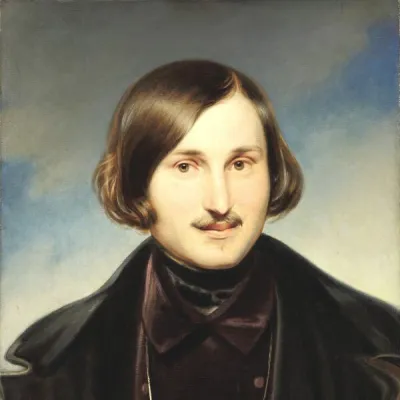
Nikolai Vasilievich Gogol
Human Design Chart
Biography
Gogol used the grotesque in his writings, for example in his works "The Nose", "Viy", "The Overcoat", and "Nevsky Prospekt". These stories, and others such as "Diary of a Madman", have also been noted for their proto-surrealist qualities. According to Viktor Shklovsky, Gogol used the technique of defamiliarization, whereby a writer presents common things in an unfamiliar or strange way so that the reader can gain new perspectives and see the world differently. His early works, such as Evenings on a Farm Near Dikanka, were influenced by his Ukrainian upbringing, Ukrainian culture and folklore. His later writing satirised political corruption in contemporary Russia (The Government Inspector, Dead Souls), although Gogol also enjoyed the patronage of Tsar Nicholas I, who liked his work. The novel Taras Bulba (1835), the play Marriage (1842), and the short stories "The Tale of How Ivan Ivanovich Quarreled with Ivan Nikiforovich", "The Portrait", and "The Carriage" are also among his best-known works.
Many writers and critics have recognized Gogol's deep influence on Russian, Ukrainian and world literature. Gogol's influence was acknowledged by Fyodor Dostoevsky, Mikhail Saltykov-Shchedrin, Ryūnosuke Akutagawa, Franz Kafka, Mikhail Bulgakov, Vladimir Nabokov, Flannery O'Connor and others.
Nikolai Vasilievich Gogol — Generator with Profile 2/4
Generator 2/4 — Design at a Glance
Nikolai Vasilievich Gogol possessed immense inner endurance and high potential for creative power. His design laid the foundation to act as a driving force, comparable to a strong workhorse with vast energy reserves. This power was not arbitrary but depended on a specific condition: reacting to external impulses.
As a Generator, Gogol had abundant sacral energy that primarily released when he responded to signals from his environment. His strategy did not involve initiating independently or forcefully pushing projects forward; instead, it involved waiting for life to pose a question or an issue to arise. When he then reacted with clear inner confirmation – a feeling of 'yes' in the gut – he could effectively use this energy and bring things into his life.
This mechanism, however, carried two central risks for his vitality. If Gogol engaged in activities that he did not actually feel internally drawn to, he wasted his valuable resource and tended towards exhaustion up to burnout. Similarly frustrating was being prevented from working on his heart projects even though his inner self still brimmed with power. Living in harmony with this reactive strategy rewarded him with a deep sense of fulfillment. Initiating too much independently without waiting for the internal impulse, however, sooner or later led to persistent frustration and a noticeable lack of energy.
Sacral Authority
Nikolai Vasilievich Gogols decision-making was characterized by Sacral Authority. As a Generator, he had an inner guidance that merged directly with his strategy, thereby simplifying it. This mechanism required an open emotional center so that his reactions did not stem from fleeting moods but were immediate physical responses to external stimuli.
His authority manifested in a palpable 'gut feeling' or sudden surge of energy. Gogol learned to pay attention to these bodily signals – often audible as grunting, humming, or simple nodding. When his sacral motor engaged with a topic, he felt vital and alive. Then seemingly inexhaustible energy was at his disposal, enabling him to tackle tasks with great enthusiasm.
This design predisposed him to move through life with joy and satisfaction. He could immerse himself in activities without them needing to be strictly purpose-driven. If his Spleen Center was activated or directly connected to the Sacral Center, it served as a supportive instance. This gave him particularly quick and spontaneous reactions. Gogol had immediate access to his physical well-being and instinctive perception, guiding him reliably once he encountered the right stimulus. His decisions thus emerged not from his head but from this deep, physical resonance space that pointed him clearly in the right direction.
The 2/4 Profile — Hermit / Opportunist
Nikolai Vasilievich Gogols design established a constant tension between the need for withdrawal and the desire for community. As a 2/4 Profile known as 'Natural Talent / Networker', he oscillated between Line 2, which demands solitude and internal processing, and Line 4, which seeks exchange with familiar people. This configuration created a dynamic pattern: During his 'Me-Time,' Gogol immersed himself in internal processes to gain clarity. Once this phase was complete, he sought contact with his network to reflect on the knowledge gathered there and develop new ideas from it.
This shift was marked by specific Line properties. The second line showed an extreme reactive mechanism upon interference, often leading to harsh measures that were later felt as justified but regrettable – a Neptunian regret over one's own severity. Simultaneously, the fourth line emphasized analysis and contrast rather than open confrontation. Gogol waited for suitable alliance partners and opportunities, with trust and individual processes being crucial. Aggressive resistance, however, hindered his investigations and reduced his credibility. Thus, he moved in a rhythm of isolated reflection and selective networking, where clear communication of his needs for company or distance was central to the balance of his design.
Split Definition — Defined & Open Centers
Nikolai Vasilievich Gogol's Design established a clear tendency: He possessed a reliable inner identity and a clear sense of direction in life, supported by the defined G Center. This firm self-love allowed him to show others new perspectives without being dependent on their approval. At the same time, he had an enormous source of vital energy in his defined Sacral Center. His life was characterized by the need to use this power through reactive actions; only when he responded to invitations and felt an inner "yes" could he find satisfaction and persistently complete tasks.
His authority lay in the defined Spleen Center, which gave him a spontaneous, intuitive bodily intelligence. He acted in the moment, trusted his survival instinct and perceived alarm signals rather than preferring rational analysis. Additionally, the defined Root Center provided constant physical pressure that propelled him forward and helped him master existential challenges.
This stable inner foundation contrasted sharply with his vulnerability in open areas. His open Head and Ajna Centers made him receptive to mental inspirations from others but tended to get stuck in doubts or foreign questions if he did not listen to his Spleen authority. He had a tendency to question whether he had found the right answer rather than trusting the moment. The open Throat Center led him to seek attention by trying to control the flow of conversation instead of waiting for an invitation to speak.
His open Heart Center lacked consistent willpower; he tended to make promises to prove his worth, which often ended in frustration. Finally, his open Solar Plexus absorbed the emotions of his surroundings. He reflected the emotional climate of others, making him vulnerable and leading him to interpret foreign moods as his own or avoid confrontations out of fear of rejection. His strength lay in not personalizing these open fields but using them as mirrors for the world around him.
Channels for self-love and meaningful life struggle.
Nikolai Vasilievich Gogol's Human Design suggests a tendency towards deep self-reflection and a stubborn struggle for individual significance. This attitude stems from the connection between inner conviction and the necessity to push through external resistance.
The Channel of Exploration 34-10 connected his Sacral Center with the G Center. Gate 34 provided the power to hold onto personal convictions, while Gate 10 initiated behavior from deepest self-acceptance. This marked him as someone who was dependent on responding to external stimuli to affirm his own identity and self-love. His focus lay in staying authentic and setting an example of individuality for others through these responses rather than imposing his beliefs.
At the same time, the Channel of Life Struggle 38-28 propelled him forward. It connected the Root Center with the Spleen Center. Gate 38 generated the pressure to maintain individual integrity and fight off distractions, while Gate 28 offered intuitive ability to recognize which struggles made sense. This configuration gave him a stubborn resolve to walk his own path, even if it meant conflicts or uncertainty. He actively sought meaning in the difficulties of his life and saw them as an opportunity for individuation.
Additional energies like Gate 21 (Control of Material Things) and Gate 39 (Provocation towards Mutation) fit into this pattern by fostering confrontation with the material world and triggering changes through analysis. Also, Gates such as 48 (Pattern Recognition) and 27 (Nurturing Care) played a role in recognizing deeper connections and bringing nurturing warmth to his interactions. His design thus revealed itself as an ongoing process of self-affirmation through reaction and struggle for personal meaning in life.
Individual Circuitry — Circuit Signature
Nikolai Vasilievich Gogol's design inclined towards inner strength and impulsive alertness. As a person with split definition, his energy consisted of two separate, parallel streams that did not flow directly into one another. The first stream connected the Sacral Center to the Identity Center. This gave him deep, individual stability and strong internal convictions, which often remained difficult to verbalize without direct connection to the Throat Center; his power was more evident in mere presence than in expression. The second independent stream linked the Spleen and Root Centers via the Life Struggle Channel. Here, a pulsing energy responded acutely to immediate necessity. This configuration created a tension field between calm, centered identity and quick, instinctive alertness. Gogol thus moved within two separate energetic worlds: one standing for long-term self-determination, and another focused on immediate survival questions. Since these systems were not connected, he had to learn to integrate these different impulses as separate experiences rather than forcing them into a single, cohesive life flow. His individuality was marked by this separation: firm and independent at the core, yet always ready to respond to external pressure situations with swift, instinctive adaptation.
Right Angle Cross of Tension 1
Nikolai Vasilievich Gogols Human-Design legte eine Tendenz zu inneren, oft ungelösten Spannungen fest. Diese Konfiguration, bekannt als das rechte Kreuz der Spannung 1, beschrieb keine äußere Handlungsfähigkeit, sondern einen tiefen inneren Zustand des Wartens und der Unruhe. Es handelte sich um eine Energie, die nicht direkt in die Welt ausströmte, sondern im Inneren kreiste, ohne einen klaren Auslass zu finden.
Diese Struktur erzeugte ein Gefühl von ständiger Erwartungshaltung, gepaart mit dem Bewusstsein, dass etwas Wichtiges noch nicht geschehen war. Für Nikolai Vasilievich Gogol bedeutete dies eine Lebensaufgabe, die weniger im aktiven Tun lag als in der Aushaltbarkeit dieser inneren Spannung. Die Mechanik dieses Kreuzes zeigte sich darin, dass traditionelle Strategien des Handelns oder Entsprechens hier nicht greiften; stattdessen ging es um das Durchstehen von Phasen der Unsicherheit und des Nicht-Wissens.
Es war keine Energie zur Lösung von Problemen im Außen, sondern eine Erfahrung der inneren Zerrissenheit zwischen dem Wunsch nach Klarheit und der Realität der Ungewissheit. Nikolai Vasilievich Gogol lebte mit dieser spezifischen Qualität: Die Spannung selbst war das Thema, nicht ihre Auflösung. Dies prägte seine Art, die Welt zu erleben – weniger als Ort des Machens, sondern als Raum des Erlebens von offenen Fragen und unausgesprochenen Drängen, die sich nie vollständig entladen konnten.
Saturn Return · Uranus Opposition — Life Cycles
Nikolai Vasilievich Gogols Human-Design legte eine Tendenz zu tiefgreifenden, strukturellen Wandlungsprozessen fest. Sein erster Saturn-Return markierte einen Wendepunkt, in dem sich jahrelange Vorarbeit verdichtete und konkrete Ergebnisse hervorbrachte. Dies zeigte sich 1835, im Alter von 26 Jahren, mit der Veröffentlichung des Romans „Taras Bulba“. Für sein Design war dies ein typischer Moment: Der Saturn-Return fungierte als Katalysator für den Übergang von innerer Arbeit zu sichtbarer, tragfähiger Leistung.
Später prägte die Uranus-Opposition seine Lebensbahn durch plötzliche, unerwartete Veränderungen. Dieser Zyklus bringt oft abrupte Brüche oder beschleunigte Entwicklungen mit sich, die alte Strukturen auflösen. Bei Nikolai Vasilievich Gogol trat diese Dynamik 1852 zutage, als er im Alter von 42 Jahren starb – ein Ereignis, das den Abschluss seines physischen Weges markierte und die disruptive Kraft dieser planetaren Konstellation unterstrich. Seine Lebensspanne war somit durch zwei entscheidende astrologische Phasen geprägt: erst die Konsolidierung und Veröffentlichung seiner Arbeit im jungen Erwachsenenalter, später der rasche, finale Wandel in der Mitte des Lebens. Diese Abfolge verdeutlichte, wie seine innere Architektur mit äußeren Zeitzyklen interagierte – von der schrittweisen Etablierung bis hin zum überraschenden Ende.
Generator · Sacral Authority — Synthesis
Nikolai Vasilievich Gogol lebte tief verwurzelt in seiner sakralen Energie (Generator-Typ) und folgte dabei einer inneren, körperlich spürbaren Autorität. Diese Reaktion auf äußere Reize befeuerte eine unermüdliche Arbeitsweise, die jedoch stets von der Notwendigkeit geprägt war, sich zurückzuziehen und interne Prozesse zu vertiefen (Profile 2/4). Der Kanal der Erforschung verband seine Selbstliebe mit dem Drang, authentisches Verhalten auszudrücken – ein Prozess, der durch das G-Zentrum als Richtungssinn verstärkt wurde. Dies führte zu einer ständigen Suche nach innerer Klarheit und einem Bedürfnis, diese in kreativem Ausdruck zu manifestieren (Wissens-Schaltkreis).
Ein zentrales Paradox prägte sein Leben: die Spannung zwischen dem tiefen Wunsch nach Selbstverwirklichung und der Notwendigkeit, sich mit den Erwartungen seiner Umgebung auseinanderzusetzen. Die Energie des Generators wurde durch die Linie 2/4 sowohl angekurbelt als auch gebremst – das Bedürfnis nach Isolation stand im Kontrast zum Wunsch nach Gemeinschaft. Dies führte zu einem inneren Ringen, das sich in Phasen intensiver Kreativität und anschließenden Rückzugsmomenten zeigte, wobei Erfolg (1835) und letztlich der Tod (1852) die äußersten Pole dieser Spannung markierten.
2 Defined Channels
Incarnation Cross - Right Angle Cross of Tension 1
Solar Return
The Solar Return shows the moment when the sun returns to its exact birth position - your personal solar year.
Life Cycles
Discover the life cycles with a detailed triple view (birth chart, cycle chart, composite).
Human Design Profile
- Type
- Generator
- Strategy
- To respond - wait for something to respond to
- Authority
- Sacral Authority
- Profile
- 2/4 - Hermit / Opportunist
- Definition
- Split Definition
- Incarnation Cross
- Right Angle Cross of Tension 1
- Date of Birth
- 31.03.1809 21:00
- Place of Birth
- Sorochyntsi, Russia
Frequently Asked Questions
What was Nikolai Vasilievich Gogol's Human Design type?
What Profile did Nikolai Vasilievich Gogol have in Human Design?
What Authority did Nikolai Vasilievich Gogol have?
Which incarnation cross was active for Nikolai Vasilievich Gogol?
When was Nikolai Vasilievich Gogol born?
Discover your own Human Design
Are you also a Generator? Find out in a personal reading how to use your sacral energy correctly and discover deep satisfaction.
More Personalities
Back to overviewAaliyah

Alain-Fournier

Alexia

Angèle

Angeli

Anne-Marie