
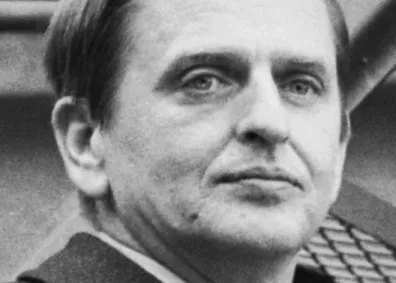
Olof Palme
Human Design Chart
Biography
His dad died when he was six, when his mom sent him to stay with an uncle in Russia and later to live with his granddad. He studied at Sigtunaskolan Humanistiska Läroverket, one of Sweden's few residential high schools, and passed the university entrance examination with high marks at the age of 17, supposedly speaking seven languages.
After studying law, he became secretary to Prime Minister Tage Erlander. He first became a Minister in 1963, and P.M. in 1983.
Palme married in 1949; divorced; married a second time in 1956; three sons, 1958, 1961 and 1969.
It was no secret that Palme was on the Chilean secret police death list for year. The Social Democratic leader was a prominent foe of Chile's right-wing leader Gen. Augusto Pinochet.
On 28 February 1986, 11:21 PM MET, he was shot in the back while walking with his wife who was grazed by the fatal bullet, Stockholm. Palme was pronounced dead 45 minutes later, 1 March 1986, 00:06 AM. The lone assailant, Christer Pettersson, a career criminal, was convicted of the murder in July 1989 and released three months later on appeal, claiming insufficient evidence.
On 10 June 2020, Swedish prosecutors stated publicly that they knew who had killed Palme and named Stig Engström, also known as "Skandia Man", as the assassin. Engström was one of about twenty people who had claimed to witness the assassination and was later identified as a potential suspect by Swedish writers Lars Larsson and Thomas Pettersson. Given that Engström had committed suicide in 2000, the authorities also announced that the investigation into Palme's death was to be closed.
The Human Design of Olof Palme: Generator 2/4
Generator 2/4 — Design at a Glance
Olof Palme revealed himself as someone with immense endurance and a deep internal source of strength. His design indicated a tendency towards great work capacity, comparable to a strong working horse that generates energy as long as it burns for its tasks. As a Generator, he possessed much sacral energy, but this was not released through self-initiated actions; rather, it was triggered by reacting to impulses from the environment. His successful strategy involved waiting for life signals and then responding with action once his inner voice gave a clear "yes". This fundamentally distinguished him from types that primarily initiate; for him, the principle of "reacting, not starting" was crucial for energy flow. When he followed this strategy and acted from his gut, it led to a feeling of deep fulfillment and satisfaction. Conversely, frustration or energy deficiency threatened when he worked against his design, such as by doing things that lacked inner resonance or being prevented from pursuing his heart's project even though he still had plenty of power left. This mechanism shaped his life approach: His strength lay in endurance for resonant tasks, while ignoring this internal signal could lead to exhaustion.
Emotional Authority
Olof Palme exhibited an inner decision-making structure heavily influenced by emotional waves. His inner authority resided in the defined Emotional Center, meaning he was subject to constant fluctuations of feelings. The world appeared colored by his current mood: Intense moments of enthusiasm alternated with phases of negative evaluation. For his design, it was crucial that these immediate impulses did not represent ultimate truth but were merely initial impressions. Quick, spontaneous reactions to such emotional outbursts could therefore have negative consequences.
The mechanics of his emotional authority demanded patience and time. Since the Emotional Center carried his authority, this always took precedence over other defined centers in his chart. To gain clarity, he had to let decisions mature, often over several nights. Only when intense feelings subsided and an emotional distance emerged did calmness set in. This process was particularly crucial for long-term life decisions. Olof Palme learned to take time to ensure that his choice was not based on a passing mood but on deeper insight. Through this conscious waiting and multiple reviews of his feelings, he managed to transform initial emotional turbulence into a stable, clear perspective.
The 2/4 Profile — Hermit / Opportunist
Olof Palme revealed himself as someone who oscillated between the deep need for withdrawal and the urge towards community. His Profile 2/4 created tension: On one hand, he sought the solitude of Line 2 to gain inner clarity; on the other hand, Line 4 drew him into the circle of his trusted companions. This dynamic required clear communication about his needs – when he wanted company and when he needed to be left alone. During his withdrawal phases, he reflected upon the knowledge of his network to develop new ideas.
This structure was shaped by specific Gates. Gate 19 in Line 2 emphasized service and selectivity in the use of personal resources. It involved an exchange of giving and taking as well as a need for recognition within the tribe. Simultaneously, Gate 44 in Line 4 worked with fixed honesty. This stance was direct, honest, and oriented towards the collective, not individual whims. In matters of survival, this configuration displayed impartial, dismissive distance to hypocrisy. The combination of reflective service from Line 2 and direct, tribe-oriented honesty from Line 4 shaped his way of utilizing resources and communicating truths within his community.
Split Definition — Defined & Open Centers
Olof Palme revealed himself as someone with a clear, consistent voice and a deep sense of his own direction. His defined Throat Center gave him the ability to translate messages from various inner sources into concrete communication and action; he did not just speak thoughts but transmuted internal information into effective expressions. This expressive strength was closely linked to his defined G Center, which provided him with a firm self-identity and a magnetic sense of the right life direction. He knew who he was and could reflect this clarity to others without being dependent on their approval.
This inner structure was driven by a defined Sacral Center, the motor of a Generator. Palme had an enormous vital energy source that only worked sustainably when he responded to questions rather than impulsively initiating actions. His strength showed in persistence and the ability to endure stagnation phases as long as he was guided by an affirming inner response. Additionally, his defined Solar Plexus Center shaped his emotional depth; his internal authority lay in waiting for the emotional wave to clear before making decisions. He tended to make choices only after emotions had clarified, which gave him a special sensitivity and understanding of social dynamics. The also defined Root Center provided constant pressure to move forward and overcome existential challenges.
At the same time, his design revealed specific vulnerabilities through open centers. His open Head Center made him receptive to mental inspirations from the environment, but he must not misinterpret them as his own truth to avoid confusion. Also, his Ajna Center was open, giving him a flexible mind but also making him prone to adopting other people's concepts or feeling unsure when lacking an immediate mental answer. Particularly defining was his open Heart Center: It lacked the consistent energy for willpower in terms of ego competitions. He tended to want to prove his worth through performance or make promises he could not keep, which plunged him into spirals of self-doubt. Furthermore, his Spleen Center was open, making him vulnerable to fears and absorbing discomfort from his surroundings; spontaneous decisions were risky for him as they often stemmed from conditioned fear rather than healthy intuition.
Channels for emotional waves, focus and quiet reflection.
Olof Palme revealed himself through a deep ability for focused analysis and patient reflection. His design featured the Channel of Concentration 52-9, connecting Root with Sacral Center. This mechanism promoted a calm pressure to hold still and logically assess details before acting. Palme used this energy to recognize and correct patterns precisely, allowing him to penetrate complex issues step by step.
Parallel to this, the Channel of Lost Son 13-33, linking G with Throat Center, came into play. Here, Palme gathered information and secrets as a listener, then withdrew to reflect on experiences before passing them along. This created an attitude of conscious observer who extracted lessons from the past to ensure continuity and stability.
Additionally, the Channel of Emotion Release 39-55 influenced his emotional dynamics. By connecting Root with Solar Plexus Center, it generated a pulsing wave between joy and melancholy. This provocation helped him sense others' minds and establish authentic connections by using his own mood as a tool to find resonance or withdraw when the mood did not match.
Individual Gates like 19 (Resources/Territory) and 44 (Awareness/Transformation) underscored his need for secure foundations and strategic interaction. Gate 24 promoted mental renewal in the rhythm of the pulse, while Gate 30 brought awareness of feelings and acceptance of limitations. The combination of these energies resulted in a person who acted through concentrated logic, patient memory, and emotional authenticity, always careful to verify the correctness of his reactions before acting or speaking.
Collective Circuitry — Circuit Signature
Olof Palme revealed himself as someone with separate, parallel operating energetic streams. His design contained two unconnected groups: a powerful base consisting of Sacral, Root, and Solar Plexus Centers along with a separate identity structure from G and Throat Centers. This separation meant that his inner motivation and emotional depth did not directly flow into his public expression but existed as independent poles.
The Knowledge Circuit connected his Solar Plexus Center to the Root Center. This generated a pulsing energy aimed at releasing emotions and embarking on new paths. It was about expressing a unique identity through emotional wave movements that heralded change.
In the Understanding Circuit, the channel between Sacral and Root Centers linked logical strategy with focused concentration. Here, an 'emotionless ratio' worked to improve things through structure and intellect, leading towards a better future. This energy served the sharing of rational insights.
The Meaning-Finding Circuit connected his Throat Center to the Identity Center. This area dealt with the past: emotions and experiences were reflected upon to find their meaning. The wisdom gained should be shared with the collective to learn together from earlier events. This cyclical, descending emotional wave shaped his way of communicating past insights.
Right Angle Cross of the Four Ways 4
Olof Palme demonstrated a fundamental disposition characterized by the necessity to navigate complex situations through clear structuring and goal-oriented decisions. His design indicated that he felt particularly strong in moments of great uncertainty or chaotic circumstances, creating order and outlining a concrete path.
This tendency stemmed from the configuration known as 'The Right Cross of Four Paths'. In Human Design mechanics, this pattern describes a specific type of leadership: someone who not only develops ideas but actively translates them into reality. It is an energy designed to overcome obstacles and bring projects to successful completion. For Olof Palme, this meant that his strength lay in choosing the one right path from many possible options and consistently following it.
He acted as a person taking responsibility for the outcome while pragmatically handling situations. The mechanics of this design require assertiveness and clarity; they support individuals who can remain under pressure yet act focused. Olof Palme lived this dynamic by concentrating on what was essential and filtering out distracting factors. His way of acting was direct and action-oriented, which helped him maintain an overview even in difficult phases and bring others along with him. This structure fostered a determined attitude that enabled him to not only think about his visions but actually implement them.
Saturn Return · Uranus Opposition · Chiron Return · 2nd Saturn Return — Life Cycles
Olof Palme experienced his life mission through phases of structural condensation followed by later expansion. His design indicated a tendency to initially take responsibility within narrower structures before expanding on broader levels. This was reflected in 1955 when, at the age of 28, he was elected chairman of the Social Democratic Youth Association – a typical moment for the first Saturn Return, where years of groundwork often condenses into a solid result and initial stable positions are taken.
The dynamics shifted with the Uranus Opposition in 1967. At 40 years old, Palme became Minister of Education; this cycle marks often a turning point where old structures become brittle and new expansive roles are forced or enabled. The energy moved away from pure consolidation towards changing established systems.
The Chiron Return in 1976, when his first term as Prime Minister ended, fell into the fulfillment phase (49–51 years). Here, one's incarnation cross – if lived according to strategy and authority – becomes increasingly experiential. The end of the first era was not a failure but a necessary conclusion of a bloom cycle to make way for the next stage.
This led to his second Saturn Return in 1983. At 56 years old, Palme became Prime Minister of Sweden again. This cycle confirms and stabilizes previously found paths. Returning to the highest level showed as a logical consequence of a life line marked by structural anchoring (Saturn) and transformative expansion (Uranus), before reaching its deeper meaning in the Chiron cycle.
Generator · Emotional Authority — Synthesis
He was a Generator whose life was characterized by deep sacral energy – an unstoppable drive to work on things that truly fulfilled him. This power manifested in his engagement for projects he dedicated full attention to (Channel of Concentration 52/9) as long as they also brought him joy. The profile as a natural talent and networker reinforced this aspect, creating a constant oscillation between the need for withdrawal for inner clarification and the desire to exchange with others. His emotional authority required time to let decisions mature, forcing him to view the outer world through a filtered perception.
A central paradox lay in the tension between his deep internal motivation and the need for connection. While he as a Generator energized what was important from his Sacral Center, his profile challenged him to repeatedly withdraw (Line 2) to regenerate this energy – an ongoing shift between engagement and distance. The cycles confirmed this: career successes alternated with crisis phases, demonstrating his ability to emerge strengthened from setbacks and forge new paths (Knowledge Circuit).
3 Defined Channels
Incarnation Cross - Right Angle Cross of the Four Ways 4
Solar Return
The Solar Return shows the moment when the sun returns to its exact birth position - your personal solar year.
Life Cycles
Discover the life cycles with a detailed triple view (birth chart, cycle chart, composite).
Human Design Profile
- Type
- Generator
- Strategy
- To respond - wait for something to respond to
- Authority
- Emotional Authority
- Profile
- 2/4 - Hermit / Opportunist
- Definition
- Split Definition
- Incarnation Cross
- Right Angle Cross of the Four Ways 4
- Date of Birth
- 30.01.1927 05:15
- Place of Birth
- Stockholm, SWED
Frequently Asked Questions
What was Olof Palme's Human Design type?
Which Profile did Olof Palme have?
What Authority guided Olof Palme?
What incarnation cross did Olof Palme have?
When was Olof Palme born?
Discover your own Human Design
Are you also a Generator? Find out in a personal reading how to use your sacral energy correctly and discover deep satisfaction.
More Personalities
Back to overviewAaliyah

Alexia

Angèle

Anne-Marie

Arcángel

Arno
