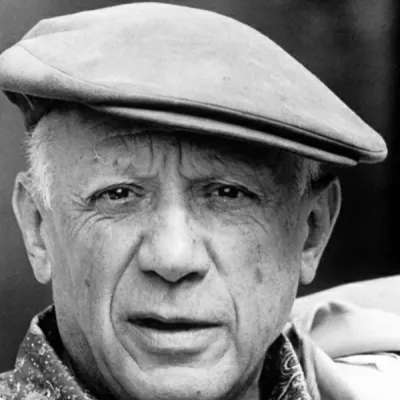
Pablo Picasso
Human Design Chart
Biography
Human Design Analysis: Pablo Picasso as Projector 1/3
Projector 1/3 — Design at a Glance
Pablo Picasso appeared as someone with a dense, focused aura - comparable to a bright flashlight. His design allowed him to immediately recognize system errors in others and bring light into dark corners. However, this direct perception risked triggering defense mechanisms in others, similar to how glaring light directly into someone's face can cause discomfort.
Instead, he was most effective through his own harmonious glow. For example, by maintaining a functional relationship himself, he naturally attracted others who would then seek out his insights. This magnetic pull replaced confrontational approaches with an elegant and inviting presence.
Central to his orientation was waiting for a validating invitation that was sincerely meant. Without this confirmation, his projection often led to conflicts or his non-self theme of bitterness. With the right invitation, however, he was rewarded successfully. As a projector, Pablo Picasso did not have a defined Sacral Center and thus lacked a constant internal energy source. He experienced phases of high productivity followed by necessary rest periods for regeneration to prevent burnout. His design required these rhythm changes, which were often overlooked in conventional work routines.
No Inner Authority
Pablo Picasso did not possess inner or physical authority, a rare characteristic of his design. His decision-making ability arose not from internal command but through external interaction and resonance with his environment. As a mental projector, he lacked center activation below the Throat Center. He arrived at decisions by exchanging ideas with many different people. Through energetic interactions in his open centers, latent potentials were activated and provided him specific information. This allowed him to view issues from numerous perspectives and express them in various ways. His high resonance capability was a great potential for identifying the right environment and people for this exchange.
Evaluating these insights was a complex process that required time and solitude. Pablo Picasso needed to be alone to recognize the red thread, distinguish what made sense, and belonged to him. Thus, he developed his specific intelligence: filtering out the essential from a mass of information, organizing it meaningfully, and structuring it. This was his capital for success as a projector. A key element in his life was being in an environment where he felt comfortable. There, he was with the right people whom he could trustingly exchange decision-making processes with over time. This exchange deepened his sense of what was right for him.
The 1/3 Profile — Investigator / Martyr
Pablo Picasso was marked by Profile 1/3, defining his life task as a cyclical process of meticulous theoretical preparation and practical trial-and-error. Line 1 brought the need for detailed work, risk assessment, and intuition before action; it required careful examination of opportunities and risks before taking a step. At the same time, Line 3 drove implementation through experience, making mistakes an integral part of the learning process.
This configuration created a tension field: The fear of Line 1 about insufficient knowledge or planning gaps contrasted with the urge of Line 3 to act simply and learn from errors. Pablo Picasso had to overcome this internal resistance to avoid getting stuck in planning and instead take the step into real implementation. Only through this synthesis did authenticity arise: A decision or recommendation was only trustworthy if it stood up to both theoretical scrutiny and practical validation.
His judgment thus rested on self-earned insights. When Pablo Picasso believed something was right, he had previously examined it intellectually as well as practically. This mechanism ensured that his influence on others was based on tested quality, not just theory or arbitrary impulse. His life revolved around obtaining these deep truths confirmed by experience.
Single Definition — Defined & Open Centers
Pablo Picasso revealed himself as someone whose thinking was marked by a constant inner pressure: asking questions, forming concepts and communicating them continuously. This dynamic resulted from his defined Head and Ajna Centers, which generated permanent mental activity. This inspiring impulse flowed directly into his defined Throat Center, thereby reliably translating his thoughts into speech and expression. He was a constant thinker and communicator whose mind was always at work.
In stark contrast to this, he lacked firmly anchored inner anchor points for identity, will or energy. His open G Center meant that he did not carry a fixed personality but blended with his environment and was shaped by it. He tended to seek direction that he himself did not possess and was dependent on being in the right places to find clarity. His open Heart Center made him vulnerable to the pressure of having to prove his worth, even though he did not exert consistent willpower for this.
His vital energy was also situational. His open Sacral Center led to him absorbing and amplifying the life force of others, often resulting in overexertion as he did not know when it was enough. He tended to push himself to meet expectations rather than listening to his own limits. Additionally, his open Solar Plexus absorbed the emotions of his environment, making him emotionally vulnerable and causing him to avoid conflicts so as not to be rejected. His open Spleen Center caused him to take on the fears and health conditions of others, while his open Root Center amplified external stress that he often tried to manage through hectic activity. Thus, his inner stability depended significantly on external conditions, while his mind was always in motion.
Channel 43-23: Structuring — Channels & Gates
Pablo Picasso showed a tendency to not only structure knowledge but also translate it into abstract meaning contexts. His design established that innovative insights often appeared as mutating perspectives that became understandable only after patient processing. This dynamic resulted from Channel of Structuring 43-23, which connected the Ajna Center with the Throat Center. Here he received spontaneous breakthroughs through Gate of Insight (43) and processed them via Gate of Assimilation (23). This enabled an original expression that promoted efficiency but required strict timing; without inner authority, his unique knowledge often remained misunderstood.
This process was supported by Channel of Abstraction 64-47 between the Head Center and Ajna Center. Through Gate of Confusion (64) and Gate of Understanding (47), he filtered every experience through mental images to recognize hidden patterns behind the facts. This channel drove him to weave stories from the chaos of experience, where clarity emerged only retrospectively, through patient waiting for the "aha moment."
Additionally, individual gates acted as background energies: Gate 28 demanded decisions in the here and now, while Gate 27 brought genetic care for the clan. Gate 31 emphasized the transmission of forces, and Gate 41 propelled evolutionary changes forward through emotional crises. In the collective, Gate 16 promoted experimentation towards mastery and Gate 45 expressed willpower on a tribal level. Gate 4 helped formulate logical protective mechanisms, while Gate 24 generated mental mutations in rhythm with the pulse. Finally, Gate 8 contributed to individual contributions for group goals, thereby drawing attention to his uniqueness and promoting it.
Individual Circuitry — Circuit Signature
Pablo Picasso showed a tension between his innate, mutating path and emotional meaning-making from the past. His design connected these forces through the Ajna and Throat Centers. In the Knowledge Circuit, only Channel 43-23 (Structuring) was active for him. This channel directly linked the Ajna to the Throat Center, enabling a capacity for structured formulation and clear expression of thought. Although the general description of this circuit mentions mutations or creative flashes of insight, these specific channels were not active in Pablo Picasso; his focus here was on order and articulation. Parallel to this, Channel 64-47 (Abstraction) was active in the Meaning Circuit. This channel connected the Head Center with the Ajna Center. This connection fostered the ability to reflect on past experiences and recognize abstract connections from the past. Since Pablo Picasso had a Simple Definition, all his defined Centers – Head, Ajna, and Throat – were linked into one group. This created an unbroken energetic flow from inspiration through thought to expression. Energy did not flow separately but as a continuous whole: impulses from the Head Center were processed in the Ajna Center and articulated in the Throat Center. This configuration underscored the connection between intuitive insight, logical structuring, and verbal or creative expressiveness without emotional waves from the Solar Plexus directly influencing the expression, since this Center remained undefined.
Right Angle Cross of the Unexpected 3
Pablo Picasso was marked by the right cross of the Unexpected 3, a configuration that oriented his inner self towards the unpredictable. His design suggested that he did not act according to controlled plans but trusted that paths would open up in the moment of encountering the unknown. This structure describes a way of living where surprises and sudden turns were not seen as disturbances but understood as necessary impulses that revealed new directions. For Pablo Picasso, this meant venturing into situations with an open outcome and learning to use the moment rather than predict it. The mechanics of this cross point towards true clarity often emerging only through the unexpected when old patterns break and make space for something new. Picasso lived this dynamic by letting himself flow with life's current instead of fighting against it. His chart shows a person whose strength lay in dealing with the unexpected and understanding it as a source of development. It was not about controlling life but responding when it took unexpected turns. This attitude shaped his way of moving through the world: open, adaptable, and ready to take the next step only when circumstances demanded or allowed.
Saturn Return · Uranus Opposition · Chiron Return · 2nd Saturn Return — Life Cycles
Pablo Picasso's life path structured itself around recurring astrological cycles marking creative transformations and turning points. In 1909 at age 28, he left Bateau-Lavoir and moved to Boulevard de Clichy 130. This first Saturn return condensed years of groundwork into a new viable chapter.
Ten years later in 1921 (age 40), the Uranus opposition arrived. It sparked a phase of radical renewal, during which Picasso created works like 'Three Musicians' and 'Composition Three Women at Fountain.' This configuration promoted breaking with established forms for novel expressions.
The Chiron return around 1930 (age 49) ushered in a period of fulfillment. Here his incarnation purpose unfolded increasingly; meaning and purpose became experiential, not as healing old wounds but as the bloom of his own design. This was evident in surrealist-inspired works like 'Crucifixion.'
The second Saturn return in 1937 (age 56) brought another structural consolidation. Picasso was appointed director of the Prado Museum in absentia. This cycle confirmed previously established foundations and institutionalized his position, typical for the consolidating power of this second Saturn passage. Each of these cycles acted as a catalytic moment propelling his artistic development and creating new structures.
Projector · No Inner Authority — Synthesis
He was a projector whose life was marked by an ongoing drive towards understanding and the ability to recognize others' potential (defined Head Center). This focus on the outside world intensified through the profile of researcher and experimenter – he ceaselessly sought new insights, rigorously tested them, and expressed them through the channel of structuring. This combination led to a profound impact on his environment as his inspired insights (Gate 43) and resulting formulations (Gate 23) opened up new perspectives and sparked changes. The repeated documented events – moves, creative phases, appointments – testify to a life characterized by constant transformation and the search for new forms of expression.
Simultaneously, a central paradox revealed itself: His lack of inner authority (no center activation below Throat Center) required exchange with others to gain clarity. Yet his ability precisely to uncover flaws in the system (projector function) could provoke resistance in direct interaction. So he lived in the tension between the need for resonance and potential rejection of his unfiltered perception – a constant navigation between wanting to shed light on darkness and the risk of inadvertently blinding.
2 Defined Channels
Incarnation Cross - Right Angle Cross of the Unexpected 3
Solar Return
The Solar Return shows the moment when the sun returns to its exact birth position - your personal solar year.
Life Cycles
Discover the life cycles with a detailed triple view (birth chart, cycle chart, composite).
Human Design Profile
- Type
- Projector
- Strategy
- Wait for the respectful invitation
- Authority
- No inner authority - learn more
- Profile
- 1/3 - Investigator / Martyr
- Definition
- Single Definition
- Incarnation Cross
- Right Angle Cross of the Unexpected 3
- Date of Birth
- 25.10.1881 23:16
- Place of Birth
- Málaga, Spain
Frequently Asked Questions
What was Pablo Picasso's Human Design type?
What profile did Pablo Picasso have?
What authority did Pablo Picasso have?
What incarnation cross did Pablo Picasso have?
When was Pablo Picasso born?
Discover your own Human Design
Are you also a Projector? Find out in a personal reading how to unfold your leadership qualities and recognize the right invitations.
More Personalities
Back to overviewSissy Spacek

Alain-Fournier

Anémone

Angeli

Ann-Margret

Bourvil