Paquirri
Human Design Chart
Biography
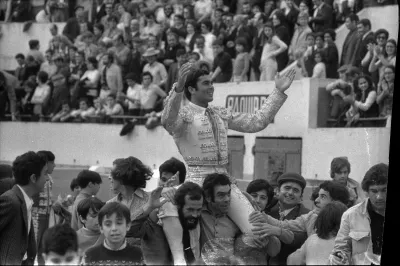
He died gored by the bull named Nibs in Cordoba on 26 September 1984.
Human Design Analysis: Paquirri as Projector 4/6
Projector 4/6 — Design at a Glance
Paquirri appeared with a dense, focusing aura that immediately revealed system errors. This quality was like a bright flashlight shining directly into dark corners and exposing where things were not functioning properly in others. As a Projector, he did not have a constant source of life energy due to an undefined Sacral Center. Instead, he experienced phases of high productivity followed by mandatory rest periods to avoid burning out.
Direct confrontation with the discovered errors would have triggered resistance from his environment, similar to shining a bright light directly into someone's face. His most effective strategy was to attract others through a harmonious example and wait for honest invitations. When he accepted these invitations and followed his path, he was rewarded with success. However, deviating from this design led to bitterness as an aftermath state. Thus, his influence relied less on constant activity than on the precise, attractive effect of his presence in moments when others were ready to accept leadership.
No Inner Authority
Paquirri lacked inner physical authority, a rare trait that fundamentally shaped his decision-making process. Instead of relying on internal certainty, his path was formed through external exchange and energetic resonance in his open centers. This process required dialogue with other people, activating dormant potentials and making information from various perspectives accessible. His high resonance ability helped him identify the right environment and suitable conversation partners.
Evaluating these diverse impressions was complex and required time as well as withdrawal. In isolation, Paquirri could recognize patterns, filter out essentials, and structure them meaningfully – his specific capital for success as a Projector or Reflector. For him, it was crucial to stay in a trustworthy environment to develop an instinct for the right approach. When he became a Reflector, he oriented himself according to the 28-day moon cycle; this period served as a framework to observe conditioning patterns and gain orientation. Urging was counterproductive here. Instead, he used the time to figure out what truly belonged to him. This strategy of exchange followed by calm analysis defined how he navigated life and unfolded his intelligence.
The 4/6 Profile — Opportunist / Role Model
Paquirri's life was marked by an internal tension between the need for belonging and the desire for intellectual distance. His Human Design profile 4/6 established this dynamic: In the first three decades of life, line 4, the networker, dominated. This phase was characterized by experimental behavior in relationships driven by a Mercury-supported intelligence focused on details, precision, and externalizing doubts. Paquirri sought security through precise analysis and exchange with others to find answers while always being cautious about opening his heart to the wrong people.
After turning 30, line 6, the role model, awakened. Here, the focus shifted from social experimentation towards finding meaning and wisdom. Paquirri now confronted the contradiction between his heartfelt desire for community (line 4) and his need for distance and reflection on the universal flow (line 6). This line taught him to accept the unforeseen rather than trying to control it. The challenge was to reconcile these two poles: the cautious, detail-oriented nature of youth with the yielding, ego-strengthening stance of maturity. Paquirri carried both the burden and potential to become a wisdom-imbued figure for others through cooperation and integration of unexpected events while simultaneously finding his own contentment.
Single Definition — Defined & Open Centers
Paquirri revealed himself through a constant, unchanging mental architecture: consistent inspiration, specific thinking patterns, and reliable communication defined his essence. His defined Head, Ajna, and Throat Centers created this stable intellectual structure. The perpetual pressure to ask questions and find answers was for him a resource, not a burden that he had to discharge. He articulated what his mind conceptualized, making his communication clear and trustworthy.
In contrast, his G, Heart, Sacral, Solar Plexus, Spleen, and Root Centers were open. This meant situational availability of identity, willpower, energy, emotions, intuition, and stress resistance in these areas. Paquirri was shaped by environmental conditioning in these domains. His open G Center made him susceptible to "borrowed" identities; he tended to question who he really was or which direction was correct rather than generating this himself. The open Heart Center led to the temptation to prove his worth through promises or competitive behavior, although he lacked consistent willpower for it.
His open Sacral Center caused him to run on "borrowed" energy, leading to overexertion and exhaustion since he was not designed for constant vital performance. The open Solar Plexus Center absorbed foreign emotions; Paquirri risked personalizing these as his own and making emotional decisions that later regretted. His open Spleen and Root Centers made him sensitive to environmental stress and survival fears. He tended to make spontaneous decisions out of fear or under external pressure rather than trusting his inner authority. The mechanics required him to set boundaries against these conditioning influences and trust in his mental design as a stable anchor point, while freeing himself from the necessity of generating identity or energy himself.
Channel 63-4: Logic — Channels & Gates
Paquirri revealed himself through a mind that filtered patterns and sought verifiable answers. The Logic Channel 63-4 connected the Head Center with the Ajna Center. This doubting mind required healthy skepticism; an answer was only considered logical if it proved itself within a consistent, practical pattern. Unstable patterns triggered mental pressure demanding resolution.
At the same time, Paquirri possessed the ability to clearly express spontaneous insights. The Channel of Structuring 43-23 connected Ajna with Throat Center. Gate 43 received innovative perspectives as sudden breakthroughs; Gate 23 assimilated and articulated them. This enabled increasing efficiency by clearly communicating new ways of thinking. The challenge lay in waiting for the right timing so that these unique insights would be accepted rather than rejected by the environment.
Additionally, other gates were at work: Gate 64 sought clarity through interpreting past experiences; Gate 5 followed natural life rhythms and built energy through habits. Gate 35 demanded change through interaction, while Gate 11 used visual memories to assess the situation. Gate 45 expressed tribal energy and hierarchy; Gate 33 required withdrawal for reflection. Gate 12 emphasized restraint and the influence of emotional moods on expression. This configuration shaped a mind that oscillated between skeptical analysis and innovative communication, always mindful of understanding patterns and communicating them efficiently.
Individual Circuitry — Circuit Signature
Paquirris Design was characterized by two parallel, separate energetic streams that both utilized the Ajna Center. As a simple definition, these forces existed side by side without directly flowing into one another. The Knowledge Circuit connected his Ajna and Throat Centers through the Channel of Manifestation, creating a pulsating, acoustic expression style based on individual identity and emotional transformation. Here it was about walking one's own unique path and expressing new knowledge through emotional waves.
At the same time, the Understanding Circuit, which linked the Head with the Ajna Center, also played a role. This stream was based on logic, strategy, and focus – an "emotionless ratio" free from conditioning. Its goal was to share rational insights and guide society towards a better future.
The tension between these two poles shaped Paquirris essence: On one hand, the emotional authenticity and creativity of the Knowledge Circuit, and on the other, the cool, visual logic of the Understanding Circuit. Both streams converged in the Ajna Center as the interface for mental processing and ultimately sought their expression in the Throat Center. While one stream was grounded in "now" and individual mutation, the other oriented itself towards future structure and strategic thinking. This configuration allowed Paquirri to formulate both profound emotional changes and clear, logical strategies while always prioritizing the balance between impulsive creativity and well-thought-out planning.
Right Angle Cross of Consciousness 1
Paquirri's existence followed the structure of the Consciousness Cross. This design set the framework for his perception and action, emphasizing the active side of his life. His chart defined him through the principle of doing and conscious knowing, distinct from passive reception.
The Consciousness Cross represents in Human Design the realm of conscious experience. It is that part of the personality which makes decisions, creates reality, and actively intervenes in the world. For Paquirri, this meant his life path was marked by this dynamic, shaping force. He did not live merely as an observer but as someone whose consciousness was geared towards making things happen and experiencing them. This configuration highlighted the aspect of actionability. His design showed itself in a stance that prioritized creating reality through personal decisions. It was about active participation in life rather than mere existence. The Consciousness Cross shaped his fundamental disposition as someone who took responsibility for his conscious experience and influenced his environment through his actions. This structure was the foundational backdrop against which all other aspects of his personality developed. It determined how he received information and translated it into concrete steps. His life thus expressed this conscious, active energy that constantly sought after shaping and experiencing.
Saturn Return — Life Cycles
Paquirri went through the first Saturn Return cycle as a crucial phase of structural consolidation. This period marked for him the transition from youth to full adult responsibility and the solidification of his personal identity. In Human Design, this cycle, typically between the ages of 27 and 30, describes a process in which self-image stabilizes through confrontation with real limits and obligations. Paquirri was characterized during this time by the necessity to align inner attitudes with external realities. The mechanics of this cycle work like a filter: what is unsustainable breaks away; what holds up becomes the foundation of the adult self. For Paquirri, this meant delving into his own substance, moving beyond youthful experimental freedom towards a clear definition of who he was and what role he played in life. This process of identity consolidation was not a sudden event but a gradual condensation of his character under increasing demands. Meeting the limits of his own possibilities helped him recognize and accept his true nature. Through this structural maturation, Paquirri gained inner stability that enabled him to face future challenges with greater clarity and composure. The first Saturn Return thus laid the groundwork for his further development as a mature individual.
Projector · No Inner Authority — Synthesis
Paquirri lived a life marked by a profound ability to perceive and analyze. His mental center – Head and Ajna defined – allowed him to recognize patterns and make connections that were hidden from others (Channel 63-4). This sharp observational skill, coupled with an open G Center, made him receptive to the energies of his environment and enabled him to intuitively grasp the needs of others. He was a networker (Profile 4/6), who experimented extensively in his youth and later acted as a role model, always striving to pass on what he had learned and open up new perspectives. His energy flowed through the structuring of information (Channel 43-23) and was then carried outward via the Throat Center to inspire others or point out errors – often with the aim of bringing about improvement.
A central tension in Paquirri's design lay between his need for clarity and his openness to external influences. His logical mind (Channel 63-4) constantly sought consistency and truth, while his open centers – Root, Solar Plexus, Heart, and Spleen – made him vulnerable to the energies of others. This led to an internal dynamic between a desire for independent thinking and a tendency to be swept along by the environment. He was an observer who recognized the pattern (Gate 11), but at the same time, through his openness, also became part of the pattern.
2 Defined Channels
Incarnation Cross - Right Angle Cross of Consciousness 1
Solar Return
The Solar Return shows the moment when the sun returns to its exact birth position - your personal solar year.
Life Cycles
Discover the life cycles with a detailed triple view (birth chart, cycle chart, composite).
Human Design Profile
- Type
- Projector
- Strategy
- Wait for the respectful invitation
- Authority
- No inner authority - learn more
- Profile
- 4/6 - Opportunist / Role Model
- Definition
- Single Definition
- Incarnation Cross
- Right Angle Cross of Consciousness 1
- Date of Birth
- 05.03.1948 01:00
- Place of Birth
- Cádiz, Spain
Frequently Asked Questions
What was Paquirri's Human Design type?
What Profile did Paquirri have in Human Design?
Which Authority guided Paquirri?
What incarnation cross did Paquirri have?
When was Paquirri born?
Discover your own Human Design
Are you also a Projector? Find out in a personal reading how to unfold your leadership qualities and recognize the right invitations.
More Personalities
Back to overviewSissy Spacek

Alain-Fournier

Aldair

Anémone

Ann-Margret

Bourvil