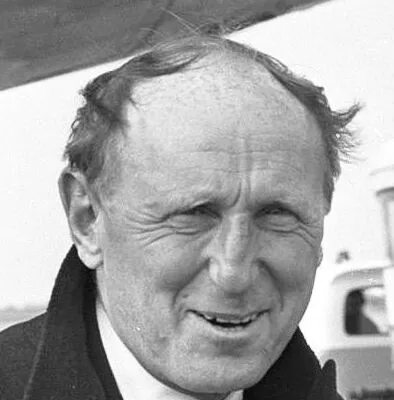
Parry O'Brien
Human Design Chart
Biography
The Human Design of Parry O'Brien: Projector 1/3
Projector 1/3 — Design at a Glance
Parry O’Brien revealed himself as someone with a dense, focused aura that shone like a bright flashlight. His design suggested he could immediately see what wasn’t functioning in systems or in others – he found the fault in the mechanism. However, this ability to ‘shed light on darkness’ could be unpleasant if used directly and unexpectedly, similar to shining a beam of light into someone’s face.
As a Projector, Parry O’Brien did not have a defined Sacral Center, meaning he lacked a constant internal source of life energy. Instead, he experienced phases of high activity followed by necessary rest periods for regeneration to avoid burnout. His best strategy was to wait for a respectful and sincerely meant invitation rather than taking the initiative himself. Through this patience and setting an example of harmonious uniqueness, he became attractive; others came to him on their own to seek advice.
If Parry O’Brien lived by this pattern of waiting for invitations, he would be rewarded with success. If he ignored this strategy and tried instead to impose his insights against the resistance of his environment, it would eventually lead to bitterness as an expression of not living according to himself. Therefore, his influence was based less on constant action than on precise but patient guidance from outside inwards once the environment was ready to accept.
Splenic Authority
Parry O’Brien was characterized by a highly sensitive and instinctive decision-making process that relied on immediate physical well-being. His inner authority lay in the defined Spleen Center, which required a specific configuration: both the Emotional and Sacral Centers were open. This structure allowed him access to deep survival intelligence. His design promoted spontaneous internal knowledge about whether situations or environments were healthy and right for him. The first impulse served as a reliable compass; he had to follow in the moment to effectively shield himself from harmful influences and maintain his health.
This Spleen impulse, however, was subtle and occurred only once. It could easily be overshadowed by external advice or other defined energies, requiring constant inner vigilance. Since Parry O’Brien could only know what was appropriate at a concrete moment, long-term plans were often difficult to sustain. His design favored flexibility and spontaneous agreements over rigid commitments. He needed much space to listen to this fine internal voice that helped him rigorously advocate for his own well-being.
The 1/3 Profile — Investigator / Martyr
Parry O’Brien showed himself as someone who not only collected knowledge theoretically but validated it through active experimentation and learning from personal mistakes. As a 1/3 Profile, his design combined the deep curiosity of the Investigator (Line 1) with the pragmatic joy of experimenting found in the Tester (Line 3). This created a dynamic where planning and implementation were closely intertwined: Line 1 drove him to secure resources and understand dependencies, while Line 3 compelled him to test these insights in practice.
Especially pronounced was his ability to adapt and recognize illusions. Through Gate 44 (Line 3), he learned to see through projections and prepare consciously for errors rather than fearing them. At the same time, Gate 19 (Line 1) ensured that he recognized individual traits and used mutual dependencies without losing his own identity. When Parry O’Brien made a decision or valued something, it was based on double verification: theoretical analysis and practical proof. His judgment was therefore particularly trustworthy as it rested on self-earned experiences that considered both personal benefit and the welfare of the environment. He lived by the principle that awareness alone is not enough but requires effective action.
Split Definition — Defined & Open Centers
Parry O'Brien was characterized by a persistent mental pressure that drove him to ask questions and understand connections. His defined Head Center and Ajna Center created a trustworthy, specific way of thinking; he was not easily influenced from the outside but constantly processed data internally. However, this process often led to inner confusion or doubt, as inspiration for him primarily took the form of a question without an immediate answer. The challenge lay in not turning this pressure into hasty actions – which only produced frustration – but rather patiently waiting until others were ready to implement his ideas. His defined Throat Center allowed him to clearly and reliably articulate these mental concepts once the timing was right.
At the same time, his defined Spleen Center acted as an intuitive instance in the here-and-now. It provided spontaneous signals for health and well-being that he could not rationalize but had to trust. His defined Root Center also ensured a steady adrenaline-driven undercurrent that propelled him forward and helped him deal with stress in a set manner.
In contrast, Parry O'Brien revealed himself in areas without fixed energy. His open G Center meant he did not have a rigid identity; he tended to reflect in relationships or environments and often sought direction shown from the outside. The open Heart Center made him vulnerable to the pressure of proving his worth through promises or competition, despite lacking consistent willpower for it. His open Sacral Center allowed him to absorb and amplify foreign vital energies, which could lead to overexertion if he did not pause. Additionally, his open Solar Plexus absorbed the emotions of his surroundings, putting him at risk of identifying with feelings that belonged to others rather than perceiving them as a neutral barometer.
Channels for critical logic, accepting details and ambitious transformation.
Parry O’Brien had a mind marked by constant skepticism and a need for logical confirmation. The Logic Channel 63-4 connected his Head Center to his Ajna Center. Here, he constantly filtered patterns; doubt drove him until an answer was practically verifiable. Unfounded belief found no place – only consistent, functioning evidence sufficed. This created an active mind that asked questions and made predictions based on data, often serving the collective.
This analytical approach led to precise communication skills. The Accepting Channel 17-62 connected his Ajna Center with his Throat Center. He mentally organized visual patterns and details before formulating them verbally. Only what integrated into his inner image was understood. This gave him the ability to translate complex theories or hypotheses so that others could assess their feasibility. However, unpacking these details required the right timing and an inviting audience to avoid resistance.
Below this cognitive level, a deeper drive for social establishment took effect. The Transformation Channel 54-32 connected his Root Center with his Spleen Center. Driven by ambition and fear of tribal failure, he sought ways to improve his position through competence. His talents were rewarded by the recognition of his environment; he worked hard to prove his worth and establish a healthy dependency between service and reward.
Additionally, individual Gates shaped this profile: Gate 19 emphasized the need for secure resources and territorial safety as a basis for spiritual or partnership approaches. Gate 44 promoted vigilance and the ability to store transformations through unconditional interaction. Gate 24 ensured cyclical mental renewal while Gate 33 supported the process of reflection and withdrawal to strengthen before new cycles. On a personality level, Gate 60 came with the pressure to accept genetic limitations as prerequisites for transcendence, alongside Gate 53 which enabled freedom for new pioneer experiences but risked depression if cycles were not completed. In his design, Gate 18 supported work on collective corrections and human rights while Gate 43 produced spontaneous insights that pushed for communication, often accompanied by the fear of rejection.
Collective Circuitry — Circuit Signature
Parry O’Brien was marked by a clear distinction between rational analysis and physical intuition. His design featured two separate, unconnected energetic blocks: one for cognitive understanding of the future and another for physical transformation. In the first block, the Mind Circuit directly connected Head Center, Ajna Center, and Throat Center. This allowed him to develop logical strategies (Logic Channel) and express them through acceptance (Accepting Channel). It was an 'emotionless ratio' aimed at improving structures and conveying insights free from conditioning. This stream of understanding drove his need to make visual and logical connections accessible for others.
Completely independent of this, the Ego Circuit existed in the second block, connecting Spleen Center and Root Center. Here, the Transformation Channel operated. Since there was no connection to the Sacral Center, constant life energy was lacking; instead, this area required pauses for resource regeneration for the tribe. It was about collectively creating well-being through mutual support and a balanced relationship of giving and taking. Parry O’Brien had to live these two forces – future-oriented rational communication and traditional resource-based cooperation – as parallel systems without direct interaction.
Right Angle Cross of the Four Ways 4
Parry O’Brien demonstrated a fundamental approach oriented towards uncovering hidden connections. His Human Design profile featured the right cross of the four paths 4. This configuration described a life task: to discover and convey hidden truths in such a way that others could truly absorb them. It was not just about conveying information but sharing insights that revealed deeper structures. Parry O’Brien lived this dynamic by seeking what lay beneath the surface and then passing it on to others. His approach involved making complex connections accessible without simplifying or distorting them. This characterized his interaction with the world: he acted as a mediator between the hidden and the visible. The right cross of the four paths 4 suggested that his influence lay in opening up new perspectives, helping others understand their reality more deeply. It was about the process of discovery and sharing as one unit. Parry O’Brien’s design promoted an attitude of curiosity and exchange where finding answers always included asking new questions. This mechanism pervaded his life by driving him to seek out what was not immediately apparent and then share it with others.
Saturn Return · Uranus Opposition · Chiron Return · 2nd Saturn Return — Life Cycles
Parry O’Brien revealed himself as someone whose inner energy was channeled through clear structure and endurance. His design encouraged a stance of persistence, where long-term goals were not just aimed for but gradually realized step-by-step. This inclination towards systematic development found its first major test and confirmation in the first Saturn Return. During this life phase, often marked by focusing on sustainable achievements, years of effort crystallized into tangible results.
In 1959, at the age of 27, Parry O’Brien received the James E. Sullivan Award. This accolade marked a peak that was not accidental but appeared as a logical consequence of his previous life path. The Saturn Return acts here like a filter: it rewards energy consistently and without distraction directed towards a goal. For Parry O’Brien, this meant that his physical presence and public engagement were now underpinned by an acknowledged achievement. It was not a sudden rise but the visible crowning of a period of intense work. This cycle’s mechanics underscore how crucial it is to follow impulses with patience until they reach full maturity. At this moment, it became clear that his energy was most effective when operating within a clear framework and not scattered.
Projector · Splenic Authority — Synthesis
Parry O’Brien lived a life path marked by a deep drive for understanding and precise perception. As a Projector with defined Spleen authority (and open Sacral Center), he acted as an observer who recognized patterns and exposed weaknesses (Channel 63-4). This ability to question the system and filter logical connections was central to his approach. The Profile of Researcher/Experimentator (1/3) reinforced this impulse, as it not only worked out insights theoretically but also tested them in practice – a process fueled by doubt and constant questioning. Receiving the James E. Sullivan Award at age 27 suggests that this thorough engagement with topics brought him success.
Simultaneously, his design revealed a tension between the necessity to share knowledge (Mind Circuit) and the potential resistance his direct manner could elicit. As a Projector, he projected his light onto the world, quickly spotted inconsistencies, and formulated precise questions – yet this “bright light” might not always have met open ears. While Spleen authority called for an instinctive self-protection, defined Head Center generated constant mental pressure to communicate insights and understand the world around him.
3 Defined Channels
Incarnation Cross - Right Angle Cross of the Four Ways 4
Solar Return
The Solar Return shows the moment when the sun returns to its exact birth position - your personal solar year.
Life Cycles
Discover the life cycles with a detailed triple view (birth chart, cycle chart, composite).
Human Design Profile
- Type
- Projector
- Strategy
- Wait for the respectful invitation
- Authority
- Splenic Authority
- Profile
- 1/3 - Investigator / Martyr
- Definition
- Split Definition
- Incarnation Cross
- Right Angle Cross of the Four Ways 4
- Date of Birth
- 28.01.1932 18:04
- Place of Birth
- Santa Monica, California, United States
Frequently Asked Questions
What was Parry O'Brien's Human Design type?
Which Profile did Parry O'Brien have?
What Authority did Parry O'Brien have?
Which incarnation cross was active for Parry O'Brien?
When was Parry O'Brien born?
Discover your own Human Design
Are you also a Projector? Find out in a personal reading how to unfold your leadership qualities and recognize the right invitations.
More Personalities
Back to overviewSissy Spacek

Alain-Fournier
Aldair

Anémone

Ann-Margret

Bourvil