
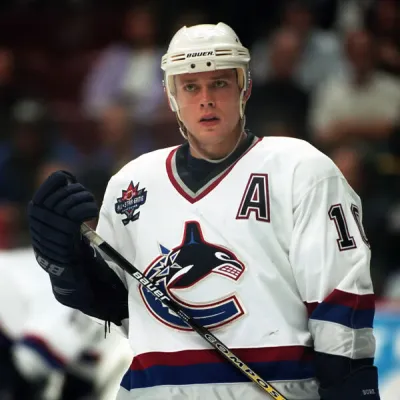
Pavel Bure
Human Design Chart
Biography
Internationally, Bure competed for the Soviet Union and Russia. As a member of the Soviet Union, he won two silver medals and a gold in three World Junior Championships, followed by a gold and a silver medal in the 1990 and 1991 World Championships, respectively. After the Soviet Union was dissolved in 1991, Bure competed for Russia in two Winter Olympics, claiming silver at the 1998 Games in Nagano as team captain, and bronze at the 2002 Games in Salt Lake City.
Following Bure's retirement in 2005, he was named the general manager for Russia's national team at the 2006 Winter Olympics in Turin. Bure was later recognized for his international career as a 2012 inductee in the International Ice Hockey Federation Hall of Fame. In 2017, an NHL panel named Bure one of the 100 Greatest NHL Players in history.
Human Design Analysis: Pavel Bure as Generator 1/4
Generator 1/4 — Design at a Glance
Pavel Bure revealed himself as someone who could rely on immense endurance and an almost inexhaustible source of energy – comparable to a workhorse that can carry its load as long as it is the right one. His design suggested that this energy was not activated by sheer will or initiative, but exclusively in response to external stimuli. The mechanics of his Generator type required a clear 'reacting' rather than initiating: Only when life sent a signal and his sacral center responded with an inner 'yes', full power became available.
This path offered the key to deep satisfaction. As soon as Pavel Bure acted on impulses from his gut, his energy flowed naturally and efficiently. Conversely, two specific dangers loomed: Either he was held back by his passion despite still being full of power – a feeling of unfulfilled potential – or he forced himself to take on tasks without inner consent. The latter inevitably led to frustration and a noticeable lack of energy, up to burnout. His success therefore did not depend on how much he could accomplish but rather on whether he waited for life to call him before responding with full intensity.
Emotional Authority
Pavel Bure displayed a fundamental stance where spontaneous reactions were seen as deceptive; his inner truth lay not in the current mood but in navigating an emotional wave. This stemmed from his emotional authority, carried by the defined Solar Plexus Center. In this design, he was subject to constant ups and downs of emotions, coloring the world through the lens of the momentary mood. A first impression was no final truth; quick decisions based on emotion often led to negative consequences.
The mechanics of this authority demand time and emotional distance. Pavel Bure had to take his time, sleep on decisions multiple times, and be questioned until intense feelings subsided. Only then did clarity and calmness set in. This patience was the key to gaining deeper insights, especially for long-term questions with significant influence on life's course. The emotional wave required not acting at the peak of excitement or frustration but waiting until the emotional waters calmed and a clear view returned.
The 1/4 Profile — Investigator / Opportunist
Pavel Bure revealed himself through a pronounced tension between the deep, controlling knowledge drive of the Investigator line and the need-oriented network aspect of the Caster. His design indicated that he thoroughly researched things but often hesitated to share this knowledge out of fear of exposure in familiar circles. This reticence did not stem from lack of competence but from the specific dynamics of his configuration: Line 1 brings a desire for deep understanding, while Line 4 seeks a group of familiar people to share insights with.
Without a loving environment and deep trust foundation, this combination often led Pavel Bure to inner tension and the feeling of not knowing enough. The fear of being exposed before loved ones could cause significant emotional pain and inhibit his expression. Only in secure networks where trust reigned could he fully unleash his abilities. There, his profound knowledge paired with his networking skills formed a basis for authority in matters of the heart. The mechanics here are clear: Thorough research only becomes effective when it can be shared within a protected framework. Without this security, the fear of incomplete knowledge dominated his interactions.
Split Definition — Defined & Open Centers
Pavel Bure revealed himself as a person of unwavering identity and immense vital potential, driven by deep emotional clarity. His defined G Center gave him a firm sense of self and a clear direction for his life path; he knew intuitively who he was and where he belonged without having to rely on others. This inner security radiated out and allowed him to support others on their journey as long as he did not try to control their direction.
This stable foundation was fueled by his defined Sacral Center with constant energy. As the guardian of this power source, Pavel Bure had immense endurance, which only worked effectively when he waited for invitations and responded accordingly. His mechanism required him to respect the "yes" or "no" of his gut feeling in order to avoid frustration and exhaustion. Initiatives without prior inquiry would interrupt this connection to the energy source.
The control of this system was managed by his defined Solar Plexus Center as an inner authority. Here lay the necessity for patience: Pavel Bure had to learn to wait out the waves of his emotions before making decisions. Truth revealed itself to him not in the moment of impulse but at the end of the emotional cycle. By waiting, he achieved a deep clarity that prevented impulsive action and made his actions more sustainable. His defined Root Center provided the necessary pressure and stress needed to advance in the material world and master existential challenges.
In contrast, Head and Ajna Centers were open. This granted Pavel Bure a flexible mind free from mental noise as long as he did not initiate. He could take in inspiration without getting caught up in endless questions or feeling the need to understand everything immediately. His open Heart Center freed him from the pressure of constantly proving his worth or making promises; he didn't need willpower to enforce himself. Similarly, his Spleen Center was open, meaning spontaneous decisions were risky and he had to learn not to be guided by fear of survival. His open Throat Center indicated that he did not always have to communicate or seek attention but could wait for the right invitations to speak. This openness allowed him to absorb the wisdom of others and let his own energy flow uninterrupted.
Channel 2-14: The Beat — Channels & Gates
Pavel Bure demonstrated a constant, mutative energy for creating new directions and material innovation. As a "Keyholder," he inspired others by authentically responding to his Sacral Center and helped them find their own direction. This powerful, individual energy drove mutations forward by challenging the status quo.
The Channel 14-2 connects the Sacral with the G Center through Gate 14 (Power Competence) and Gate 2 (Higher Knowledge). As one of the three tantric channels, it brings mutation, innovation, and uniqueness. The connection between material resource availability (Gate 14) and directing movement through space and time (Gate 2) generates a powerful resource for creative life force that strengthens direction changes. Pavel Bure had access to essential resources to transform mutative impulses into material directions. By trusting his inner reaction, he could bring innovative perspectives without knowing the path ahead. His task was to be honest with himself and his fate; through this authentic living, he mechanically encouraged others to discover their own identity and life purpose.
Additionally, Channel 34-10, which connects the Sacral with the G Center, played a role. Gate 34 provides inner strength for self-affirmation, while Gate 10 initiates behavior from deepest within to accept and love oneself. This channel promoted the perfection of personal behavior for social survival capability. Pavel Bure followed his own convictions, no matter how unusual, demonstrating through his reactions the benefits of complete self-love. This encouraged others to connect with their own beliefs.
The Channel 39-55 connected the Root with the Solar Plexus Center. Gate 39 (Provocation) and Gate 55 (Mind) set a pulsating on/off wave of moods in motion. This mechanism covered a continuum between joy and sadness, including melancholy and uncertainty. Pavel Bure could strengthen perception through provocation and tease out the minds of others. By living authentically within this emotional wave, he delved into the depths of his own mind and truth.
Individual Circuitry — Circuit Signature
Pavel Bure showed himself to be marked by separate, parallel energy blocks. His design consisted of two independent groups: a connection between the Identity and Sacral Centers as well as another between the Solar Plexus and Root Centers. These blocks were not directly connected but existed as separate fields alongside each other.
The Knowledge Circuit further extended these two separated segments in Pavel Bure’s design. Through Channel “The Beat” (Gates 2-14), energy flowed between Identity and Sacral Center, promoting pulsating, acoustic creativity. Parallel to this, the channel "Release Emotions" (Gates 55-39) linked Solar Plexus with Root Center, creating emotional waves and impulses that did not directly feed into the creative identity energy but rather worked as their own rhythmic force. This circuit supported the expression of a unique individuality through new insights, where emotional intensity and creative innovation ran alongside each other as independent streams.
The Projector Circuit strengthened this inner firmness. It connected solely the Identity with the Sacral Center via Channel “Exploration” (Gates 10-34). This created a deep, individualistic orientation and solidified convictions. Since this circuit did not connect to the Throat Center, these strong internal convictions often remained unspoken or difficult to verbalize. Pavel Bure’s design thus fostered brave, independent personality structures that operated in two separate energetic spheres—a creatively-identity-based one and an emotionally-impulsive one—without forming a continuous flow between all defined areas.
Right Angle Cross of Tension 1
Pavel Bure revealed himself through a basic attitude that was based on inner tension and the urge to find solutions. His design featured the Right Cross of Tension 1, a configuration that describes a specific rhythm of pressure and release. This does not simply mean stress but rather a deeper architectural necessity: Pavel Bure was programmed to accumulate tensions which he then released in a powerful outburst or clarifying action.
This mechanism works like a drawn bow. As long as the tension builds up, energy and focus are created; only through letting go – whether through physical activity, emotional discharge, or a decisive act – does the system return to calm. For Pavel Bure, this cycle of tension and release was central to his well-being and effectiveness. Without regular release, energy would stagnate and lead to inner unrest.
The Right Cross of Tension 1 underscores that this dynamic has been present from the start. It is about learning to deal with this pressure: not avoiding it but using it as a driving force. Pavel Bure's path involved understanding his internal engine and consciously shaping moments of release rather than being helplessly at its mercy. This structure shaped how he approached challenges – always with a certain intensity that could only be reduced by achieving a goal or surviving a crisis.
Saturn Return · Uranus Opposition · Chiron Return — Life Cycles
Pavel Bure's design was characterized by recurring moments of public recognition and validation of his life work. This structure created a rhythm in which external affirmation worked as an integral part of his development.
The first Saturn Return often marked the transition from preparation to established position. In 1998, at age 27, Bure won a silver medal for Russia's team at the Winter Olympics in Nagano. This event condensed years of groundwork into a tangible, publicly visible result and solidified his status.
Later, the Uranus Opposition cycle often associated with sudden changes or recognition by new generations came into play. In 2012, at age 41, Bure was inducted into the International Ice Hockey Federation Hall of Fame. This underscored the enduring relevance of his contributions beyond active sports and confirmed his influence on the field.
The Chiron Return cycle, typically unfolding between ages 49 to 51, brings one's incarnation cross fully into bloom. If the strategy was observed, meaning and purpose become tangible. In 2017, at age 46 – just before this peak – an NHL commission selected Bure among the top 100 NHL players of all time. This ranking signaled the increasing unfolding of his unique purpose and clear visibility of his life work as a whole. The mechanics show how external validation for Pavel Bure was not random but cyclically structured.
Generator · Emotional Authority — Synthesis
A central red thread runs through the design: deep, sacral energy (Generator type, Beat Channel) paired with the desire for knowledge depth and its dissemination (Researcher/Networker Profile, Gate 2). This combination points to a person acting from inner strength and being capable of creating new things through endurance. The defined identity (G Center) reinforces this drive by providing clear direction and the ability to pull others along – especially in areas of innovation and change (Knowledge Circuit).
The design reveals a central paradox between emotional ups and downs (Emotional Authority) and the need for deep trust (1/4 Profile). On one hand, the emotional wave requires time for decision-making to gain clarity. On the other hand, there is great fear of exposure and heartache, which hinders exchange with others – precisely when this is essential for sharing deep knowledge. Success phases in cyclic return cycles (Saturn, Uranus, Chiron) suggest that integrating these opposing forces can lead to outstanding achievements.
3 Defined Channels
Incarnation Cross - Right Angle Cross of Tension 1
Solar Return
The Solar Return shows the moment when the sun returns to its exact birth position - your personal solar year.
Life Cycles
Discover the life cycles with a detailed triple view (birth chart, cycle chart, composite).
Human Design Profile
- Type
- Generator
- Strategy
- To respond - wait for something to respond to
- Authority
- Emotional Authority
- Profile
- 1/4 - Investigator / Opportunist
- Definition
- Split Definition
- Incarnation Cross
- Right Angle Cross of Tension 1
- Date of Birth
- 31.03.1971 19:35
- Place of Birth
- Minsk, Belarus
Frequently Asked Questions
What is Pavel Bure's Human Design type?
Which Profile does Pavel Bure have?
What Authority guides Pavel Bure?
What incarnation cross is assigned to Pavel Bure?
When was Pavel Bure born?
Discover your own Human Design
Are you also a Generator? Find out in a personal reading how to use your sacral energy correctly and discover deep satisfaction.
More Personalities
Back to overviewAaliyah

Aldair

Alexia

Angèle

Anne-Marie

Arcángel
