
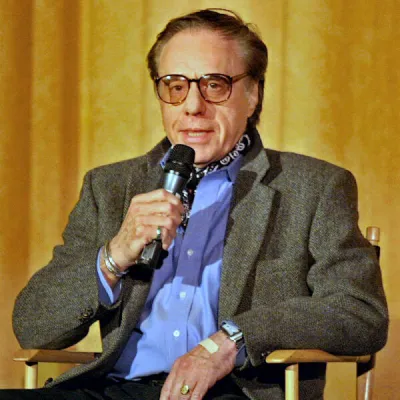
Peter Bogdanovich
Human Design Chart
Biography
He was the second son of an immigrant Yugoslavian dad and an Austrian mom, whose older brother died before he was born. He has one younger sister. To escape the Nazis, his Jewish family fled to the U.S. in the late '30s shortly before he was born. A post impressionistic painter, his dad had just become recognized in America before he died in 1970. Young Peter grew up in New York City, spending summer vacations in New England. Not a very good student, he had a flair for public relations while dabbling in drama club. At 12, he began keeping track of every movie he saw, with notes of his opinions, a number that had grown to some 6,000 by the time of his Saturn return. He never graduated from prep school but studied acting in New York, appearing in several Shakespeare festivals after his 1955 stage debut.
From 1960 on, he directed plays off-Broadway. He wrote film criticism and feature articles for Esquire, the NY Times, the Village Voice and other periodicals. He watched films steadily, some over and over. Moving from New York to California as a writer, he met legendary director John Ford when doing a feature piece on him. In 1966, he entered film as an assistant director with Roger Corman, writing scripts and scouting locations. In October 1971 Columbia released his film, "The Last Picture," shot in black and white. It was hailed as a masterpiece and was nominated for Oscars in eight categories, including Best Motion Picture.
His third feature film, "What's Up Pussycat?" was released in March 1972. Bogdanovich continued to write monographs and is the author of "John Ford," 1968, "Fritz Lang in America," 1969 and "The Last Pioneer," 1971.
In January 1971 he separated from his wife, Polly Platt.
Peter Bogdanovich as a Generator 6/2 in Human Design
Generator 6/2 — Design at a Glance
Peter Bogdanovich's design indicated a tendency towards great endurance. As a Generator, he had abundant sacral energy that made him extremely strong and resilient – provided this power was used for tasks he supported internally. His fundamental work style did not lie in initiating but rather in reacting to external signals. The motto was 'react from the gut.'
This mechanism meant his energy primarily became free when he responded to impulses from his environment, instead of taking the first step himself. If he acted in accordance with this principle and followed the clear 'yes' of his sacral center, his design rewarded him with a feeling of deep fulfillment and satisfaction. In contrast, ignoring this signal – for example, by constantly initiating without an internal impulse or suppressing the urge to work – eventually led to frustration and energy loss.
Two specific stumbling blocks characterized this dynamic: On one hand, he tended to waste energy on things he actually had no interest in, which could lead to burnout. On the other hand, it was harmful if someone prevented him from working on his heart project when he still wanted to continue full of power. His success therefore depended on using his high capacity only when life prompted him and his inner self agreed.
Sacral Authority
Peter Bogdanovich's decision-making did not rely on cognitive analysis but rather on immediate physical reactions. As a Generator, he possessed sacral authority as the primary instance. This mechanism allowed him to respond through internal signals like grunting, humming or a surge of energy in the lower abdomen. Such 'gut feelings' appeared as direct responses to external stimuli and served as clear yes-or-no signals.
This physiological response was the source of his enthusiasm and inexhaustible energy. When his sacral motor kicked in, he felt vital and alive. This enabled him to perform tasks with great joy and satisfaction without an external sense of purpose being necessary. The strategy of waiting for this inner confirmation greatly simplified his process as it replaced complex deliberations.
Peter Bogdanovich thus showed himself to be someone who used his life force by listening to these physical 'noises.' His energy unfolded fully when he followed this inner guidance and immersed himself completely in what he was doing. This configuration described a way of living that relied on spontaneous, vital resonance rather than intellectual planning to find orientation and motivation in everyday life.
The 6/2 Profile — Role Model / Hermit
Peter Bogdanovich's design was marked by a significant shift in his lifestyle: An early phase of intense experimentation gave way later to deep, detached introspection. This dynamic stemmed from his 6/2 profile, the 'Role Model.' Until age thirty, the energy of Line 3 dominated, characterized by trial and error. During this time, Peter Bogdanovich actively sought experiential values through direct action and learning from mistakes without yet possessing profound self-knowledge.
After his first Saturn return, Line 6 activated, ushering in a fundamental shift: The focus moved from external activity to inner withdrawal. Peter Bogdanovich metaphorically retreated into his 'cave' to view the past decades from great distance. This phase served for healing and integrating earlier experiences. Line 6 required absolute security and strict alignment of words and deeds; without this trust in the process, it withdrew to avoid hypocrisy or superficiality.
Simultaneously, Line 2 worked in the background with its ability for spontaneous adaptation to new forms. But only through the mature perspective of Line 6 could Peter Bogdanovich not only execute these adaptations but also reflect on them and transform them into coherent life wisdom. The result was a person who later in life was perceived as a wise model – someone sharing insights no longer through blind experimentation, but through grounded, introspective distance. Others sought his advice to learn from this deep self-knowledge.
Single Definition — Defined & Open Centers
Peter Bogdanovich had a fundamental, constant vital energy through his defined Sacral Center, paired with the existential forward momentum of his defined Root Center. This configuration gave him immense endurance and stress resistance, which only became effective when he responded to external impulses rather than initiating actions himself. His energy was available only for tasks that his Sacral Center answered with a clear "yes"; mental decisions without this inner confirmation led to frustration and exhaustion as the sacral power then could not be accessed.
At the same time, he acted as a mirror of his environment through his numerous open centers: Head, Ajna, Throat, G, Heart, Solar Plexus, and Spleen. His open Head and Ajna Centers meant that mental clarity and inspiration came situatively from outside; he tended to get entangled in questions that were not his own or desperately sought answers to alleviate confusion. The open G Center allowed identity and life direction to fluctuate; he adapted to the people around him and found orientation only through the right environment, rather than having a firm internal goal.
Emotionally, he was vulnerable through his open Solar Plexus Center to absorb other people's moods and experience them as his own, which could lead to inner unrest if he did not distinguish between foreign and personal emotions. His open Heart Center lacked consistent willpower; he felt the pressure to prove himself, often ending in promises that he could not keep due to lack of energy. Finally, his open Spleen Center reflected the health or well-being of his environment rather than having a stable intuition for safety. This openness made him sensitive to his surroundings while his defined centers provided raw power to endure within them – provided he waited for the correct invitation before acting.
Channels for revolutionary change through accepted boundaries.
Peter Bogdanovich's design was characterized by a pulsating rhythm of adrenergic tension and melancholic waiting periods, followed by sudden, evolutionary breakthroughs. This energy was unpredictable and generative; it forced adaptation or transformation. The key lay in accepting limitations and trusting the sacral response rather than rational control. Interpersonally, this dynamic was conditioning. Without acceptance of this rhythm, it led to frustration and chaos as mutation occurred suddenly – like music in the gaps between notes.
This trait resulted from Channel of Mutation 60-3. It connected the Root Center with the Sacral Center through Gate of Limitation (60) and Gate of Order (3). The potential for evolutionary change depended on accepting limitations and moving beyond the confusion of a new beginning. Gate 60 was the fulcrum of all evolutionary possibilities, while Gate 3 attempted to realize a novel approach. The powerful, pulsating on/off energy of this channel permeated his way of living out his design and deeply influenced everyone around him.
The key to dealing with this melancholic process lay in avoiding the attempt to rationalize its moodiness. Patience and attention during phases when the pulse was still deepened his inner journey. Even if it wasn't visible, something continued to develop underground. This endless movement from chaos to order and back created constant opportunities for new beginnings. Peter Bogdanovich had to accept that he did not know the timing of transformation and surrender to the response from his Sacral Center to bring about the energy of change.
Additionally, Gates like 31 (Transmission), 41 (Evolution/Crisis), and 24 (mental mutation/rhythm) were influential. Gate 44 promoted awareness and transformation through interaction, while Gate 27 brought caring warmth into activities. Gate 54 connected worldly success with mystical insight, and Gate 42 emphasized the importance of experience and completion for new commitments. These configurations supported the mutative process by integrating leadership, emotional development, and inner stillness.
Individual Circuitry — Circuit Signature
Peter Bogdanovich exhibited a pulsating, acoustic energy that was rooted in the present and sought out his unique path of identity. His design indicated a tendency to deviate from the status quo, driven by the mechanics of the Mutation Channel (3-60). This channel connected his Sacral Center with his Root Center. Since he had a Simple Definition and these two centers were part of a single group, they formed a direct, continuous flow of energy.
The energy of this channel promoted mutations—deviations from what was previously known. This supported the expression form of his unique identity. While the general description of the Knowledge Circuit does mention creative flashes (Channels 20-57, 24-61) or inspiration (Channel 1-8), these channels were not active in Peter Bogdanovich's design. Therefore, his experience within this circuit was limited exclusively to the dynamics between Sacral and Root Centers.
This connection generated a rhythmic, driving force. It served to acquire and transform new knowledge by propelling changes forward. The energy was not static but moved in waves directly from the inner (Sacral) level to the action plane (Root). This allowed for transformation based on an individual, non-conformist approach to life and creation. It was about expressing this individuality through concrete, mutating steps that stood out from the norm.
Left Angle Cross of the Alpha 1
Peter Bogdanovich's design indicates a tendency towards identity as an Alpha prototype. He emerged as someone who pioneered new paths or redefined existing structures through intuitive insight. This configuration originated from the left cross of Alpha 1.
In Human Design mechanics, the Alpha Center represents the power of initiation and pioneering spirit. As a prototype, that is, the first manifestation of this energy, Peter Bogdanovich carried a specific responsibility: He was not just an innovator but the one who laid the groundwork. His inner authority rested on intuition and direct perception. This means he did not make decisions by logically weighing all options but relied on an internal impulse that felt right to him.
This combination of Alpha energy and prototype status created a life task connected with building something fundamental. He lived in a dynamic where his intuitive certainty formed the foundation for future developments. Others could build upon this basis, as he was the first to show the way. His role involved creating clarity through direct perception and charting new directions without being dependent on external expectations. This characterized how he approached challenges: He did not seek validation from outside but followed his inner voice that told him where the next step lay. Thus, he became an architect of new structures, driven by a deep intuitive certainty about his path.
Saturn Return · Uranus Opposition · Chiron Return · 2nd Saturn Return — Life Cycles
Peter Bogdanovich's life path followed a clear cyclical structure marked by three astrological turning points. His first Saturn return around the age of 29 signalled the transition from preparation to concrete realization. This was evident in 1968 when, at the age of 29, he directed his debut thriller "Targets" – a moment where years of groundwork condensed into a solid professional achievement.
The Uranus opposition around the age of 41 often brought a phase of letting go and transformation. For Bogdanovich, this transformation occurred in the realm of relationships: at 41, he fell in love with Dorothy Stratten, whom he later married. This event disrupted established patterns and opened up new, unexpected areas of life.
The Chiron return around the age of 46 is considered a fulfillment cycle where the inner sense of one's design unfolds – provided that one’s own strategy has been observed. For Bogdanovich, however, this period coincided with a profound crisis: in 1985, at the age of 46, he had to file for personal bankruptcy. This moment highlighted that external circumstances do not necessarily align with the inner rhythm of unfolding; instead, it revealed the harsh reality when internal and external developments diverge. The three cycles thus did not form a linear progression but rather distinct areas of life: career, relationship, and financial existence.
Generator · Sacral Authority — Synthesis
Peter Bogdanovich lived a life deeply marked by the dynamic tension between internal reaction and external influence. As a Generator with sacral authority, he found his energy primarily in reacting to impulses—a capability enhanced by the connection of his Sacral and Root Centers. This energetic foundation allowed him endurance and creative power as long as he surrendered to the demands of a given moment. At the same time, the pattern of open centers (Ajna, Head, Heart, Solar Plexus, Spleen) indicates that he had a high sensitivity to the energies around him and absorbed them strongly. This led to constant engagement with external influences that shaped his identity and put him in phases of inspiration and transformation.
A central paradox in Peter Bogdanovich's design lies in the discrepancy between his ability for deep, sacral-driven reaction and the lack of inner, defined direction. The open G Center suggests he strongly sought external validation and often defined his identity through relationships and circumstances. This contrasts with the Generator’s need to act from gut instinct and not be swayed by conditioning. The repeated turning points in his life—from early success as a director through personal crises to financial difficulties—reflect this inner struggle: a constant swing between authentic expression and adapting to the expectations of his environment.
1 Defined Channel
Incarnation Cross - Left Angle Cross of the Alpha 1
Solar Return
The Solar Return shows the moment when the sun returns to its exact birth position - your personal solar year.
Life Cycles
Discover the life cycles with a detailed triple view (birth chart, cycle chart, composite).
Human Design Profile
- Type
- Generator
- Strategy
- To respond - wait for something to respond to
- Authority
- Sacral Authority
- Profile
- 6/2 - Role Model / Hermit
- Definition
- Single Definition
- Incarnation Cross
- Left Angle Cross of the Alpha 1
- Date of Birth
- 30.07.1939 21:50
- Place of Birth
- Kingston, NY, United States
Frequently Asked Questions
What was Peter Bogdanovich's Human Design type?
Which Profile did Peter Bogdanovich have?
What Authority guided Peter Bogdanovich?
What incarnation cross did Peter Bogdanovich have?
When was Peter Bogdanovich born?
Discover your own Human Design
Are you also a Generator? Find out in a personal reading how to use your sacral energy correctly and discover deep satisfaction.
More Personalities
Back to overviewSissy Spacek

Aaliyah

Alexia

Anémone

Angèle

Ann-Margret
