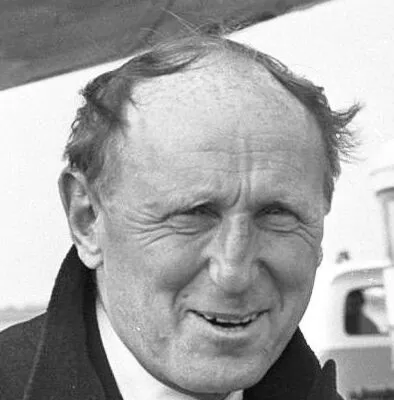
Photo: Wikimedia Commons
Peter Turrini
Human Design Chart
Biography
The Human Design of Peter Turrini: Projector 6/2
Projector 6/2 — Design at a Glance
Peter Turrini revealed himself through an aura that seemed like a focused flashlight. His design suggested he immediately saw where systems failed or processes were inefficient. This ability to identify the flaw in the system was his natural drive. However, this direct perception could be perceived as unpleasant from the outside if it arrived uninvited.
As a Projector, Peter Turrini did not have a constant intrinsic energy source from the sacral center. Instead, he worked in phases of high intensity and focus followed by necessary rest periods for regeneration. The traditional model of continuous output did not fit his physiological rhythm. His effective strategy was to wait for an honest invitation from others. When he received this respect, he could convey his insights so that they were accepted.
Living by this principle rewarded him with success. Ignoring the necessity of invitations and pauses threatened a feeling of bitterness as an expression of non-self. Therefore, his path did not lie in constant action but rather in precisely directing his attention where it was truly desired and appreciated.
Splenic Authority
Peter Turrini showed a tendency for immediate, instinctive orientation. His design indicated that he relied on a fine inner signal that instantly told him whether a situation or environment was healthy for him. This ability stemmed from his authority in the spleen center, a system functioning as a biological alarm and health guardian. Since both Peter Turrini's emotional and sacral centers are open – a prerequisite for this specific form of authority – he could not wait for emotional clarity or tactile confirmation. Instead, he had to seize and follow the first spontaneous impulse. This moment was crucial: The spleen voice is a one-time signal that can easily be drowned out by other influences. Therefore, his decision-making required high vigilance and often a short retreat to not miss this fine impulse.
This mechanism shaped his life through the necessity of great flexibility. Since plans could change at any moment when the inner alarm sounded or a new intuition arose, it was difficult for him to adhere to long-term commitments. His design thus promoted a lifestyle with much freedom and spontaneity to rigorously avoid harmful influences and protect himself optimally. The ability to recognize what is right in the moment always stood forefront, independent of other defined centers or external expectations.
The 6/2 Profile — Role Model / Hermit
Peter Turrini's design is characterized by a clear shift throughout his life: In his youth, an experimental drive dominated based on trial and error. Until the age of 30, line six acted as third, leading to a phase of intense self-exploration. Retreats after failures were part of the natural process during this early developmental stage.
After turning 30, the actual dynamics of line six are activated. This phase is marked by a need for distance to reflect on accumulated experiences. A time of healing and deep self-awareness emerges as Peter Turrini steps back from daily life to gain a clear overview of his commitments and limitations. This integrity-seeking process leads him to learn how to say no and consciously engage in certain responsibilities.
The second line of the profile supports this through the ability for concentration and consideration. It demands pauses for regeneration, with the risk of selfishly retreating. Around age 50, this path culminates in wisdom. Peter Turrini then steps forward as a role model whose life experience helps others to clarify their own essence and smooth out their paths.
Single Definition — Defined & Open Centers
Peter Turrinis Human Design indicates a tendency towards intuitive presence and existential alertness. His defined Spleen Center gives him direct access to the 'now', guided by instinct and the need for well-being rather than rational analysis. This spontaneous judgmental ability was reinforced by his defined Root Center with a constant, adrenalized push that propelled him forward – not as a stress reaction to external demands but as an inner resource to handle material challenges and maintain life force.
At the same time, Peter Turrini showed openness in certain areas to external influences, creating specific vulnerabilities. His open Head Center meant he did not have a constant source of internal inspiration; instead, he tended to pick up mental pressure from his environment and engage with questions that were not his own, which could easily leave him feeling confused or needing to find answers. Similarly, his open Ajna Center: He reflected concepts and opinions from his surroundings rather than producing them from a firm inner conviction. This required the ability to observe thoughts as transient phenomena without identifying with them or holding them as personal truth.
His open G Center also shaped his identity finding: Peter Turrini had no fixed direction or static self-image. He relied on interaction and the right place to come into contact with correct energy, rather than pursuing a firm goal. His open Heart Center made him vulnerable to the need to prove his worth or make promises to gain acceptance – a mechanism that resulted in self-doubt when ignored. Additionally, his open Sacral Center meant an unstable energy flow; he could absorb and amplify others' vital energy but was not designed to generate this energy independently or set limits on work rhythms from personal strength. Finally, his open Solar Plexus absorbed emotional moods of the environment, leading him to experience foreign feelings as his own and avoid confrontation to prevent emotional waves.
Channels for logical judgment and power of proof.
Peter Turrini exhibited a fundamental attitude of constant questioning: an insatiable drive to challenge patterns in order to correct and perfect them. This tendency was rooted in his design as Channel Judgment 58-18. He connected the vital life energy from the Root Center (Gate 58) with the analytical Spleen function (Gate 18). This mechanism acted like a sentry, assessing whether what was perceived was balanced or needed correction. His goal was not mere criticism but the restoration of joy and satisfaction through functioning patterns.
This logical rigor stood in tension to other aspects of his design. While he sought objective correctness, he also carried Gate Innocence 25, which promoted a mystical individualization, as well as Gate Focus 52, which required pauses for pattern correction. His actions were further shaped by the dedication to the physical process (Gate 46) and the need for personal integrity under pressure (Gate 38).
In interpersonal contexts, his strategy was crucial: He should only offer solutions when explicitly asked. This prevented his relentless judgment from being perceived as aggressive and allowed him to provide practical corrections that the collective actually accepted and used.
Collective Circuitry — Circuit Signature
Peter Turrini's design is characterized by a focus on logical clarity and strategic structure. His chart shows a simple definition, meaning his energy focuses are clearly separated and there are no complex internal tensions between different centers.
Central to this orientation is the Understanding Circuit. In Peter Turrinis case, this circuit exclusively connects the Spleen Center with the Root Center through Channel Judgment (Gates 18 and 58). This creates a direct, uninterrupted flow between the ability for intuitive pattern recognition and reaction to stress or challenges. The energy of this channel promotes an 'emotionless ratio', as the Solar Plexus is not involved. Peter Turrini thus had the capacity to share and apply logical insights free from emotional conditioning.
The connection between Spleen and Root means that his intuitive perceptions were directly translated into action-oriented reactions once a situation was felt as challenging. It represents focused energy aimed at improving things and guiding society through rational structures towards a better future. As it is a simple definition, this power exists as an independent block, not woven with other energetic systems like the Head or Ajna Center. Peter Turrini used this configuration to clearly grasp and convey visual and strategic connections.
Left Angle Cross of Healing 2
Peter Turrinis design indicates a tendency towards profound and often painful transformation. His inner cross aligns with the 'left healing cross 2', pointing to a path that does not lead through superficial adaptation but rather through experiencing breaks and losses. This configuration describes not a linear development, but a spiral in which old structures must be broken down to make room for a more authentic existence.
The mechanics of this cross demand radical honesty about one's own pain. It is not about quickly solving problems or restoring harmony, but enduring the darkness and acknowledging it as a necessary part of the growth process. For Peter Turrini, this means that his greatest strength lies in accepting his own vulnerability and forging a new, more resilient form of integrity from it. The focus is on inner work: What must die so that the true can live?
This process is rarely comfortable. It requires patience and the courage not to be swayed by external expectations. Healing here does not come through avoiding suffering but through its complete integration. Peter Turrini showed himself as someone who did not avoid this hard lesson of life, but used it as a central driving force for his personal evolution. His task was to gather the fragments of the past and transform them into a coherent whole that is deeper and truer than anything before.
Saturn Return · Uranus Opposition · Chiron Return · 2nd Saturn Return — Life Cycles
Peter Turrinis design shows a clear structure of professional consolidation and artistic unfolding reflected in his life phases. Already with the first Saturn return in 1971, at age 27, he established himself as an independent writer. This cycle marked the transition from preparation to sustainable professional structuring, a phase where inner values met outer reality.
The Uranus opposition around the age of 38 brought about the premiere of his play 'Campiello' on September 26, 1982. This aspect often promotes sudden impulses or necessary breaks with old patterns, which here manifested in a concrete artistic publication.
With the Chiron return in 1993 at age 49, a phase of fulfillment began. The premiere of 'Alpenglühen' on February 17, 1993 stands for the bloom of one's own purpose if one has followed their strategy. It was not about healing in a mythological sense but about the visible unfolding of the incarnation task.
The second Saturn return in 2001 at age 57 crowned this development with the premiere of 'Ich liebe dieses Land' on December 7. This cycle deepened the already established structures and confirmed his long-term dedication to literary work as the core of his life mission.
Projector · Splenic Authority — Synthesis
A central red thread in Peter Turrinis design is the ability to recognize patterns and make corrections – fueled by the combination of a projector type with defined spleen (health judgment) and the channel of judgment (58/18). This constellation gives him an acute ability to grasp the potential and weaknesses in systems, coupled with an instinctive sense for what is beneficial in the present moment. The recurring documented events (career) show a pattern of creative work that arises through deep reflection and a skillful alignment on the essential – a process of continuous refinement and healing (healing cross 2).
The central paradox lies in the tension between the projector need for recognition of his insights and the fine, intuitive authority of the spleen. While he is destined to bring light into darkness for others and point out errors, his inner leadership system (spleen center) requires a cautious approach to avoid being perceived as intrusive. The early years (up to about 30) are marked by an experimental spirit (6/2 line), followed by a phase of intense self-reflection and the desire for distance before he can share his wisdom with others – a dance between the urge to correct and the necessity to wait for the right moment.
1 Defined Channel
Incarnation Cross - Left Angle Cross of Healing 2
Solar Return
The Solar Return shows the moment when the sun returns to its exact birth position - your personal solar year.
Life Cycles
Discover the life cycles with a detailed triple view (birth chart, cycle chart, composite).
Human Design Profile
- Type
- Projector
- Strategy
- Wait for the respectful invitation
- Authority
- Splenic Authority
- Profile
- 6/2 - Role Model / Hermit
- Definition
- Single Definition
- Incarnation Cross
- Left Angle Cross of Healing 2
- Date of Birth
- 26.09.1944 06:00
- Place of Birth
- Wolfsberg, AUS
Frequently Asked Questions
What is Peter Turrini's Human Design type?
What is Peter Turrini's Profile?
What is Peter Turrini's Authority?
What incarnation cross is active for Peter Turrini?
When was Peter Turrini born?
Discover your own Human Design
Are you also a Projector? Find out in a personal reading how to unfold your leadership qualities and recognize the right invitations.
More Personalities
Back to overviewSissy Spacek
Alain-Fournier
Anémone

Angeli
Ann-Margret

Bourvil