
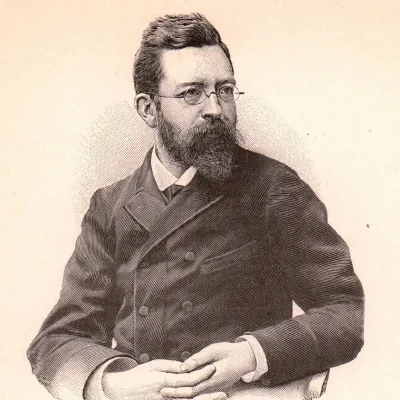
Pierre de Nolhac
Human Design Chart
Biography
A Member of the French School of Rome in 1882, he worked there on Italian humanism of the sixteenth century. In 1886 he was attached to the Museum in the Palace of Versailles and became curator in 1892, founding a chair of art history within the École du Louvre in 1910, then retiring to the Musée Jacquemart-André in 1920. He was elected a member of the Académie française in 1922.
His activities in the museum of Versailles were crucial, since they contributed greatly to modernisation and to restoring the collections, including the furniture, which had been dispersed during the French Revolution. He played a role in the preparations for the Treaty of Versailles, which took place in the Palace in June 1919.
The central library of Versailles has many manuscripts of major works by Pierre de Nolhac, including Erasmus and Italy, Queen Marie Antoinette, Nattier, Louis XV and Marie Leszczynska. Also available are the original of his 1924 acceptance speech to the Académie française and his very extensive correspondence with figures as diverse as Marcel Proust, Henri Bergson, Leconte de Lisle, Ernest Renan, or Mussolini Liautey.
He was the father of the painter Henri de Nolhac. He died on 31 January 1936 at age 76 in Paris.
What does Generator 1/3 mean for Pierre de Nolhac?
Generator 1/3 — Design at a Glance
Pierre de Nolhac revealed himself as someone with immense inner endurance who could channel his strength not through independent initiatives but rather through reactive actions. As a Generator, he possessed a large amount of sacral energy that made him a powerful and steady 'workhorse' – provided this energy was used for tasks that truly mattered to him. His design indicated that he wasn't the type to start projects on his own; instead, he functioned best when responding to signals from his environment.
This mechanism meant for him: First wait until life posed a request and then check if his gut feeling gave a clear 'yes'. When this inner signal came, he could respond with full power and experience deep satisfaction. If Pierre de Nolhac tried to work against this flow – by initiating things he didn't feel like doing or being kept from his heart project – his energy would stagnate. Instead of feeling fulfilled, frustration or a sense of exhaustion would hit him. His strength thus lay not in pushing forward but in the ability to respond from the gut to what was offered and bring in his immense endurance.
Emotional Authority
Pierre de Nolhac's inner authority was Emotional Authority carried by his defined Emotional Center. This configuration fundamentally determined his decision-making: he was subject to a constant wave movement of feelings that colored his perception of the world. What appeared inspiring at one moment could be felt negatively in the next. His immediate feeling was always just a snapshot, not necessarily the deeper truth. Therefore, spontaneous decisions based on current emotions were often risky for him and could have negative consequences.
The mechanics of his authority required time. The longer he let a decision mature, the clearer his inner voice became. This demanded patience and consciously sleeping over important questions. Through this delay, intense feelings subsided, allowing him to gain emotional distance. Only then did the necessary clarity and calmness set in, especially crucial for long-term life decisions. Emotional Authority always took precedence over other defined centers in his design; it was the primary compass, independent of further energetic conditions. Pierre de Nolhac lived this necessity of waiting and emotional distancing as a central aspect of his inner guidance.
The 1/3 Profile — Investigator / Martyr
Pierre de Nolhac's design indicated a tendency towards a deep connection between theoretical knowledge and practical experience. As a person with Profile 1/3 – the Researcher and Experimenter – he was dependent on not just studying insights but also testing them through personal action. His judgment was considered particularly trustworthy, based on this double validation: he combined meticulous information gathering with the willingness to try these out in everyday life and learn from any mistakes.
This dynamic was shaped by specific energetic influences. Line 1 promoted the gift of serendipity – being at the right place at the right time – as well as a desire for mental nourishment through collaboration with like-minded individuals. Simultaneously, there was an underlying fear of anonymity and the feeling that his ideas were not recognized. Line 3 complemented this by focusing on loyalty and adaptability in relationships. Here Pierre de Nolhac learned through the process of making and breaking contact, seeking intimacy but also knowing the risk of rejection or withdrawal. His life task consisted of integrating these seemingly contradictory forces – the need for acknowledged expertise on one hand and the necessity to grow through trial and error – into a coherent path.
Single Definition — Defined & Open Centers
Pierre de Nolhac revealed himself as someone who did not plan his actions from the Head Center but waited for an inner, vital response. His defined Sacral Center generated a constant energy source daily that he used by reacting to life rather than initiating it. This power connected with his defined Solar Plexus Center: He learned to give emotional waves time before making decisions to gain emotional clarity. Additionally, his defined Spleen Center provided spontaneous, intuitive impulses in the here and now, protecting his well-being.
At the same time, Pierre de Nolhac was marked by several open centers that made him vulnerable to certain conditioning. His open Head Center led to him being easily distracted by foreign questions or mental pressure instead of trusting his inner authority. The open Ajna Center meant that his conceptual thinking was flexible; he tended to adopt other people's ideas and had to learn not to interpret them as absolute truths. His open G Center showed that he did not have a fixed, unchanging identity but often received direction and love from the environment and relationships, making him vulnerable to "borrowed" identities. Furthermore, in his open Heart Center, he lacked consistent willpower; he tended to make promises or prove himself to demonstrate his worth, although this was not his natural energy source. This configuration described a person who drew strength from patience and reaction while learning to let go of mental uncertainties and the pressure to self-prove.
Channels for care, intimacy and mystical principles.
Pierre de Nolhacs Design establishes a tendency towards deep, merging connections based on patience and temporal maturation. The Channel of Union 59-6 links his sacral life energy with his emotional wave. This configuration creates a strong desire for intimacy that is not immediate but regulated by the rhythm of attraction and repulsion. Only when he waits until emotional clarity sets in can this energy be fruitful; otherwise, confusion threatens interpersonal dynamics.
Parallel to this, a deep connection to tribal thought is shown through the Channel of Synthesis 19-49. Here, Gate of Claims (19) drives the search for belonging and security while Gate of Principles (49) ensures that these bonds align with his innermost ideals. This mechanism fosters loyalty and the desire to create or protect a stable community based on clear understanding of values and mutual support.
Another defining aspect is the Channel of Preservation 27-50. Through Gate of Care (27) in the Sacral Center, Pierre de Nolhac possesses a natural ability for provision and sustenance that is channeled through Gate of Values (50) in the Spleen Center. This gives him an instinct for traditional structures and the protection of what has been created. He acts as someone who takes responsibility to ensure order and continuity, with his aura automatically inspiring trust.
Additionally, prioritized Gates like 11 (visual memory) and 36 (crisis as development) contribute to assessing situations through historical patterns and cyclical experiences. Gate 29 supports this with persistent energy while Gate 53 represents the urge for new paths and freedom. This combination shapes a person standing between preserving old values and exploring new horizons, always guided by his inner emotional and sacral authority.
Tribal Circuitry — Circuit Signature
Pierre de Nolhacs Design showed a tendency towards emotional synthesis and instinctive protection. His energy flowed in two separate areas: on one hand, the Ego Circuit connected the Solar Plexus Center with the Root Center via Channel 49-19. This created a rhythmic emotional wave that required pauses for rest since there was no direct connection to the Sacral Center. It was about mutual support and finding balance between giving and taking within a community.
Parallel to this, the Hunter Circuit in Pierre de Nolhac directly connected the Sacral, Solar Plexus, and Spleen Centers. Through Channels of Preservation (27-50) and Pairing (6-59), it united life force, emotions, and instincts. This configuration emphasized ancient themes: protecting the family, nurturing, and preserving genetics. It was a primal energy of "Mother and Father" aimed at caring for and defending one's clan.
Although both circuits touched the Solar Plexus Center, they were not energetically connected to each other. Pierre de Nolhac therefore experienced these forces as coexisting streams: once emotional coordination in a social context with necessary pauses, and the other a constant instinctive force for preservation and care of the close ones. This simple definition created a clear yet divided energetic structure oriented towards cooperation and family protection.
Right Angle Cross of Eden 4
Pierre de Nolhac's Human Design profile was marked by the right cross of Eden 4. This configuration described a life dynamic characterized by a deep connection to the inner self while simultaneously orienting towards the external world. It represented an energetic structure that tended to translate internal truths into concrete actions without losing touch with one's essence.
The right cross of Eden 4 connected specific energies fostering a balance between intuition and logical structure. Pierre de Nolhac was someone who intuitively sensed what felt right, but he implemented these insights with clear, almost architectural precision. This mechanism allowed him to penetrate complex relationships and present them in a form that others could understand.
His energy did not flow randomly but followed an inner compass integrating emotional depth with intellectual clarity. As a result, his contributions often had a unique authenticity because they stemmed from an authentic source while also being structured. Pierre de Nolhac lived this dynamic by transforming his internal impulses into external results that were both personally significant and objectively valuable.
Saturn Return · Uranus Opposition · Chiron Return · 2nd Saturn Return — Life Cycles
Pierre de Nolhac's Human Design indicated a tendency towards structured knowledge dissemination and academic anchoring. This was evident in 1886, at the age of 27, when he began teaching at the École pratique des hautes études. For his Human Design, this marked a typical moment: the first Saturn return often signals the transition from inner development to external validation and institutional integration. During this phase, years of groundwork condensed into a solid, socially recognized outcome. The mechanics of the first Saturn return describe a time when an individual learns not only to exercise their talents privately but also to embed them in established structures, thereby taking responsibility for a larger whole. Pierre de Nolhac's chart indicated his ability to present complex content in such a way that it found footing in an academic context. The choice of the École pratique as an entry point underscores this aspect: here it was not just about knowledge but its practical application and transmission to future generations. This cycle shaped his subsequent career through the connection between personal expertise and public authority. The structure built at this age served as a foundation for later developments, allowing him to anchor his specific knowledge sustainably and thereby strengthen his contribution to the scientific community.
Generator · Emotional Authority — Synthesis
Pierre de Nolhac was a Generator whose life was marked by deep, sacral energy. This power source, combined with emotional authority and the Profile of Researcher/Experimenter (1/3), led him to an unceasing quest for knowledge through personal experience. His natural ability to test things thoroughly resulted in self-acquired knowledge that others could rely on – a process that was always accompanied by an emotional wave requiring time for clarification. The capacity to generate energy seemed closely tied to the need to express it through active engagement and experimenting with new paths.
A central paradox in his design lay in the interplay of sacral vitality and emotional depth. While the sacral response signaled a direct yes or no, his emotional authority required maturation over time for decision-making. This led to a tension between an impulsive drive towards activity and the necessity to fully experience emotions before making commitments. This inner dynamic shaped his approach both in research and resource management, where mutual support played a crucial role.
3 Defined Channels
Incarnation Cross - Right Angle Cross of Eden 4
Solar Return
The Solar Return shows the moment when the sun returns to its exact birth position - your personal solar year.
Life Cycles
Discover the life cycles with a detailed triple view (birth chart, cycle chart, composite).
Human Design Profile
- Type
- Generator
- Strategy
- To respond - wait for something to respond to
- Authority
- Emotional Authority
- Profile
- 1/3 - Investigator / Martyr
- Definition
- Single Definition
- Incarnation Cross
- Right Angle Cross of Eden 4
- Date of Birth
- 15.12.1859 07:00
- Place of Birth
- Ambert, France
Frequently Asked Questions
What was Pierre de Nolhac's Human Design type?
Which Profile did Pierre de Nolhac have in Human Design?
What Authority guided Pierre de Nolhac?
What incarnation cross was assigned to Pierre de Nolhac?
When was Pierre de Nolhac born?
Discover your own Human Design
Are you also a Generator? Find out in a personal reading how to use your sacral energy correctly and discover deep satisfaction.
More Personalities
Back to overviewAaliyah

Alain-Fournier

Alexia

Angèle

Angeli

Anne-Marie
