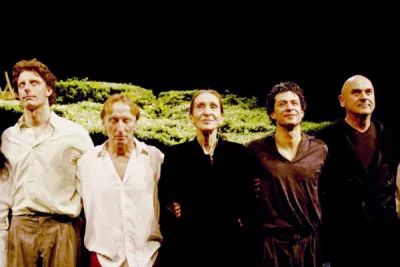
Pina Bausch
Human Design Chart
Biography
Bausch was a shy and fearful child, raised by parents who ran a modest hotel cafe in Solingen. She remembers speaking seldom. Taken to an exercise dance class, she was singled out for praise and filled with pride; all her dreams from then on were of the theater. She began with ballet classes, then studied under Kurt Joos, the great German choreographer. At 19, she went to Juilliard in New York. She studied at the Essen Folkwang School, and danced with the Folkwang Ballet, the New American Ballet and the Met Opera House Ballet.
Gaunt and 5'7", with a pale, angular face, she tends to wear men's trousers and an oversized coat in her signature black. Her productions are distinctive, bold and vital, with highly original signatures. In 1984 her company made its U.S. debut at the Los Angeles Olympic Arts Festival. Bausch lives in her art and demands that her people do so as well. Her scripts spring from close collaboration with the dancers, who go through group mind exercises in order to dredge up material that gives depth to the movement. The sets and music are given as precise attention, and the completed production becomes transformed, greater than the sum of its parts.
Her first set designer, the brilliant Rolf Borzik, was her great love and mentor and she lived with him until he died of cancer in 1980. Reclusive and anxious, when she began her state-supported company, she confessed to terror at the challenge. What emerged was a strange, dream-like, violent, disturbing form of dance theater that eventually influenced her generation.
Five days after she received a diagnosis of cancer, she died on June 30, 2009, age 68, in Wuppertal, Germany.
Pina Bausch as a Manifestor 3/5 in Human Design
Manifestor 3/5 — Design at a Glance
Pina Bausch emerged as a pioneer and visionary whose role was to steer the world into new directions. Her design mirrored that of a Roman emperor: she had the grand vision but did not lead the necessary battles herself; instead, she passed on impulses for others to implement. This style of leadership inevitably polarized her. As her thoughts often far outpaced those around her, she was frequently misunderstood. While some were drawn to and followed her ideas, others rejected or even hated them. The pain point of misunderstanding was a central aspect of her character.
To find the right followers who could carry her visions, her design required a clear strategy: she had to inform her surroundings precisely about her intentions in good time. This information served to minimize friction and create clarity. When Pina Bausch followed this strategy and aligned with her inner authority, she was rewarded with a sense of internal peace. Conversely, living against this design left her feeling an enduring, deep-seated anger. The dynamics between her visionary strength, the risk of misunderstanding, and the necessity of information thus determined her path to inner balance or frustration.
Splenic Authority
Pina Bausch relied on a fine, spontaneous inner voice as her sole basis for decision-making. Her design featured authority in the Spleen Center, meaning that her health and alarm system dictated direction. This required open emotional and sacral centers, giving her an acute survival intelligence: an immediate physical sense of whether a situation or environment was beneficial or harmful.
This impulse was extremely subtle and occurred only once at each moment. It could not be repeated or analyzed later. Therefore, Pina Bausch had to remain highly alert to avoid overshadowing this initial spark with external influences or excessive thinking. Often, withdrawing from the situation helped sharpen her perception and recognize the clear impulse.
Long-term planning stood in opposition to this mechanism as the right path only became apparent in the here and now. Flexibility was essential; fixed commitments or rigid structures would have restricted her natural adaptability. Instead, she lived spontaneously, rigorously distancing herself from harmful influences and maintaining freedom. This form of decision-making directly served her well-being and health by moving her always in directions marked safe by her inner alarm system without getting entangled in long-term strategies.
The 3/5 Profile — Martyr / Heretic
Pina Bausch's design inclined towards generating practical knowledge through personal experimentation, including failure, which acted as an attractive resource for others. As a person of Profile 3/5, the Experimenter and Hero, she initially had little faith in preordained truths. Instead, she learned through direct experience and mistakes. This process along Line 3 required discernment in choosing influences; it was not about the number of followers but their quality.
The resulting competence became the foundation of her role as a rescuer or model (Line 5). She possessed the ability to manage foreign resources effectively and offer practical solutions during crises. Her authentic, experience-based expertise attracted others who wanted to draw from her knowledge. The tension lay in the public nature of this learning process: failure was essential for gaining insight but could be painful when it occurred in full view.
Pina Bausch thus emerged as someone who solved other people's problems with self-acquired knowledge. Line 5 described her capacity to take responsibility for foreign means and build a trust base. However, there was always the risk of losing power or gaining a negative reputation if this responsibility was not fulfilled. Her path was marked by cycles of trial, error, and the resulting authority as a competent hero who helped others in difficult situations.
Single Definition — Defined & Open Centers
Pina Bausch revealed herself through a consistent, reliable expression of self and clear identity. Her defined Throat Center acted as a focal point for communication and manifestation; she spoke not from fleeting thoughts but from a deep wellspring within her. The also defined G Center gave her a stable sense of direction and love, enabling her to show others new paths without being dependent on them. Her willpower came from the defined Heart Center: She controlled her resources herself, kept promises, and asserted herself. This was complemented by the defined Spleen Center, which allowed her spontaneous, intuitive judgments in the present moment – a body intelligence that warned of dangers and promoted well-being.
In contrast, Head, Ajna, Sacral, Solar Plexus, and Root were open. These open centers made Pina Bausch vulnerable to absorbing foreign energies. The open Head and Ajna Centers could absorb mental pressure or confusion from the environment; she tended to engage with questions that weren’t her own rather than trusting her inner authority. The open Sacral Center led to amplifying others’ energy, which could lead to exhaustion as she lacked a steady reservoir of personal energy. She had to learn to set boundaries and rest instead of running on borrowed energy.
The open Solar Plexus Center absorbed emotional waves from the environment. Pina Bausch was sensitive to the emotional climate around her; she could take in and amplify others’ moods and feelings. It was important for her not to identify these emotions as her own but to use them as information without personalizing them. Finally, the open Root Center took on stress and adrenalized pressure from the environment. This external pressure could be misinterpreted as an internal drive to act constantly or achieve something. The challenge lay in not internalizing this foreign stress but recognizing it as an external phenomenon and letting go of it to avoid burnout. Through trust in her defined centers – Throat, G Center, Heart, and Spleen – she could use these open fields without being overwhelmed.
Channels for logical leadership, intuitive integration and bold action.
Pina Bausch revealed herself as a personality whose aura was significantly shaped by the logical, collective leadership of the Alpha Animal Channel 7-31. This channel connected her role as self with leading and required that her authority be legitimized through trust and invitation from the community; she did not act as an autocrat but as a leader who understood patterns and showed the way. Parallel to this, the Perfect Form Channel 57-10 defined her behavior: an intuitive, self-referential aesthetic based on survival instincts and acting independently of external recognition. This constellation created a tension field through the juxtaposition of the Money Line 21-45, which linked the Will to Control (Gate 21) with Authority over Resources (Gate 45), raising issues of material sovereignty as well as her own rhythm. Additionally, prioritized gates added layers: Gate 41 drove evolutionary change and crisis experience, while Gate 27 promoted caring warmth and Gate 28 encouraged risk-taking in the here-and-now. Further influences like pattern recognition from Gate 62 or emotional mood from Gate 12 rounded out the picture, yet the core mechanics remained the balance between the need for collective affirmation of her leadership and inner intuitive security of her own form.
Collective Circuitry — Circuit Signature
Pina Bausch’s design leaned towards structured, rational clarity. Her focus was on visually and strategically improving connections, driven by an intelligence that operated free from emotional conditioning. This stance came from the Mind Circuit, specifically the Alpha Animal (Channel 31-7), which linked her Throat Center with her Identity Center. Here energy flowed for logical insights and future-oriented structures directly into how she communicated and defined herself. Parallel to this, the Ego Circuit worked through the Money Line (Channel 45-21), linking her Throat Center with her Heart Center. This created a flow of material resources and mutual support within the tribe but required rest periods for regeneration as there was no direct connection to the Sacral Center. A third aspect emerged through the Integration Circuit with Perfect Form (Channel 10-57). This channel connected her Identity Center with her Spleen Center, allowing her to draw strength from reacting to life and directing it through intuitive knowledge in the present moment. As Pina Bausch had a Simple Definition, all defined centers – Throat, Identity, Heart, and Spleen Centers – formed one continuous energetic stream. Her entire expression was thus marked by a clear connection between rational strategy, resource-oriented cooperation, and intuitive self-preservation.
Right Angle Cross of the Unexpected 2
Pina Bausch's Design inclined towards a way of existence characterized by unpredictability and spontaneous turns. Her deeper life dynamics followed the archetypal structure of the Unexpected Right Cross 2. This configuration did not describe a situational reaction to external circumstances but rather a constant underlying energy. She was someone whose essence was defined by breaking patterns. The mechanics of this cross worked independently of concrete triggers; it created a backdrop of surprises and the extraordinary. This did not mean that her life appeared chaotic, but that its underlying structure was oriented towards the unexpected. The energy of this configuration fostered an attitude where familiarity was broken to create new space. It was a fundamental inclination that shaped her experience without her having to actively seek it out. The unpredictable was no accident but rather an expression of this deeply rooted archetypal form. Pina Bausch lived in a dynamic that questioned the known and reformed it through spontaneous impulses. This structure determined her inner orientation towards the unknown as a constant companion in her life's journey.
Saturn Return · Uranus Opposition · Chiron Return · 2nd Saturn Return — Life Cycles
Pina Bausch's development followed a clear cyclical structure that was marked by four distinct turning points. These phases divided her career into areas of invitation, breakthrough, artistic deepening, and official recognition.
In 1970, at the age of 30, her first Saturn return occurred. This cycle condensed years of preparatory work into a solid result: Pina Bausch received an invitation as guest choreographer from the Rotterdam Dance Center.
Ten years later, the Uranus opposition took effect. In 1980, at the age of 40, this led to her first appearance at the Berlin Theatertreffen with the piece "Arien," a moment of artistic breakthrough.
The phase of fulfillment and bloom was marked by her Chiron return. In 1989, at the age of 49, Pina Bausch experienced the premiere of "Die Klage der Kaiserin." During this period, her life purpose became increasingly tangible if she had followed her strategy.
Her second Saturn return completed this arc. In 1997, at the age of 57, her work was officially recognized: She received the Berlin Theatre Prize, the Grand Cross with Star of the Order of Merit of the Federal Republic of Germany, and the Honorary Ring of the City of Wuppertal.
These events confirm the mechanics of her Human Design cycles, where internal maturation processes translated into concrete professional milestones.
Manifestor · Splenic Authority — Synthesis
Pina Bausch's design reveals a central continuity in the connection between inner authority and the expression of this authority externally. A defined G Center, Heart Center, and Spleen Center formed a foundation for a strong self-understanding and the ability to act authentically (Gate 10/57). This internal compass was reinforced by the Alpha Animal Channel (Gate 7/31), which showed a natural inclination towards leadership and initiating change. The repeated recognitions of her work (documented events in Saturn Return and Uranus Opposition) confirm this ability to recognize collective patterns and shape new forms of expression – always guided by the spontaneous impulse of Spleen authority.
At the same time, a central paradox in Pina Bausch's design was revealed: the tension between the need for authentic expression and conditioning from external influences. The open Sacral and Solar Plexus Centers made her receptive to the energies of others, while the defined Heart Center signaled strong willpower. This contradiction led to a dynamic interplay between absorbing impulses from the environment and the need to filter these impulses through one's own inner authority and transform them into creative energy – a process that was both inspiring and challenging (Gate 28/35).
3 Defined Channels
Incarnation Cross - Right Angle Cross of the Unexpected 2
Solar Return
The Solar Return shows the moment when the sun returns to its exact birth position - your personal solar year.
Life Cycles
Discover the life cycles with a detailed triple view (birth chart, cycle chart, composite).
Human Design Profile
- Type
- Manifestor
- Strategy
- To inform others before acting
- Authority
- Splenic Authority
- Profile
- 3/5 - Martyr / Heretic
- Definition
- Single Definition
- Incarnation Cross
- Right Angle Cross of the Unexpected 2
- Date of Birth
- 27.07.1940 06:45
- Place of Birth
- Solingen, Germany
Frequently Asked Questions
What is Pina Bausch's Human Design type?
What Profile did Pina Bausch have in Human Design?
What Authority guided Pina Bausch?
What incarnation cross did Pina Bausch have?
When was Pina Bausch born?
Discover your own Human Design
Are you also a Manifestor? Find out in a personal reading how to use your initiation power peacefully and dissolve resistance.
More Personalities
Back to overviewAaliyah

Alexia

Alizée

Angèle

Anne-Marie

Arcángel