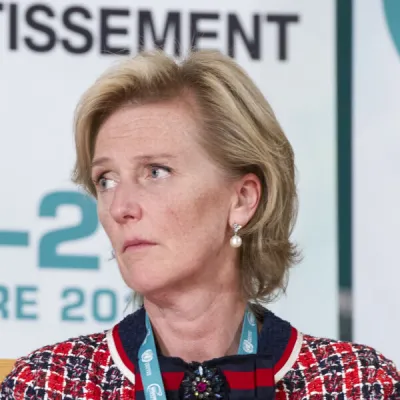
Princess of Belgium Astrid
Human Design Chart
Biography
She married Archduke Lorenz of Austria-Este on 22 September 1984, and they have five children.
In 2016 Astrid's first grandchild, Princess Anna Astrid, was born, daughter of Prince Amedeo. The prince's second child, a son, was born in 2019.
Princess of Belgium Astrid as a Manifestor 4/6 in Human Design
Manifestor 4/6 — Design at a Glance
Belgian Princess Astrid's Human Design shows a tendency towards proactive action and visionary leadership. She was someone who could actively steer the world into new directions, much like an emperor in ancient Rome who does not fight himself but sends soldiers to expand his empire. However, this configuration comes with a specific pain point: misunderstanding and polarization. Since her visions often reach further than those of her surroundings, she is loved and followed by some, while others reject or even hate her.
To minimize resistance and attract the right followers, it was crucial for Princess Astrid to communicate her intentions and visions in advance before acting. By doing so, she could find people willing to follow her lead. If she adhered to this strategy, she would be rewarded with a sense of inner peace. On the other hand, if she acted against this design without informing or respecting her authority, it resulted in persistent, deep-seated anger. Her Human Design thus describes a life task: as a visionary shaping the future by clearing the path for others through clear communication and accepting that not everyone will share her perspective.
Emotional Authority
Belgian Princess Astrid's Human Design shows a tendency to avoid making decisions based on first impulses but instead subject them to the natural rhythm of her feelings. Her inner authority lies in her defined Emotional Center, meaning her perception is always influenced by a wave-like movement of highs and lows; current mood colors her view of the world without representing immediate truth.
Immediate reactions were unreliable in this system as they only reflected momentary snapshots. A spontaneous decision could thus easily be skewed by temporary enthusiasm or negative coloring and later prove to be wrong. The mechanism of her authority required patience: she had to sleep on decisions, allowing time for intense feelings to subside. Only when the emotional wave subsided did she gain the necessary distance. This process led to true clarity and calmness. Only after the emotional storm had passed could she recognize and act upon her deeper truth. This waiting strategy was especially crucial in long-term, life-defining questions to ensure that the chosen path was stable and authentic rather than a product of fleeting mood.
The 4/6 Profile — Opportunist / Role Model
Belgian Princess Astrid's Human Design shows a tendency to move between a deep need for emotional connection and a later call to distant wisdom. In the first three decades of her life, her energy was exploratory and experimental, driven by an insatiable appetite for new experiences. This corresponds with the mechanics of Line 4 in Profile 4/6 (Networker/Role Model), which during this phase acts similarly to Line 3: it intensively gathers life experience, especially in relationships and friendships, to shape her own identity.
With Saturn return, around age thirty, a structured transformation occurred. Line 6 activated, bringing forth a new quality of leadership personality. Here the characteristic conflict of this profile came into play: the heart of Line 4 yearned for belonging and community, while the head of Line 6 longed to withdraw to contemplate life's meaning. This distancing was not an escape but clarification. Belgian Princess Astrid showed herself as someone who used nostalgia not to dwell in the past but to overcome old doubts and pose new questions for inner transformation. The challenge lay in integrating these two poles: the cautious heart protecting itself from false people, and the wide horizon of the role model.
Single Definition — Defined & Open Centers
Princess of Belgium Astrid's Design reveals a tendency towards inner stability and emotional depth, paired with clear expressiveness. Her defined G Center gave her a reliable sense of self-identity and direction; she intuitively knew where she belonged without having to control it. This formed the foundation of her personality, connected with the defined Solar Plexus Center as an internal authority. Here lay the wisdom in waiting: truth revealed itself only after the emotional wave had passed. She avoided impulsive decisions by exercising patience until emotional clarity emerged—a process that took time but allowed for deep insights.
Her defined Throat Center served as a reliable anchor point for communication and action. It transformed energies from her system into speech or deed, always connected to her emotional source (Solar Plexus) and identity (G Center). This enabled her to articulate her truth clearly once she felt secure within herself. The defined Root Center provided the steady physical pressure and stress management impulse that maintained her life rhythm and anchored her in the material world.
In contrast, her open centers made her situationally adaptable but also vulnerable to conditioning. Her open Head and Ajna Centers meant no constant mental focus; she tended to absorb others' mental confusion or doubts rather than possessing her own conceptual truths. Her open Heart Center lacked consistent willpower; there was a risk of overcompensating with promises to prove worth, though her wisdom lay in not needing to prove anything. Her open Sacral Center had no generative energy source; she was vulnerable to exhaustion from "borrowed" energy from others and needed clear boundaries as well as rhythm. Finally, her open Spleen Center made her sensitive to existential fears and the comfort frequency of defined spleens, making spontaneous decisions seem risky. The challenge lay in using her defined inner structure to avoid falling into these traps of her open centers.
Channels for reflection, emotional synthesis and transformative change.
Princess of Belgium Astrid's Design was characterized by a tension between the desire for new experiences and the necessity to withdraw for reflection. This dynamic was primarily shaped by four channels.
The Transience Channel 35-36 functioned as an emotional motor, seeking change and resisting logical caution in order to force new experiences. Often this resulted in an impulsive urge to act, driven by a fear of boredom or a feeling of inadequacy.
At the same time, the Recognition Channel 30-41 propelled her with restlessness and longing for the "what if". This channel connected the Root Drive with emotional intensity, leading to a strong desire to engage in new situations often before the emotional wave had brought clarity.
In contrast stood the Synthesis Channel 19-49, which regulated the need for clan affiliation and emotional bonding. It sought validation through the "clan" – whether family or close circle – and checked if relationships adhered to principles of loyalty and mutual support. Here it was about tuning into the collective emotionally and securing one's place within it.
Finally, the Lost Son Channel 13-33 offered balance through reflection. As a listener, Princess of Belgium Astrid gathered information and secrets but then withdrew to process these experiences and gain deeper meaning. This channel required patience and rejected hasty conclusions.
The interaction of these channels described a cycle: impulses towards change (35-36) and new experiences (30-41) were moderated by the need for emotional security within the clan (19-49) and ultimately integrated through patient, reserved reflection (13-33). The challenge lay in not satisfying the urge to act before emotional clarity had been achieved while also preventing the wisdom of withdrawal from turning into isolation.
Collective Circuitry — Circuit Signature
Princess of Belgium Astrid's Human Design profile shows a tendency to cyclically process past emotional experiences in order to derive collective insights from them. This configuration is evident through the Meaning-Making Circuit, which functions as a continuous energy flow between her Throat, Solar Plexus, Root, and Identity Centers. Unlike future-oriented logic, this circuit focuses on the past: emotions from the Solar Plexus Center move in wave-like patterns with clear beginnings, middles, and ends. Princess of Belgium Astrid reflected on events to uncover their underlying meaning and shared these visual and emotional insights.
The active Channels "The Lost Son" (33-13), "Transience" (35-36), and "Recognition" (30-41) supported her ability to distill universal truths from personal experiences and share them with others.
Parallel to this, the Ego Circuit operated through the Channel "Synthesis" (49-19), which connects the Solar Plexus and Root Centers. This part of her design emphasized cooperation and the joint creation of resources within a community. Since this circuit does not connect to the Sacral Center, there was no constant life force; instead, it required rhythmic pauses for energy regeneration for the group. Thus, Princess of Belgium Astrid found herself in a tension field between deeply processing emotional pasts cyclically for collective participation and practically supporting her community through mutual aid and resource sharing.
Both circuits utilized the emotional wave of the Solar Plexus but with different goals: once for meaning-making reflection, the other for stabilizing cooperation in the present.
Right Angle Cross of Consciousness 2
Princess of Belgium Astrid's Human Design profile establishes an archetypal structure defined by the Consciousness Cross 2. This configuration sets a specific energetic alignment that determines the fundamental orientation and inner compass of her personality. The Consciousness Cross 2 acts as a central shaping principle in Human Design, which cannot be considered in isolation but influences how impulses are processed and directed towards a particular life purpose when viewed holistically. It describes not a fleeting mood or single trait, but a deeply rooted dynamic that manifests over time through recurring patterns and decisions. For Princess of Belgium Astrid, this means her inner orientation is guided by this specific cross-structure, offering clarity about her natural role and contribution to the world. The energetic alignment of this cross ensures certain themes in life receive priority while others recede into the background. It represents a firm archetypal template that structures both potential and challenges within the design. Princess of Belgium Astrid thus moves within a framework defined by this Consciousness Cross dynamic, significantly influencing her response to external circumstances and inner development.
Saturn Return · Uranus Opposition · Chiron Return · 2nd Saturn Return — Life Cycles
Princess of Belgium Astrid's Human Design profile indicates a tendency towards profound inner maturation, especially when she engages with questioning old role structures and establishing an authentic internal authority. This consolidation process is characteristic of the second Saturn Return cycle (ages 58–62), during which life experiences are integrated and values reassessed.
In 2019, at age 57, her second grandson was born. This event fell within the preparatory phase of this maturation cycle and acted as a catalyst for reflection on legacies and her role within family tradition. The arrival of the child marked the beginning of a period where questions about her place in life and the passing down of responsibility became more pronounced. Rather than mere biological continuation, it highlighted the mechanical necessity to review existing identities and adopt a new, mature stance rooted in genuine self-determination rather than external expectations.
Manifestor · Emotional Authority — Synthesis
Princess of Belgium Astrid navigates her life through a dynamic tension between the drive to accumulate experiences and share the insights gained (Channel 13-33) and the deeply rooted need to pay attention to her emotional wave (emotional authority). This combination shapes a character that is both restlessly curious and dedicated to finding wisdom and meaning in every encounter. She seems destined to explore life patterns, refine them through personal experience, and then share her insights with others – a cycle accompanied by a profound sensitivity to the ups and downs of her emotions.
A central paradox lies in her need for connection alongside an urge towards individuality (Gate 1). She is meant to build relationships and share resources (ego circuit), yet her open definition in key centers requires constant self-regulation and avoidance of conditioning. This tension leads to a search for authenticity and a deep understanding that true fulfillment lies in walking one's own path – even if it differs from others' expectations.
4 Defined Channels
Incarnation Cross - Right Angle Cross of Consciousness 2
Solar Return
The Solar Return shows the moment when the sun returns to its exact birth position - your personal solar year.
Life Cycles
Discover the life cycles with a detailed triple view (birth chart, cycle chart, composite).
Human Design Profile
- Type
- Manifestor
- Strategy
- To inform others before acting
- Authority
- Emotional Authority
- Profile
- 4/6 - Opportunist / Role Model
- Definition
- Single Definition
- Incarnation Cross
- Right Angle Cross of Consciousness 2
- Date of Birth
- 05.06.1962 12:20
- Place of Birth
- Laeken, Belgium
Frequently Asked Questions
What is the Human Design type of Princess Astrid of Belgium?
What Profile does Princess Astrid of Belgium have?
What Authority does Princess Astrid of Belgium have?
Which incarnation cross is active for Princess of Belgium Astrid?
When was Princess of Belgium Astrid born?
Discover your own Human Design
Are you also a Manifestor? Find out in a personal reading how to use your initiation power peacefully and dissolve resistance.
More Personalities
Back to overviewChristian-Jaque
Kesha

Lucebert
Marilyn

Masaccio

Papus