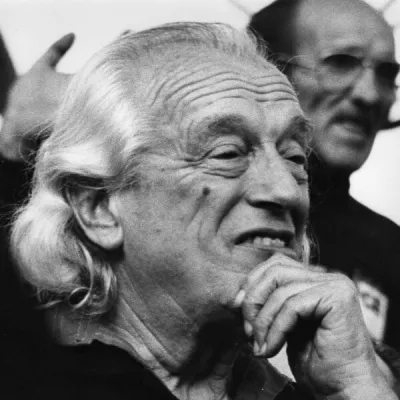
Rafael Alberti
Human Design Chart
Biography
He died 28 October 1999
What does Projector 2/4 mean for Rafael Alberti?
Projector 2/4 — Design at a Glance
Rafael Alberti revealed himself as someone with a dense, focused aura that acted like a bright flashlight. This quality allowed him to immediately recognize system errors in others and bring "light into the darkness" for them. However, since this direct error recognition was often perceived as unpleasant and caused resistance, his strategy was not to criticize directly. Instead, he attracted others through his own harmony; his shining example was so appealing that people would naturally seek out his advice. Therefore, he waited for a respectful and sincerely meant invitation before using his leadership skills. This protected him from the uncomfortable direct projection of his perception.
His energy management followed a specific rhythm: Due to his undefined Sacral Center, Rafael Alberti did not have a constant intrinsic source of life energy. He experienced phases of high activity and rapid productivity, followed by necessary rest periods. These pauses were essential to prevent burnout, as traditional schooling or standard jobs often ignored this need for cyclical regeneration. When he lived according to this design—by waiting for invitations and respecting his energy cycles—he was rewarded with success. Deviations from this strategy eventually led to his non-self theme of bitterness.
Self-Projected Authority
Rafael Alberti revealed himself as a Projector with the rare authority in Self. This configuration shaped an extreme openness that made him vulnerable to distraction by external motoric energies. The greatest danger lay in getting lost in this vastness and constantly seeking external energy.
His inner truth was in his identity. He made decisions through two paths: spontaneous self-dialogues or physical directional impulses. In conversations – whether alone or invited with others – it was central to listen to his own speaking. He had to distinguish when his true essence spoke and when only the mind did so. What he spontaneously expressed without thinking articulated his uniqueness and made him recognizable to others.
Alternatively, he felt a physical pull in a specific direction, geographically or thematically. This feeling showed him where he should go or from where he should distance himself. By following this inner compass needle, he became a guide for others. There lay his specific potential for success: not in chasing after validation but in the loyalty to this spontaneous expression and physical pull. Only through this did he avoid the trap of energy waste and find his clear guidance.
The 2/4 Profile — Hermit / Opportunist
Rafael Alberti showed a fundamental tension between the deep desire for isolated reflection and the wish to connect within a familiar network. His design suggested that he dove into internal processes during his "Me-Time" to find calm and clarity. This phase of solitude was essential for him, as it formed the prerequisite for absorbing knowledge from his environment, evaluating it, and developing brilliant ideas.
At the same time, a dominant emotional force in him was carried outward. His network served as a mirror that amplified and reflected this energy back to him. To successfully manage the cyclical shift between withdrawal and community, it was crucial for him to clearly communicate his availability: he needed to make clear when he sought company and when he wanted to be undisturbed. This prevented frustration in his surroundings and protected his necessary isolation.
During times of retreat, his ideas matured through rigor and selectivity. If these thoughts were not brought outwards or developed further, boredom threatened to set in – both for him and those around him, as unused creativity was often projected outward. Only when the need of Line 2 was satisfied did he return from this inner cave to connect with his favorite people and share the insights gained in silence within a social context.
Single Definition — Defined & Open Centers
Rafael Alberti revealed himself through a defined G Center and a defined throat as someone with clear, consistent identity. He possessed an inner compass for his life direction and the ability to communicate this truth reliably. His voice was not a product of fleeting moods or external inspiration but flowed directly from his higher self. This gave him a magnetic presence; he knew who he was and could easily convey it to others without exhausting himself.
This stable center contrasted with his seven open centers: Head, Ajna, Heart, Sacral, Solar Plexus, Spleen, and Root were undefined. These areas functioned as open windows to the environment. Rafael Alberti absorbed and amplified the energies of his surroundings – from mental confusion over foreign emotions to stress and vital exhaustion. The challenge was not to identify these absorbed signals as his own self.
So he tended to find himself trapped in the open Heart Center, trying to prove his worth through promises or performance despite lacking the consistent energy for it. In the open Sacral Center, he risked overloading by borrowing others' energy, leading to exhaustion if he did not pause. His open Solar Plexus made him vulnerable to emotional waves of the environment; he could amplify foreign moods and misinterpret them as his own instability. The open Spleen Center drew him through survival fears to people with defined Spleens who gave a false sense of security, while the open Root Center took in external stress that he could not control.
The mechanics of his design required a conscious distancing from these conditioning influences. Instead of getting lost in mental questions (open Head/Ajna) or emotional turbulence, he had to trust his inner authority. Only then could he use the clarity of his G Center and the authenticity of his throat without being overwhelmed by the chaotic streams of open centers. His strength lay in the constancy of his identity while the flexibility of open centers allowed him to adapt to different environments without internalizing them as his own truth.
Channels for reflection, memory and inner stillness.
Rafael Alberti revealed himself as someone who collected life stories and secrets naturally as a listener. He withdrew to sort these experiences and find deeper meaning before sharing them. His role was that of a witness, creating continuity and stability through the sharing of lessons from the past.
This attitude stems from Channel The Lost Son 13-33. It connects the G Center with the Throat Center via Gate 13, which listens and stores information, as well as Gate 33, which withdraws to reflect on collected experiences. This channel brings the cyclical experience process of maturation to its end. Rafael Alberti saw all sides of an experience after reflection before sharing it. As a keeper of what was heard, he gathered souvenirs and withdrew to sort them out. His challenge lay in timing: He did not reveal secrets prematurely or withdraw so much that no one knew about them.
The wisdom gained through this patient observation revealed truths of collective history. Rafael Alberti testified how fulfilling it is to give oneself over to the experience process as a conscious passenger, rather than experiencing frustration from unfulfilled expectations. He learned from the past and shared the realization that life ultimately makes sense.
Additionally, Gate 11 with visual memory and collective ideas, Gate 12 with poetic expression and emotional mood, Gate 6 with friction and emotional waves as a motor for growth, Gate 36 with crises as cyclical movement towards development, and Gate 46 promoting devotion and presence in the here and now influenced his communication. Gate 15 supported collective behavior through adaptation to natural rhythms, while Gate 45 expressed tribal energy and willpower. These configurations shaped his ability to integrate experiences and pass them on.
Collective Circuitry — Circuit Signature
Rafael Alberti's design laid a tendency towards cyclical meaning-making that unfolded through emotional reflection of past experiences. His perception circuit processed these contents in wave-like patterns: Each cycle from the Solar Plexus Center – the source of emotions – ran a clear arc from beginning over middle to end. In contrast to the cool, future-oriented logic of other areas, his processing of the past was front and center. These energies were often inexplicable or illogical as they stemmed from emotional life and could not be derived purely rationally.
The concrete mechanics showed in the connection between Identity and Throat Center through Channel The Lost Son. This channel allowed him to formulate felt insights and emotional waves from his past and share them with the collective. The goal was not only personal understanding but shared learning from history. As Rafael Alberti had a simple definition, these two centers formed a continuous flow without interruption by other groups. His energy focused on translating visual and emotional impulses from the past into words to make them accessible to others. This created a space for collective experience where sharing meaning from the past was at the center.
Right Angle Cross of Eden 4
Rafael Alberti's Human Design profile carried the signature of the right cross from Eden 4. This configuration shaped a specific life dynamics that relied less on individual empowerment and more on a deep, often unconscious devotion to something greater. It was a pattern of adaptation and service where the self stepped back to make room for a higher purpose or collective order.
In Human Design, this cross describes an energy that does not work through loud assertion but rather through silent resonance and subordination. The mechanics here are those of surrender: The person in this configuration finds their truth not in resistance or isolated leadership, but in the willingness to integrate into a larger context. It was a dynamic of 'fitting in', which did not represent weakness, but a specific form of strength through connection and loyalty.
For Rafael Alberti, this meant that his path often led him to immerse himself in tasks or relationships that transcended his personal identification. The energy of this cross demands acceptance rather than control. It manifests in the ability to adapt while maintaining inner stability by subordinating one's will to the flow of life or the requirements of a community. It was a design that sought and found its deepest fulfillment through service and devotion without losing its essence, but rather realizing it within the context of the whole.
Saturn Return · Uranus Opposition · Chiron Return · 2nd Saturn Return — Life Cycles
Rafael Alberti faced a profound turning point in his middle age, which abruptly interrupted his accustomed life path. This phase was marked by the Uranus opposition, an astrological cycle often experienced as a turning point or identity crisis and frequently triggered by external circumstances. For Rafael Alberti, this pivotal moment occurred in 1939 at the age of 37 when he had to go into exile due to the Spanish Civil War. This event not only marked a physical relocation but symbolized the sudden collapse of his previous reality, forcing him to reorient himself. The Uranus opposition acted here as a catalyst for an enforced transformation: old structures broke down to make way for new perspectives. Rafael Alberti had to confront during this time the question of who he was without his familiar surroundings. The crisis of exile thus became a key moment when his inner stance was put to the test and initiated a fundamental change in his life path.
Projector · Self-Projected Authority — Synthesis
Rafael Alberti lived a life marked by a profound ability for perception and reflection (Channel 13-33). This gift, to recognize patterns and accumulate experiences, fed his creative energy and enabled him to act as an intermediary between inner world and outer expression (defined G Center & Throat Center). He intensely perceived the emotional landscape of his environment (open Solar Plexus), processed these impressions in silence (Line 2) and then shared his insights with others to open up new perspectives (Line 4). His life was thus a constant oscillation between retreating inward for collection and opening outward towards community – a rhythm that both gave him strength and presented challenges.
A central tension field in Rafael Alberti's design lay in the combination of his open emotional sensitivity and defined G Center. While the open Solar Plexus made him susceptible to others' energies, the defined G Center offered an inner compass, a firm identity that provided orientation. This constellation led to a paradox: He was both receptive to external influences and committed to preserving and expressing his own inner truth – a balancing act between adaptation and authenticity that shaped his life and ultimately drove him into exile (Uranus opposition with exile).
1 Defined Channel
Incarnation Cross - Right Angle Cross of Eden 4
Solar Return
The Solar Return shows the moment when the sun returns to its exact birth position - your personal solar year.
Life Cycles
Discover the life cycles with a detailed triple view (birth chart, cycle chart, composite).
Human Design Profile
- Type
- Projector
- Strategy
- Wait for the respectful invitation
- Authority
- Self-Projected Authority
- Profile
- 2/4 - Hermit / Opportunist
- Definition
- Single Definition
- Incarnation Cross
- Right Angle Cross of Eden 4
- Date of Birth
- 16.12.1902 12:00
- Place of Birth
- Cádiz, Spain
Frequently Asked Questions
What was Rafael Alberti's Human Design type?
Which Profile did Rafael Alberti have?
What was Rafael Alberti's Authority?
Which incarnation cross was active for Rafael Alberti?
When was Rafael Alberti born?
Discover your own Human Design
Are you also a Projector? Find out in a personal reading how to unfold your leadership qualities and recognize the right invitations.
More Personalities
Back to overviewSissy Spacek

Alain-Fournier
Anémone

Angeli

Ann-Margret

Bourvil