Raphaël Poirée
Human Design Chart
Biography
Raphaël Poirée as a Projector 4/6 in Human Design
Projector 4/6 — Design at a Glance
Raphaël Poirée presented himself through an aura that resembled a focused flashlight: it shed light directly on weaknesses in the environment that were still in the dark. This design gives him the ability to recognize systemic flaws immediately. However, if he addresses these flaws abruptly, it often feels like a blinding light to the person he's addressing, causing them to become defensive. His influence is more elegant and effective when he shines through his own harmony instead. Then, others are drawn to him automatically, asking for his solutions. His strategy is to wait for an honest, appreciative invitation before taking the lead. As a projector, Raphaël Poirée lacks a defined Sacral Center, meaning he doesn't have a constant, intrinsic source of life energy. Instead, he experiences phases of high activity followed by necessary rest periods to avoid burnout. The traditional work model, which demands continuous performance, often ignores this need. If he lives according to this rhythm and the strategy of invitation, he will be rewarded with success. If he deviates from this path by imposing himself uninvited or not conserving his energy, this will eventually lead to the non-self state of bitterness. His path, therefore, lies in patiently waiting for recognition from others, not in forcing his insights upon them.
Self-Projected Authority
Raphaël Poirée showed a basic attitude characterized by extreme openness, coupled with the constant danger of being distracted by external motoric energies. His design tends to lose itself in this openness when he constantly seeks external energy instead of trusting his inner truth. This mechanism describes the authority in the self, a configuration that only occurs in projectors and is rare.
His decision-making did not rely on logical analysis but on two paths. On one hand, through self-dialogues or dialogues when invited. Crucial was listening to himself and distinguishing whether his mind or his true self was speaking. Spontaneous, unreflected statements revealed his uniqueness to others. On the other hand, he followed a physical feeling that drew him geographically or thematically in a specific direction.
By remaining true to this inner attraction, he became a guide for others. His specific potential for success lay precisely in recognizing and consistently following this personal direction, rather than getting lost in the general openness. This required discipline to resist the distraction from the environment and to clearly distinguish the voice of the self from the noise of the mind.
The 4/6 Profile — Opportunist / Role Model
Raphaël Poirée's design tends towards experimental behavior in youth, followed by a later orientation towards wise role models. The Profile 4/6, the 'Networker/Role Model', often starts like a Line 3 before the first Saturn Return: a lot is tried out, especially in relationships and friendships. Once Line 6 becomes active, an internal conflict arises between the Heart (Line 4), which seeks community, and the Head (Line 6), which questions the overview and meaning. This tension characterizes the entire life.
The fourth line requires resonance and recognition by the majority to be influential. If this authority is not recognized, Raphaël Poirée withdraws, as leadership without influence is meaningless. The sixth line strives for the big picture and must make decisions for mutation. Here, rationalization (Mercury enhanced) and the need for material security (Saturn in fall) play a role. Stagnation serves here to preserve individuality. In later years, it is expected that Raphaël Poirée meets the high standards of a wise role model and stands out through cooperation. Throughout, the great heart of Line 4 remains cautious, to avoid opening up to the wrong people and getting hurt.
Single Definition — Defined & Open Centers
Raphaël Poirée was characterized by a design that combined constant mental clarity with a deep inner direction. His defined Ajna Center ensured a reliable, independent way of thinking; he processed data and concepts in the same way, unaffected by external influences. This mental stability flowed directly into his defined Throat Center, allowing him to consistently and reliably express what he thought. His voice was not an impulse, but the articulated truth of his mind. This was complemented by his defined G Center, which gave him a firm sense of self-identity and a clear sense of his personal direction. He knew who he was and where he stood without having to rely on others.
At the same time, Raphaël Poirée was strongly exposed to his environment through several open centers. His open Head Center made him vulnerable to mental pressure and the questions of others, which he often internalized as his own problems, pulling him into a whirlpool of confusion. His open Heart Center lacked consistent willpower; he tended to want to prove himself through promises to demonstrate his worth, ending in a cycle of self-doubt if he couldn't keep them. His open Sacral Center received the vital energy of his environment, leading to overexertion as he didn't know when to stop. Additionally, his open Solar Plexus absorbed the emotions of others, making him appear emotionally unstable, and his open Spleen Center made him sensitive to uncertainty and the desire for false security. Finally, his open Root Center took on external stress, which could place him in a state of frenzy and exhaustion if he didn't learn to separate from this pressure.
Channels for reflection, inspiring expression and accepting logic.
Raphaël Poirée was characterized by a dual nature of expression: as an inspiring role model whose mere presence has an effect, and as a reflective chronicler who collects experiences to categorize later. This dynamic stems from the Channel of Inspiration 1-8 in his design, which connects the G Center with the Throat Center. It's not about explaining through speech, but living one's unique identity so authentically that others are inspired to express their own creativity. Raphaël Poirée was designed to attract attention by demonstrating his individual direction – an effect based on inner, authentic authority, not social adaptability, but patience until the right recognition.
At the same time, the Channel of the Lost Son 13-33 shapes his personality. This gate pair also connects the G and Throat Centers, but with a focus on listening and retreating. Gate 13 collects information and secrets, while Gate 33 needs time to reflect on these experiences before sharing them. Raphaël Poirée used this ability to preserve life stories and learn from the past, bringing continuity and stability to his environment. His wisdom arose from patient observation, not predicting the future.
Additionally, the Channel of Acceptance 17-62 acted as juxtaposed energy. It connected the Ajna Center with the Throat Center and drove an internal process of translating visual patterns (Gate 17) into logical details and language (Gate 62). Raphaël Poirée mentally organized information to integrate it into his worldview; only what he could structure did he understand. This gave him the ability to clearly explain complex connections, but it required the right timing to avoid resistance.
Individual gates such as Gate 7 (Leadership), Gate 2 (Receptivity), Gate 10 (Integration), Gate 15 (Collective Rhythm), and Gate 45 (Tribe Energy) rounded out this profile by supporting themes like hierarchy, evolutionary mutation, genetically determined behavior, and the summation of energy in a tribal context.
Collective Circuitry — Circuit Signature
Raphaël Poirée's design tended towards a structured yet individually marked expression form. As a person with a simple definition, he showed clear flowing energy streams without internal conflict. The combined group of Identity, Ajna, and Throat Centers formed the foundation of his effectiveness.
The Knowledge Circuit connected his Throat with his Identity Center. This promoted the urge to express his unique identity through inspiration and initiate change. Parallel to this, the Understanding Circuit connected his Ajna with his Throat Center. This was about sharing logical, rational insights, free from conditioning, to guide society towards a better future. Additionally, the Meaning Circuit also connected his Throat with his Identity Center. This energy focused on reflecting on the past to find the meaning behind events and share these emotional insights with the collective.
Although all three circuits touched the Throat and Identity Centers, their orientation differed: one focused on innovative, individual mutations, the second on future-oriented logic, the third on past emotional experiences. Raphaël Poirée used these defined connections to coherently bring knowledge, strategy, and meaning into the world, always supported by the clear structure of his simple definition.
Right Angle Cross of the Sphinx 3
Raphaël Poirées Human-Design profile suggests a tendency towards a deep, almost mystical connection to one's inner truth. This configuration, known as the right cross of the Sphinx 3, does not describe an external action but rather a fundamental inner orientation. It characterizes a person who does not seek external validation but whose authority lies in the stillness and direct experience of the self.
In Human-Design, this cross configuration is associated with the search for the 'True', which exists beyond logic and societal norms. It is about the ability to look into the depths of one's essence and find answers that often remain invisible to others. Raphaël Poirée, through this structure, showed himself to be someone whose identity is not defined by what he does or achieves, but by what he is in his essence.
This inner strength often acts as a calming pole in a constantly changing world. It allows for action without the typical uncertainty that plagues many people in their search for meaning. Instead, a sense of belonging to something greater emerges, something that cannot be explained but must be lived. The energy of this design supports an authentic presence that attracts others not through loudness but through the quiet certainty of one's existence. It is an invitation to penetrate the surface and recognize the hidden structure of life without having to put it into words.
Saturn Return · Uranus Opposition · Chiron Return — Life Cycles
Raphaël Poirée showed himself to be someone whose energy was marked by consistent, long-term endurance and the ability to condense effort into measurable results. This structure promotes an attitude where patience and persistence are not seen as passivity but as an active strategy to overcome resistance and build stable foundations.
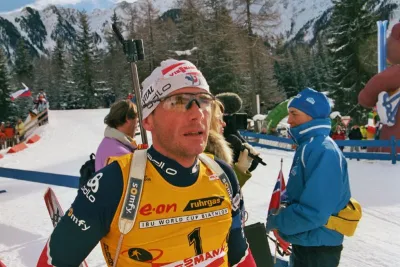
This character trait became visibly apparent in 2002, at the age of 28, when he won the silver medal in the pursuit race at the Olympic Games. This success marked his first Saturn return, a cycle in which years of often invisible groundwork condenses into a solid and recognized result. For his design, this moment was no coincidence but the natural consequence of a lifestyle that relies on structure and reliability. The Saturn return challenges and fosters the integration of discipline; it demands that one confronts their own limits and expands them through persistent action. Raphaël Poirée's design thus set a tendency towards strategic endurance, which was put to its first major test at this age and paved the way for future achievements built on a solid foundation.
Projector · Self-Projected Authority — Synthesis
A central red thread in this design is the dynamic interaction between inner perception and outer expression. The defined mental center (Ajna) allows for consistent concept formation and the recognition of patterns, while the channel of inspiration (1-8) harbors the urge to express these insights creatively and publicly. This interplay is reinforced by the profile as a networker/role model, which implies a natural tendency towards connection and sharing of knowledge. The authority in the self underscores the necessity to listen to one's inner voice to communicate authentically and make a unique contribution - a process that is additionally marked by introspective phases through the line 6 in the profile.
The central paradox lies in the tension between the desire for community (line 4 in the profile) and the need for individual reflection (line 6). This creates an inner conflict between the need to adapt and cooperate and the drive to follow one's own, independent path. The projector strategy, to wait for an invitation, intensifies this dynamic, as the decision of when and how to share inspiration depends on external factors, while the inner authority and knowledge circuit demand a strong inner voice. A notable event, a silver medal, indicates that success lies in the connection between inner clarity and outer action.
3 Defined Channels
Incarnation Cross - Right Angle Cross of the Sphinx 3
Solar Return
The Solar Return shows the moment when the sun returns to its exact birth position - your personal solar year.
Life Cycles
Discover the life cycles with a detailed triple view (birth chart, cycle chart, composite).
Human Design Profile
- Type
- Projector
- Strategy
- Wait for the respectful invitation
- Authority
- Self-Projected Authority
- Profile
- 4/6 - Opportunist / Role Model
- Definition
- Single Definition
- Incarnation Cross
- Right Angle Cross of the Sphinx 3
- Date of Birth
- 09.08.1974 21:00
- Place of Birth
- Rives, France
Frequently Asked Questions
What is Raphaël Poirée's Human Design type?
What Profile does Raphaël Poirée have?
What Authority does Raphaël Poirée have?
What is Raphael Poirée's incarnation cross?
When was Raphael Poirée born?
Discover your own Human Design
Are you also a Projector? Find out in a personal reading how to unfold your leadership qualities and recognize the right invitations.
More Personalities
Back to overviewSissy Spacek

Alain-Fournier

Aldair

Anémone

Ann-Margret

Bourvil