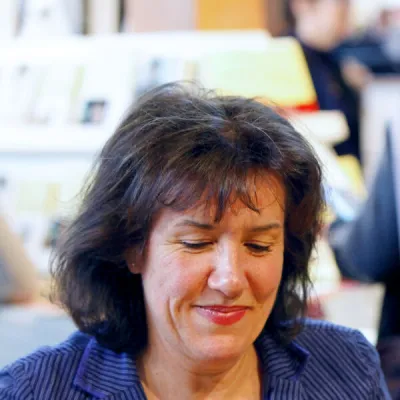
Raphaëlle Bacqué
Human Design Chart
Biography
Human Design Analysis: Raphaëlle Bacqué as Projector 5/1
Projector 5/1 — Design at a Glance
Raphaëlle Bacqué appeared through her aura like a precise focusing flashlight that immediately revealed system errors and inefficient processes. However, this immediate perception required a specific approach: Direct criticism often triggered resistance in her environment, similar to shining a bright light into someone's face. Instead, her true strength lay in illuminating by setting a harmonious example herself. When she consistently and authentically followed her own path, others were automatically drawn to her, asking for her insights.
Raphaëlle Bacqué's central strategy thus involved waiting for an honest, appreciative invitation. Only these invitations protected her energy from unnecessary friction loss and allowed her to effectively bring in her leadership skills without having to fight against the resistance of others.
Since Projectors do not have a defined Sacral Center, Raphaëlle Bacqué did not possess a constant intrinsic energy source. Her rhythm was cyclically structured: Phases of high performance and fast work alternated with necessary rest phases. These recovery times were essential to prevent burnout – a need often overlooked by linear working models.
Living according to this design, Raphaëlle Bacqué was rewarded with tangible success. However, ignoring her need for invitation and rhythm eventually led to the emergence of her non-self theme: bitterness. This emotional reaction clearly signaled that she had deviated from her own path.
Emotional Authority
Raphaëlle Bacqué demonstrated decision-making ability that did not exhaust itself in the first reaction but gained its true clarity through temporal distance. Her design suggested that spontaneous impulses were often deceptive; what appeared as an urgent necessity or deep conviction at the moment was frequently just a transient emotional coloring. This dynamic stemmed from her emotional authority, carried by the defined Solar Plexus Center. This mechanism meant that her inner truth did not lie in immediate reaction but in the cycle of ups and downs of her feelings. As each emotion is only a snapshot, she risked being guided by fleeting moods if she made quick decisions.
Therefore, it was necessary to create time and distance – the strategic 'sleeping on' important questions. This process was not a sign of hesitation but an essential filter. Through patience, she allowed the initial emotional wave to subside until the dust settled and left behind calm, clear insight. Only then, when intense feelings had subsided and emotional distance had been gained, could she recognize her true reality. This path required discipline against the inner pressure for immediate action but offered her a long-term advantage: decisions based on this composure proved stable and sustainable, free from the fluctuations of momentary mood.
The 5/1 Profile — Heretic / Investigator
Raphaëlle Bacqué exhibited a fundamental attitude of patient knowledge acquisition, coupled with almost magnetic radiance that attracts others in crisis moments. Her design suggested she developed deep understanding to offer it to others for problem-solving – similar to an expert who is exhausted after hours of consultation because they did not protect their boundaries.
This dynamic stems from the 5/1 Profile: Line 5 brings a need for sacrifice during real crises, while line 1 represents the autonomous creative process that requires patience rather than willpower. Raphaëlle Bacqué tended to use her gifts when others sought solutions. The challenge lay in not distorting this readiness through emotional instability or condescension but steering it according to her inner authority and strategy. Only so could she maintain the balance between her own research process and service for others without exhausting herself.
Split Definition — Defined & Open Centers
Raphaëlle Bacqué demonstrated a firm inner identity and emotional depth as constant traits. Her defined G Center gave her a reliable sense of direction and self-love, while the defined Solar Plexus Center guided her to make decisions only after experiencing an emotional wave. This emotional authority served as a compass: clarity did not arise in the moment but through patient waiting.
The defined Throat enabled her a consistent way of communication and manifestation in the world. She could express her truth from the sources of G Center and Solar Plexus – whether it was from her identity or feelings. The also defined Root Center provided constant pressure to move forward, which had to be channeled through her inner authority to avoid obsessive stress.
In contrast, Head, Ajna, Heart, Sacral, and Spleen were open. The open Head and Ajna Centers made her vulnerable to mental confusion or the pressure to find answers that actually belonged to others. She tended to get entangled in questions that weren't hers instead of trusting her emotional clarity. The open Heart Center lacked consistent willpower; here there was a risk of making promises or proving herself to gain value – a cycle of self-disapproval.
The open Sacral meant no continuous energy flow. She was sensitive to the generative energy of others and tended to absorb and amplify it, which could lead to exhaustion if she ignored her limits. Spontaneity in the moment was risky here; instead, it required pauses and trusting her authority to not be overwhelmed by borrowed energy.
The open Spleen Center carried a fundamental fear of survival and made her sensitive to well-being or its lack in her environment. She tended to cling to people with defined Spleens for security, even if this wasn't healthy. Spontaneous decisions from the gut were unreliable here; wisdom arose only through consciously distinguishing between her own intuition and absorbed fears.
Through the combination of firm identity (G), emotional depth (Solar Plexus), and reliable voice (Throat) while simultaneously situational access to mental inspiration, willpower, generative energy, and intuition, Raphaëlle Bacqué showed herself as someone who used her constant inner resources to navigate the fluctuating external influences of open centers.
Channel 49-19: Synthesis — Channels & Gates
Raphaëlle Bacqué was shown through a tension field between an intense drive for tribal belonging and the need for withdrawal into internal condensation. Her design laid a tendency to use relationships as emotional glue while simultaneously needing distance to truly understand experiences.
This conflict stems from two dominant channels. The Synthesis Channel 19-49 in her Personality Design acted as a strong binding factor. It connected the pressure of the Root Center with emotional waves, making Raphaëlle Bacqué finely attuned to her position within a community. This mechanism required careful scrutiny of partnerships and tribal belonging before any engagement. She sought balance between feasibility and fairness, where loyalty and protection of shared resources were central values. The emotional frequency of this channel determined who belonged to the inner group and who did not, shaping her interactions through a strong need for mutual support and clear affiliation.
Simultaneously, the juxtaposed Lost Son Channel 13-33 acted as an internal observer. It connected listening (Gate 13) with withdrawal (Gate 33). While Gate 19 sought closeness, Gate 33 demanded distance for processing. Raphaëlle Bacqué collected life stories and secrets but then withdrew to reflect on these information in deeper context. This process of patience and waiting for what lies beneath the surface stood in contrast to the immediate binding drive of the other channel. She shared her insights only when wisdom from the past was fully distilled. This mechanism created a dynamic where she oscillated between the desire for close contact and the necessity of isolated reflection to formulate authentic truths.
Tribal Circuitry — Circuit Signature
Raphaëlle Bacqué showed herself through two separate energetic strands that existed in parallel and required exchange. The first strand connected Throat Center with Identity Center in the Meaning-Making Circuit. Here it was about processing past and emotions. Energy flowed wave-like – with beginning, peak, and end – serving to gain felt insights from history to share later with others. It was a cyclical process of understanding through reflection.
The second strand connected Solar Plexus with Root Center in the Ego Circuit. This area focused on cooperation and building shared resources. Energy worked not cyclically but like a ratchet: step by step, accumulation was achieved based on clear giving and taking. As there was no connection to Sacral Center, constant life force was lacking; pauses for regeneration were therefore essential to generate new resources for the tribe.
This Split Definition meant that Raphaëlle Bacqué could not experience these two areas as a continuous flow. Emotional meaning-making and resource-oriented cooperation remained energetically separate. Her strategy lay in exchange with others to integrate and balance these isolated forces.
Left Angle Cross of Refinement 2
Raphaëlle Bacqué was characterized by a consistent focus on the essential, systematically separating what was unnecessary. Her design suggested that her strength did not lie in accumulating information or experiences but rather in the ability to refine and reduce them to their core essence. This process of inner transformation required constant scrutiny of what was authentic versus mere noise.
The Refiner 2 Left Authority precisely describes this mechanism: it is about clarity emerging when letting go of the non-essential. For Raphaëlle Bacqué, this was not a passive trait but an active life task. She had to learn to develop trust in her own essence by freeing herself from external expectations and internal constraints. The mechanics of this authority show that true authenticity often only becomes accessible through the pain of letting go. It is a path of subtraction where every decision aims at sharpening one's identity rather than diluting it. Raphaëlle Bacqué thus revealed herself as someone who sought answers in the depths of her own nature and thereby developed a clear, unadulterated presence based on this rigorous inner work.
Saturn Return · Uranus Opposition · Chiron Return · 2nd Saturn Return — Life Cycles
Raphaëlle Bacqué went through the four classical astrological cycles that serve as structural turning points in the human maturation process. These phases marked temporal anchors for her internal development and identity formation.
The first Saturn return, typically between ages 29 and 30, established her adult self-image and the associated responsibility. It functioned as a moment of structuring where the foundations of her adult existence solidified.
Around age 40, the Uranus opposition occurred. This cycle demanded liberation from outdated structures and courage for autonomy. It acted as a catalyst for a necessary identity shift that dissolved old bonds to make room for new freedom.
The Chiron return, roughly between ages 50 and 60, integrated deep experiences through wisdom. In this fulfillment cycle, meaning became experiential; it was not about healing past wounds in a mythological sense but rather the blooming of one's purpose if she had followed her strategy.
Finally, the second Saturn return between ages 58 and 60 consolidated her life work. This cycle prepared for the final phase by stabilizing the achieved maturity and integrating previous accomplishments into a coherent whole. These universal rhythms shaped Raphaëlle Bacqués path of letting go and integration.
Projector · Emotional Authority — Synthesis
Raphaëlle Bacqué seems to be marked by a deep inner logic and a need for authenticity. The combination of emotional authority, the Investigator profile, and definition in the G Center points towards someone who only reaches solid insights through thorough self-reflection and waiting for emotional clarity – and then enjoys sharing these with others. Her ability to recognize errors (Projector) is complemented by her deep engagement with experiences (Channel 13-33), generating wisdom and functioning as an advisor. The emphasis on recognizing patterns in the past and passing them forward points towards a natural role as custodian of collective knowledge.
A central tension arises through the connection between her defined G Center, which suggests a clear sense of identity, and open centers for mental clarity (Ajna) and life force (Sacral). While she has a firm inner direction, she is also receptive to external influences and conditioning. This leads to a dynamic interaction between the need for self-determination and the challenge of asserting oneself in a world often characterized by quick decisions and impulsive actions. The ability to embrace this openness while finding her own path seems a key theme of her design.
2 Defined Channels
Incarnation Cross - Left Angle Cross of Refinement 2
Solar Return
The Solar Return shows the moment when the sun returns to its exact birth position - your personal solar year.
Life Cycles
Discover the life cycles with a detailed triple view (birth chart, cycle chart, composite).
Human Design Profile
- Type
- Projector
- Strategy
- Wait for the respectful invitation
- Authority
- Emotional Authority
- Profile
- 5/1 - Heretic / Investigator
- Definition
- Split Definition
- Incarnation Cross
- Left Angle Cross of Refinement 2
- Date of Birth
- 01.02.1964 16:40
- Place of Birth
- Paris Arrondissement 14, France
Frequently Asked Questions
What is Raphaélle Bacqué's Human Design type?
What profile does Raphaélle Bacqué have in Human Design?
What authority determines Raphaélle Bacqué's decisions?
Which incarnation cross is Raphaelle Baccé assigned to?
When was Raphaelle Baccé born?
Discover your own Human Design
Are you also a Projector? Find out in a personal reading how to unfold your leadership qualities and recognize the right invitations.
More Personalities
Back to overviewSissy Spacek
Alain-Fournier
Anémone
Angeli

Ann-Margret

Bourvil