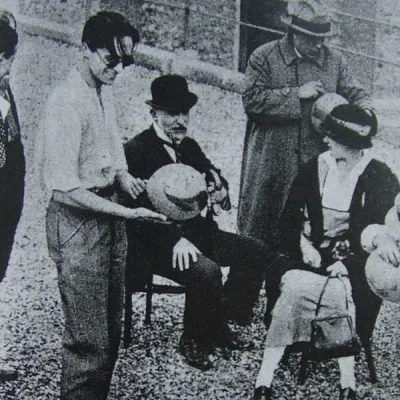
René Clair
Human Design Chart
Biography
Clair died on 15 March 1981, Neuilly-sur-Seine, France.
René Clair — Generator with Profile 1/3
Generator 1/3 — Design at a Glance
René Clairs design points to a tendency towards great endurance if he pursues tasks that resonate with him internally. As a Generator, he had plenty of sacral energy, making him seem like a strong workhorse - extremely resilient and powerful when he burns for his goals. This energy was not released through mere initiative alone but only when he responded to impulses from his environment. Therefore, the motto of his design is clear: Not initiate, but react.
His most successful strategy involved waiting for signals from life and responding to them as soon as his sacral center gave a clear “yes”. If René Clair lived in harmony with this principle, his system rewarded him with a deep sense of fulfillment and satisfaction. However, if he went against this mechanism - for example by constantly initiating himself or doing things that did not give him inner pleasure - it would eventually lead to frustration and energy loss. Two stumbling blocks shaped his dynamics: Either he wasted his strength on tasks without internal resonance, which could lead to burnout, or he was held back from his heart project even though he still had plenty of power left. His design challenged him to act from the gut and only do what gave him a real sense of response.
Sacral Authority
René Clair was a Generator whose design showed a direct connection between strategy and inner authority. This configuration fundamentally simplified his decision-making process: He did not need complex deliberation but intuitively reacted to external stimuli. His inner guidance came from the defined sacral center, the sacral authority. This manifested as a physical response - an energy surge or gut feeling like a grunt or hmm - signaling whether something piqued his interest.
When this sacral motor responded to an impulse, René Clair felt vital and alive. He then had inexhaustible energy and tackled his tasks with great enthusiasm. His design predisposed him to perform activities not out of duty but with joy and satisfaction, fully immersing himself in them.
Additionally, the active spleen center acted as a supporting authority. This gave him the ability to react particularly quickly and spontaneously. He had immediate access to his physical well-being and instinctive perception. These instincts he could rely on to guide him reliably, further reinforcing his decisions. The combination of sacral energy and spleen-induced quickness formed a lifestyle aimed at spontaneous, powerful responses in the here and now without long hesitation or intellectual over-analysis.
The 1/3 Profile — Investigator / Martyr
René Clair was someone whose life path was marked by Profile 1/3 - the Researcher and Experimentator. His basic attitude involved not just collecting knowledge theoretically but practically testing it on heart and gut. For his design, self-earned insight was the only valid measure; if he made a decision or judgment, he had previously tested this both mentally and in reality.
This configuration combined the depth of Line 1 with the experimental courage of Line 3. The first line brought patience and introspection, allowing him to carefully absorb and condense new insights. Without this depth, there was a risk of being perceived superficially. At the same time, Line 3 drove him forward through trial and error. Here it was less about consistent planning than about testing formulas and art often without immediate practical benefit in sight.
A tension field emerged in his design when the energy of Line 1 dominated: Then fear could arise of moving from theory to implementation because he felt he did not know enough yet. But his design challenged him to overcome this inhibition and open himself up to the experimental process. Mistakes were essential steps in the learning process, not failures. His authority rested on others trusting his judgment, which was based on a solid foundation of theoretical understanding and practical experience.
Split Definition — Defined & Open Centers
René Clairs Human-Design profile established a tendency towards constant mental clarity and vital endurance. His defined Ajna Center ensured a continuous, trustworthy thought process; concepts emerged from him in the same way regardless of external influences. This mental structure flowed directly into his defined Throat Center, allowing him to reliably express and manifest what he thought. His voice was the anchor point for this transformation from idea to action.
As a Generator with a defined Sacral Center, René Clair possessed an enormous source of vitality. However, this energy was only fully available when he responded to questions rather than initiating himself. His mantra was: “Do not initiate.” By waiting and giving the sacral answer (“Hmm” or “Yes”), he secured satisfaction while avoiding frustration. Simultaneously, his defined Spleen Center acted as an intuitive instance in the present moment, making spontaneous judgments about health and well-being without needing rational justification.
At the same time, René Clair was exposed to several open centers of conditioning. His open Head Center made him vulnerable to mental pressure; he tended to engage with others' questions or seek inspiration to resolve confusion rather than trusting his inner authority. His open G Center meant a lack of fixed identity; he often adapted himself to his environment and sought the right direction through where he was, instead of asserting it himself.
His open Heart Center drove him to prove his worth through promises or competitive behavior, which could lead into a cycle of self-doubt if these were not kept. Additionally, his open Solar Plexus absorbed others' emotions, putting him at risk of personalizing foreign moods as his own instability and avoiding confrontation. Finally, his open Root Center took on external stress, causing him to rush unnecessarily or become hyperactive in order to escape this pressure rather than simply recognizing it as not his own.
Channels for spontaneous insight and individual power.
René Clairs Human-Design profile established a basic attitude based on spontaneous insights that he translated into clearly structured concepts. This ability was shown through the Channel of Structuring 43-23: The Gate of Insight (43) received inspired knowledge as sudden breakthroughs, while the Gate of Assimilation (23) processed and expressed these information. This process required patience; his innovative perspectives could only then foster efficiency and reach others when communicated at the right time. Without this timing, René Clair risked being misunderstood or rejected since his thinking was often years ahead. His task was to let go of control and allow his mind to digest knowledge in its own pace before sharing it.
Simultaneously, the Channel of Power 34-57 acted as a fundamental survival instinct. It connected the Gate of Intuitive Insight (57) in the Spleen Center with the Gate of Power (34) in the Sacral Center. This configuration gave René Clair sharp intuitive awareness towards his environment, allowing him to respond instantly to dangers or disturbances and thus protect his vitality. This energy was purely individually oriented and served self-preservation independent of others' needs. Through this connection, he remained physically fit and attentive, relying on spontaneous sacral reactions rather than mental planning.
Additionally, further Gates shaped his profile: The Gate of Formulation (4) helped him recognize logical patterns and create future security through clear formulas. The Gate of Revolution (49) challenged him to respect principles within family and tribe while Gate 31 steered the transmission of power in the collective. The Gate of Reflex Protection (50) preserved traditional values, and the Gate of Rhythm (5) underscored the necessity of following fixed routines to build energy. In his subconscious, Gates 47 for finding meaning from the past and 18 discriminating between necessary corrections were active. Gate 45 summed up tribal energy while Gate 14 promoted skillful power handling. Gate 12 brought poetic restraint, and Gate 35 sought change through new experiences.
Individual Circuitry — Circuit Signature
René Clairs Human-Design profile established a tendency towards structured individual expression. His Knowledge Circuit connected his Ajna with his Throat Center via the Channel of Structuring (Gates 43 and 23). This created a direct line from mental planning to spoken or written expression. René Clair was someone who translated inner concepts into concrete, understandable forms. The mechanics of this channel emphasized the ability to organize complex thoughts and carry them outward through the Throat Center. It wasn't just about inspiration but disciplined implementation of ideas in words or actions.
Simultaneously, there existed a separate energetic power: His Integration Circuit connected his Sacral with his Spleen Center via the Channel of Power (Gates 34 and 57). As René Clair had a Split Definition, these two circuits were not directly connected. They worked as two independent systems. The first area ensured clear expression and mental structuring. The second area, the connection between Sacral and Spleen Center, provided life-sustaining energy and intuitive knowledge for self-affirmation. Here it was about drawing power from reacting to life and using intuitive judgment in the present moment. These separate streams shaped René Clairs experiential world: on one hand, a clear, structured expression of his identity; on the other hand, an inner intuitive resource for navigating daily life. Both areas functioned alongside each other without directly merging into a common flow.
Right Angle Cross of Explanation 4
René Clairs design carried the signature of the right cross of the Declaration, a configuration aligned with uncovering and clarifying misunderstandings or hidden connections. His inner drive was to eliminate confusion and bring clarity to complex situations. This did not happen through aggressive enforcement but rather through a precise, often analytical approach to information.
This structure implies a natural ability to distinguish between what is essential and what is peripheral. René Clair worked as someone destined to shed light on dark corners and present things in a way that made them understandable for others. The energy of this cross promoted a process of decryption: What initially appeared unclear or contradictory became accessible through his perspective.
It was a passive yet effective presence, waiting for questions to arise so it could provide clarifying answers. His role was to serve as a catalyst for understanding by revealing the underlying logic of phenomena or situations. This created space for insight and reduced conflicts arising from misinterpretations. René Clair lived this dynamic by contributing to making visible connections that had previously been hidden. His presence thus fostered an atmosphere of transparency and clear thinking in his environment.
Saturn Return · Uranus Opposition · Chiron Return · 2nd Saturn Return — Life Cycles
René Clair's design showed a tendency towards structural condensation during phases of increased responsibility. The first Saturn return often marked a point where years of groundwork coalesced into solid results. In 1926, at the age of 28, René Clair married actress Bronja Perlmutter – an event reflecting this mechanical consolidation on the relationship level.
Later came the Chiron return, a fulfillment cycle between the ages of 49 and 51. During this phase, one's personal cross unfolds increasingly in life; meaning and purpose become experiential if the person has lived according to their strategy and authority. This is not about healing old wounds but rather a bloom time for one’s destiny. In 1946, at age 48, René Clair returned to France and directed "Silence Is Golden." This step fell into the prelude of this cycle and signaled an approach to this phase of profound unfolding.
The second Saturn return then confirmed long-term stability in his work. In 1955, at the age of 57, René Clair directed his first colour film, "The Manoeuvre," for which he received the Louis-Delluc Prize. This success underscored how his design could unfold its impact through clear structures and recognized achievements in later years. The sequence of these cycles illustrated a path from personal commitment over professional reorientation to public recognition.
Generator · Sacral Authority — Synthesis
René Clair was a Generator whose life was marked by an unstoppable urge to experience and process those experiences. His sacral authority (and the associated energy) required constant external stimuli to reach a vital state—a force he nourished through trying new paths (Profile 1/3) and deeply penetrating concepts (defined Ajna Center). This process of learning, testing, and structuring (Channel of Definition) led to a unique perspective that he shared through creative expression. The repeated recognitions for his work (recorded events in the cycles) confirmed this inner drive towards transformation and reinforcement.
A central paradox lay in the combination of the need for constant stimulation and the ability to develop profound concepts. While sacral energy craved new experiences, the defined Ajna Center allowed for a consistent, specific way of thinking. This led to a tension between experimenting (Line 3) and the need to thoroughly test insights (Line 1), which manifested in a pulsating interplay of creativity and melancholy—an expression of individuality within the knowledge circuit.
2 Defined Channels
Incarnation Cross - Right Angle Cross of Explanation 4
Solar Return
The Solar Return shows the moment when the sun returns to its exact birth position - your personal solar year.
Life Cycles
Discover the life cycles with a detailed triple view (birth chart, cycle chart, composite).
Human Design Profile
- Type
- Generator
- Strategy
- To respond - wait for something to respond to
- Authority
- Sacral Authority
- Profile
- 1/3 - Investigator / Martyr
- Definition
- Split Definition
- Incarnation Cross
- Right Angle Cross of Explanation 4
- Date of Birth
- 11.11.1898 14:00
- Place of Birth
- Paris, France
Frequently Asked Questions
What was René Clair's Human Design type?
What Profile did René Clair have?
What Authority did René Clair have?
What incarnation cross did René Clair have?
When was René Clair born?
Discover your own Human Design
Are you also a Generator? Find out in a personal reading how to use your sacral energy correctly and discover deep satisfaction.
More Personalities
Back to overviewAaliyah

Alexia

Angèle

Anne-Marie

Arcángel

Arno