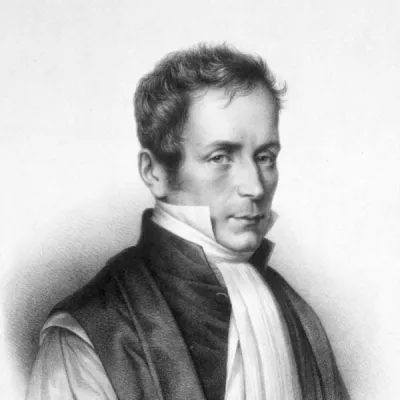
René Laennec
Human Design Chart
Biography
He became a lecturer at the Collège de France in 1822 and professor of medicine in 1823. His final appointments were that of head of the medical clinic at the Hôpital de la Charité and professor at the Collège de France. He went into a coma and subsequently died of tuberculosis on 13 August 1826, at age 45.
Human Design Analysis: René Laennec as Manifesting Generator 5/1
Manifesting Generator 5/1 — Design at a Glance
René Laennec revealed himself as someone marked by a hybrid energy configuration. As a Manifesting Generator, he had a constant sacral energy source that gave him deep inner knowledge about his life direction. At the same time, he possessed the ability to skip steps and quickly draw things into his life. This speed, however, was a double-edged sword. Often, he was too quick and skipped important stages, leading to the need to return later and make up for missed steps. Such setbacks could quickly lead to frustration as they touched on his non-self theme. Additionally, he tended to pursue multiple things simultaneously, driven by various impulses. Without strict adherence to his strategy—reacting to life and only acting when the sacral center agreed—his creative drive easily tipped into overextension. However, when he learned to regularly check his projects for inner approval, he found deep satisfaction. Then, it was no problem for him to work on different tasks in parallel. On the contrary: the compulsion to finish one thing before starting the next hindered his access to his true creative power. His design promoted a playful mode where variety and fun were the driving forces.
Emotional Authority
René Laennecs design showed a tendency towards emotional wave movement. His inner authority was the Emotional Authority, carried by the defined Emotional Center. In Human Design mechanics, this authority always takes precedence over all other defined centers, regardless of further configurations in the chart. This meant that his perception and decision-making were marked by constant emotional fluctuations. His feelings did not form a static truth but a fleeting snapshot. Spontaneous judgments based on a current high or low often proved misleading. The mechanics therefore required patience: decisions had to mature, often over several nights. Only when the initial emotional intensity subsided did clarity emerge. This process of “slumbering” was no obstacle but the essential path to inner calm and true insight. René Laennec thus showed himself as someone who did not react to the first impulse but waited for the calm that followed the emotional storm. This strategy protected him from wrong decisions that would arise from fleeting enthusiasm or despair. The need to take time and ask himself repeatedly was not a sign of weakness but the specific function of his defined Emotional Center as authority.
The 5/1 Profile — Heretic / Investigator
René Laennecs design inclined towards deep, isolated research that he later provided as practical solutions for others. As a 5/1er, the Hero and Researcher, he lived with the inner tension field between the need for withdrawal to learn and the magnetic attraction that drew others to him to find answers. This configuration described a life task: uncovering hidden connections and passing them on to others.
His energy was shaped by specific themes. The fifth line of Gate 30 addressed irony and realism in expectations. The transience of goals was recognized, yet practical solutions were offered to still make progress. This supported trust in the process of progress, even when setbacks occurred. At the same time, the first line of Gate 34 carried the aspect of indiscriminate power as a survival mechanism. This energy served to protect himself by the show of strength and intimidate others in emergencies, not out of principle but for defense.
For René Laennec, the challenge was to set clear boundaries. Without this balance, he risked being drained by the constant demand for solutions, similar to an expert who is exhausted after intensive knowledge transfer. His design showed that he had to learn to also say no, to maintain the beneficial balance between his own research and problem-solving for others. This way, he could optimally use his gifts without exhausting himself.
Split Definition — Defined & Open Centers
René Laennec's design inclines towards clear, willful communication stemming from a deep inner identity and a reliable energy source. His defined G Center grants him a firm self-identity and the feeling of being lovable, helping him to love others without becoming dependent. This inner security flows into his defined Heart Center, giving him willpower and the ability to keep promises and seek recognition for his work. He tends to determine his life himself and use resources wisely, trusting his own ego to influence situations.
His energy is generated by his defined Sacral Center, giving him constant vitality. He relies on reacting to questions rather than initiating to avoid overstepping his energy boundaries. This reactive nature connects with his defined Throat Center, serving as a pivot to translate messages from the heart and sacral energy into the world. His voice thus expresses his truth and will, clearly and honestly, as long as he follows his strategy.
At the same time, René Laennec is evident in areas where his design is open. His open Head Center makes him vulnerable to mental pressure and confusion when trying to find answers that do not belong to him. He tends to question whether he must find inspiring answers, which can distract him from his correct decision-making process. Similarly, his open Ajna Center leads him to absorb concepts and ideas from the environment without identifying them as his own truth. This allows him to think flexibly but requires patience to avoid showing certainty about things he does not truly understand. By trusting his defined centers, he can use these open areas as mirrors rather than being overwhelmed by them.
Channels for intuitive power, charisma and deep recognition.
René Laennec revealed himself as someone who reacted to his environment through a deep, instinctive perception and connected these insights with a powerful, manifesting energy. His design tended to immediately transform intuitive impulses into concrete actions, often being self-absorbed in his activities and only sparingly available to others. This stance stemmed from the connection of Survival Intelligence and Generative Life Force.
The Power Channel 34-57 linked Gate 34 of the Sacral Center with Gate 57 of the Spleen Center. This configuration created an archetype of individualized survival: Laennec was constantly attuned to vibrations and dangers in his environment, reacting spontaneously and quickly to secure his well-being. His attention was selective; he listened with the "right ear" to grasp the truth behind words and acted from a pure, unconditioned reaction that kept him vital and independent.
This intuitive foundation flowed directly into his ability to express himself. The Brainwave Channel 57-20 channeled insight from the Spleen (Gate 57) directly to the Throat Center (Gate 20), the Gate of Now. Laennec possessed the ability to think in the moment and verbally express his spontaneous truth before others understood it. This was not planned communication, but a wave-like discharge of knowledge that encouraged others to activate their own inner intelligence.
Simultaneously, the Charisma Channel 34-20 propelled him. Here, the raw, physiological energy of the Sacral Center (Gate 34) met the Gate of Now (20) in the Throat Center. This generated a strong urge to manifest through reaction. Laennec could hardly remain still; his energy had to discharge in the here and now, leading to impressive achievements but also to being distracted by busyness when he did not heed his inner guidance.
Another element was the Beat Channel 14-2, which connected the Sacral Center (Gate 14, skilled handling of power/resources) with the G Center (Gate 2, higher knowledge). This gave him the ability to recognize innovative directions and support them through material resources. He was a key holder who, through honest living and trust in his own reaction, encouraged others in their development without having to actively lead them.
Additionally, the Channel of Devotion 44-26, linking the Spleen (Gate 44, vigilance) with the Heart (Gate 26, ego/willpower), gave him a sense of what the tribe or collective needed and the ability to "sell" or promote it convincingly, often as an entrepreneur or promoter who generated resources.
The Channel of Recognition 30-41 connected the Root (Gate 41, limitation/desire) with the Solar Plexus (Gate 30, emotional recognition). This generated a strong drive for new experiences, driven by restlessness and emotional anticipation. Laennec sought the completion of cycles, learning to enjoy his desires without succumbing to the pressure of immediate fulfillment.
Individual Gates like Gate 29 (Yes-Saying, Persistence) and Gate 27 (Care) underscored his ability to receive rewards through correct reaction and care for the tribe, while Gates like 1 (Uniqueness) and 48 (Pattern Recognition) complemented his creative and analytical depth.
Individual Circuitry — Circuit Signature
René Laennec appeared as a person whose design featured two separate energetic streams that did not communicate directly with each other. The first stream connected the Heart, Identity, Throat, Spleen, and Sacral Centers. Here, the Knowledge Circuit was at work: René Laennec possessed Channel 20-57 (Lightning Strike), which channeled creative impulses directly from the Spleen to the Throat Zone, as well as Channel 2-14 (The Beat), which brought rhythmic patterns from the Spleen into the Identity. Parallel to this, the Integration Circuit connected Throat, Sacral, and Spleen Centers via Channels 20-34 (Charisma) and 34-57 (Power). This gave him the ability to channel intuitive reactions from the Spleen through the Sacral Center and express them acoustically in the Now. Additionally, the Ego Circuit connected Heart and Spleen Centers via Channel 26-44 (Devotion), fostering a cooperative, resource-oriented attitude, though without a direct connection to the constant life force of the Sacral Center within this specific channel.
The second, completely isolated stream included the Solar Plexus and Root Centers. Here, the Meaning Circuit worked through Channel 30-41 (Recognition). This connection generated a cyclical emotional wave that allowed René Laennec to reflect on past experiences and recognize their meaning before emotionally processing them. Since these two groups were energetically separate, these abilities existed as parallel, non-integrated forces: on one hand, the innovative, rhythmic, and cooperative expressive ability in the first stream, and on the other hand, the profound, cyclical emotional reflection in the second stream.
Left Angle Cross of Industry 1
René Laennecs design indicated a tendency towards persistent, goal-oriented striving. This configuration, the left cross of diligence 1, described a life task characterized by consistent effort and endurance. It was not about spontaneous impulses, but rather a deep, inner driving force that motivated him to pursue tasks with perseverance, even if the path was rocky. This energy shaped his way of delving into challenges and not giving up prematurely, but working until the end. The structure of this cross linked various aspects of his character into a coherent pattern of dedication and sense of duty. It showed him as someone who valued solid foundations and was willing to put in the necessary effort to achieve results that would stand the test of time. This inner discipline formed the foundation upon which he pursued his goals without being easily distracted by external circumstances. His path was marked by the need to continuously commit and take responsibility for progress, which gave him a certain stability and reliability.
Saturn Return · Uranus Opposition — Life Cycles
René Laennec showed a fundamental disposition marked by inner stability and a deep, often unspoken perception of his surroundings. His design indicated a tendency to influence not through external dominance, but through a quiet, enduring presence. This orientation promoted the ability to penetrate complex relationships without falling into hasty actions.
In 1822, at the age of 41, he became a professor at the Collège de France. This event marked a turning point in his design, corresponding to the Uranus opposition. During this phase, often seen as a time of maturation and re-evaluation of earlier structures, a new quality entered his life. The Uranus opposition signaled a period in which old patterns dissolved and space was created for a deeper, more authentic expression. For René Laennec, this meant that his inner authority and knowledge now found a public platform. He did not use this position for self-promotion, but to convey his insights in a way that was based on his deep inner conviction. His appointment as a professor was thus not just a career step, but an external confirmation of an inner development that allowed him to translate his specific way of perceiving and understanding into a structured teaching. This underscores how his design was geared towards not just accumulating knowledge, but conveying it sustainably in a mature stage of life experience.
Manifesting Generator · Emotional Authority — Synthesis
He was a being who lived deeply in the connection between action and reaction. The defined sacral energy (Sacral Center) provided a constant life force, but was not linearly exploited by the Manifestor component (Manifesting Generator). Instead, he could react swiftly to opportunities and set things in motion, with the channel of the beat (Gate 14/2) giving a special talent for using energy and directing movement. This ability to react to impulses and simultaneously set a direction shaped his approach of always exploring new paths and transforming existing knowledge (Knowledge Circuit).
A central tension field lay in the combination of emotional authority and the drive to share knowledge (Profile Hero/Researcher). The emotional wave (Emotional Center) required time for decision-making and weighing different perspectives, while the line 5 in the profile exerted a nearly magnetic pull on others seeking his expertise. This dynamic led to an inner tension between the need for mature deliberation and the desire to make his knowledge fruitful - a give-and-take that was intensified by the melancholy of the Knowledge Circuit.
6 Defined Channels
Incarnation Cross - Left Angle Cross of Industry 1
Solar Return
The Solar Return shows the moment when the sun returns to its exact birth position - your personal solar year.
Life Cycles
Discover the life cycles with a detailed triple view (birth chart, cycle chart, composite).
Human Design Profile
- Strategy
- To respond - wait for something to respond to
- Authority
- Emotional Authority
- Profile
- 5/1 - Heretic / Investigator
- Definition
- Split Definition
- Incarnation Cross
- Left Angle Cross of Industry 1
- Date of Birth
- 17.02.1781 06:00
- Place of Birth
- Quimper, France
Frequently Asked Questions
What was René Laennec's Human Design type?
What profile did René Laennec have in Human Design?
Which authority guided René Laennec?
What incarnation cross characterized René Laennec?
When was René Laennec born?
Discover your own Human Design
Are you also a Manifesting Generator? Find out in a personal reading how to unfold your multi-talents and direct your energy wisely.
More Personalities
Back to overviewAldair

Alizée

Angeli

Arletty
Artus
Balthus