
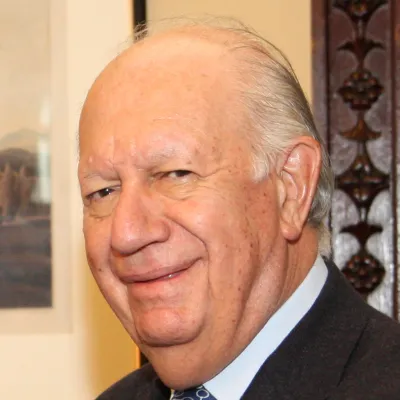
Ricardo Lagos
Human Design Chart
Biography
Since May 2007 he has served as a Special Envoy on Climate Change for the United Nations Secretary-General Ban Ki-moon. He teaches political and economic development at Brown University in the United States.
The Human Design of Ricardo Lagos: Manifesting Generator 6/2
Manifesting Generator 6/2 — Design at a Glance
Ricardo Lagos exhibited a dynamic that relied on hybrid energy sources: the constant availability of sacral power, paired with the ability to accelerate processes. His design suggested that he did not act purely through initiative but was dependent on reacting to external impulses. Only this reaction activated his energy efficiently.
As an Manifesting Generator, he possessed the mechanical ability to skip steps and achieve results at lightning speed. However, this speed offered a double-edged sword. If he moved too quickly or skipped important stages, he often had to backtrack to fill gaps – a process that could cause frustration as it went against his inner nature.
Moreover, his system tended to pursue multiple tasks simultaneously rather than focusing linearly on one thing at a time. This multitasking ability was sustainable only when his internal authority and the strategy of reacting were always in agreement. Without this internal consent, his creative power quickly tipped into exhaustion.
Deep satisfaction arose for him from a „play mode“. As long as he responded to impulses that his sacral center confirmed with a clear „yes“, he could work on various projects simultaneously without being blocked. The variety was not an obstacle but the key to maintaining his energy and joy in creating.
Emotional Authority
Ricardo Lagos demonstrated an internal decision-making structure that required time and emotional distance as indispensable prerequisites for clarity. His design indicated that spontaneous reactions or immediate judgments were often misleading, as they could be influenced by fleeting mood swings. This tendency resulted from his emotional authority: As the Emotional Center is defined, he was subject to a natural wave movement of feelings. The world appeared to him in shades of positive and negative light depending on the current wave – a snapshot that did not yet represent his deeper truth.
For Ricardo Lagos, it was therefore crucial not to accept these emotional impulses as final values. Quick decisions based on the current mood risked resting on unstable foundations. Instead, his design worked such that he found calmness through patience and conscious waiting – often by sleeping on dilemmas multiple times. Over time, the initial strong feelings subsided, leading to a clear, rational distance. This process was particularly central for long-term, life-defining questions: Only after the emotional wave had receded could he recognize his true, stable insight and act free from the distortion of the moment.
The 6/2 Profile — Role Model / Hermit
Ricardo Lagos was marked by a design that divided his life path into two clear phases: an early period of active experimentation and a later phase of deep reflection. In his youth, before the age of 30, the energy of his Profile Line 3 dominated. This fostered a stance of trial and error, in which he gathered diverse experiences and learned through his own mistakes. This experimental nature served to build a broad spectrum of life knowledge that would later serve as a foundation.
Around thirty years old, the energy of Line 6 was activated, marked by the first Saturn Return. This transition led to a metaphorical retreat into a „cave“, a time of intense distancing and self-reflection. Here he processed his earlier experiments, transformed them into wisdom, and healed past patterns. This introspective phase was crucial for developing his inner calmness, supported by the energy of Gate 5, which emphasizes self-control and maintaining a steady rhythm.
Emerging from this reflective phase, he eventually emerged as a reflected role model. The wisdom he gained in isolation became accessible to others. His ability for deep introspection served as a guide for others to find their own meaning. Through the combination of Gate 37, which highlights purposefulness and transition into the collective, he could convey his personal insights in a way that helped people recognize their own life purpose. Thus, his path was one of transformation from an exploring experimenter to a wisdom-transmitting natural talent.
Split Definition — Defined & Open Centers
Ricardo Lagos was characterized by a massive, constant presence of willpower, identity, and vital life force. His design featured four defined engines – Sacral, Heart, G Center, and Solar Plexus – along with a defined Throat Center. This architecture generated immense inner substance: The G Center provided unwavering direction and the feeling of lovability, while the Heart Center supplied willpower and resource control. The Sacral energy offered vital endurance, and the Solar Plexus emotional depth as authority. All converged in the throat, allowing these energies to reliably manifest as communication and action.
The challenge lay in balancing this definitive inner authority (Solar Plexus emotions plus G direction) with the drive for immediate implementation through Heart and Sacral. It was necessary to wait for the emotional wave before setting out the enormous willpower and vitality into the world.
At the same time, Head, Ajna, Spleen, and Root were open. These centers acted as mirrors for environmental impulses: mental inspiration or confusion (Head/Ajna), intuitive health signals (Spleen) and external stress (Root). Ricardo Lagos tended to wonder whether he had to find inspiring answers or felt pressure to quickly complete tasks to get rid of adrenalized stress. These open centers made him vulnerable to conditioning by others; he needed to learn not to take mental questions and external pressures as his own truth but to trust his inner authority to maintain clarity.
Channel 20-34: Charisma — Channels & Gates
Ricardo Lagos was someone who inspired others through consistent self-love and authentic behavior ("I am"). This attitude stemmed from the Awakening Channel 10-20, which connects the G Center with the Throat Center: It expresses the wisdom that one must accept oneself to act as a living example in the here and now.
This individual leadership was deepened by the Exploration Channel 34-10. It links the Sacral Center with the G Center and provides inner strength (Gate 34) to hold onto personal convictions while Gate 10 initiates behavior. This requires patience on sacral reactions, not appearing self-centered but guiding others towards self-love through one's own confirmation.
The charismatic presence arose from the Charisma Channel 34-20. As a connection between Sacral and Throat Centers, it is the classic energy of the Manifesting Generator: The urge to act is guided by sacral reactions. Without this inner guidance, the energy can become chaotic; with it, a powerful, inspiring presence emerges that naturally attracts others without draining them.
Additionally, gates like 5 (Rhythm) and 9 (Detail Work) promoted waiting for the right moment and perfecting patterns. Gate 35 brought change through interaction while Gate 22 created openness for social mutations. The combination of these energies shaped a person who did not live their independence in isolation but as a radiant center of self-determination, reinforcing others' individuality simply by being present and reacting correctly.
Individual Circuitry — Circuit Signature
Ricardo Lagos exhibited a fundamental attitude that oscillated between personal firmness and social cooperation. His design contained two separate energetic blocks: one for the Self and one for the Community.
In the individual realm, the Centering Circuit connected Identity and Sacral Centers through the Exploration Channel. This created an inner, pulsating power source for courage and steadfast convictions. Parallel to this, the Integration Circuit linked Throat, Sacral, and Identity Centers (Channels "Awakening" and "Charisma"). Here it was about intuitively guiding life energy into the present moment to secure one's survival through correct reaction. These two circuits formed a closed unit of individuality that did not have direct connection to the emotional or heart-shaped area.
Completely separate from this, the Ego Circuit existed. It connected Heart and Solar Plexus Centers via the Community Channel. Driven by Sun Gate 37, this was not an individual expression but timeless, traditional mechanics of giving and taking. It was about mutual support and resource building in a social context. Since this block was separated from the Sacral Center, this social energy required mandatory pauses for regeneration.
Thus, Ricardo Lagos carried two parallel realities: an intense, self-determined inner world (Centering/Integration) and a cooperative, resource-oriented outer world (Ego). The challenge lay in integrating these divided definitions – uniting personal strength with the necessity of social pauses and communal responsibility without one block overwhelming the other.
Left Angle Cross of Migration 1
Ricardo Lagos demonstrated a fundamental attitude of consistent perseverance that did not aim for quick results but rather focused on continuing the chosen path despite resistance or monotony. This energy source in Human Design is the left cross of 1, often referred to as the Perseverance Cross. It defines a life strategy characterized by steady progress. The core of this mechanism lies in the ability to not give up even when progress seems slow or no immediate reward is evident.
It is an energy of 'continuing', less marked by explosive dynamism and more by inner discipline and persistence. Ricardo Lagos' design suggested that his effectiveness lay in not stopping but consistently maintaining course. This perseverance is not about actively forcing goals, but rather a passive yet persistent presence in the process. It requires the will to maintain direction even during phases of boredom or uncertainty. The strength of this cross unfolds over time and repetition by showing that consistent progress often proves more effective than quick but unstable impulses. Ricardo Lagos' energy followed this pattern of persistent advancement.
Saturn Return · Uranus Opposition · Chiron Return · 2nd Saturn Return — Life Cycles
Ricardo Lagos’ design shows a structure primarily characterized by cyclical maturation phases. Without specifically defined centers or channels in the raw content, no individual strategy can be derived; instead, a pattern of recurring life stages emerges that aims at inner order and adaptability.
The first Saturn return often marks the transition from an experimental phase to consolidation. For Ricardo Lagos, this means a time when earlier impulses were transformed into stable structures. The Uranus opposition follows as a phase of letting go and realignment, where old bonds are dissolved to make way for new developments. This alternation between structuring and liberation characterizes the dynamics of his design.
The Chiron return represents a peak: a fulfillment cycle in which one's incarnation cross unfolds. Here meaning is experienced when living according to one’s own strategy. It is not about healing in the traditional sense, but about realizing one’s personal purpose. The second Saturn return completes this process by confirming and anchoring the achieved maturity sustainably.
Ricardo Lagos’ design thus reflects a path marked by clear phases: building up, changing, fulfilling, and affirming. This sequence offers an inner logic that promotes both stability and growth.
Manifesting Generator · Emotional Authority — Synthesis
A central red thread in this design is the dynamic connection between inner perception and outer expression. The defined Sacral Center (and the associated Centering Circuit) provides a constant, deeply rooted energy source that is channeled through the active Throat Center (Channel Awakening). This combination points to someone whose actions arise from a strong internal drive but do not discharge in impulsive steps, instead maturing through emotional waves and an intense phase of reflection. The 6/2 line further strengthens this process by initially gathering experience and later developing wisdom that can then be shared – a cycle of doing, retreating, and sharing.
The central paradox lies in the tension between the impulsive potential of a Manifesting Generator and the necessity of emotional clarity. The ability to quickly initiate things (Gate 20) contrasts with inner authority that requires time to digest decisions. This creates a field of tension between the desire for immediate action and the realization that true power lies in the patient maturation of ideas – a search for authentic expression within an emotional landscape.
4 Defined Channels
Incarnation Cross - Left Angle Cross of Migration 1
Solar Return
The Solar Return shows the moment when the sun returns to its exact birth position - your personal solar year.
Life Cycles
Discover the life cycles with a detailed triple view (birth chart, cycle chart, composite).
Human Design Profile
- Strategy
- To respond - wait for something to respond to
- Authority
- Emotional Authority
- Profile
- 6/2 - Role Model / Hermit
- Definition
- Split Definition
- Incarnation Cross
- Left Angle Cross of Migration 1
- Date of Birth
- 02.03.1938 06:10
- Place of Birth
- Santiago, Chile
Frequently Asked Questions
What is Ricardo Lagos' Human Design type?
What Profile does Ricardo Lagos have in Human Design?
Which Authority guides Ricardo Lagos' decisions?
Which incarnation cross is active for Ricardo Lagos?
When was Ricardo Lagos born?
Discover your own Human Design
Are you also a Manifesting Generator? Find out in a personal reading how to unfold your multi-talents and direct your energy wisely.
More Personalities
Back to overviewAldair

Alizée

Angeli

Arletty

Artus

Balthus
