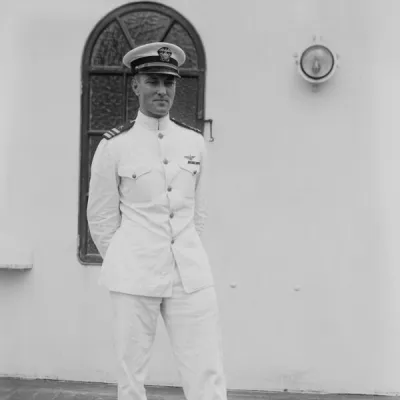
Richard E. Byrd
Human Design Chart
Biography
He died on 11 March 1957 in Boston, Massachusetts.
Researchers of Byrd's newly discovered flight diary, discovered in January 1996, say that he actually flew short of his goal and knew it at the time. Where he actually saw the pole from his plane, his diary disproves his claim that he reached it, and they may have turned back some 150 miles short. Byrd's disqualification would hand the title of "first person to reach the North Pole" to Roald Amundsen, the Norwegian explorer who travelled over the pole in a dirigible three days after Byrd's air expedition, arriving there on 12 May 1926.
The Human Design of Richard E. Byrd: Manifesting Generator 1/3
Manifesting Generator 1/3 — Design at a Glance
Richard E. Byrd showed himself to be someone who could quickly draw things into his life. As an Manifesting Generator, he combined the constant sacral energy of a Generator with the initiating qualities of a Manifestor. This hybrid configuration allowed him to skip steps and push projects forward with great speed. However, this quickness carries specific risks: Often, important stages were overlooked, leading to him having to return later and make up for missed steps. Such setbacks could quickly lead to frustration, as they touched on his non-self theme. Additionally, he tended to start several things at once by reacting to various impulses. If strategy and inner authority were not in alignment, his joy of creation quickly turned into dissatisfaction. To use his energy effectively, it was advisable for him to first react to life and then act only when his sacral center gave a clear "yes." With the correct application of this strategy, he drew deep satisfaction from his creations. Working on multiple projects simultaneously was then no obstacle for him, but rather a source of variety and fun. He fell into a play mode that sustained his creative power as long as he did not feel the pressure to complete one thing before starting the next.
Sacral Authority
Richard E. Byrd was a Generator whose decision-making was characterized by Sacral Authority. With his Emotional Center open, this inner guidance could manifest. It did not appear as intellectual analysis but rather as a physical reaction to external stimuli. Richard E. Byrd learned to pay attention to his "gut feeling." This manifested in sounds like grunts, hums, or a confirming "mm-hmm." Such signals marked the moment when his Sacral Motor engaged. Then he felt vital and alive. An apparently inexhaustible energy was at his disposal. He tackled his tasks with great enthusiasm. His design suggested moving through life with joy and contentment. He immersed himself in his activities without a strict utilitarian focus being paramount. The Generator strategy of reacting aligned completely with his authority here, greatly simplifying his process. Additionally, the active Spleen Center served as a supportive force. It gave him the ability to act particularly quickly and spontaneously. Richard E. Byrd had direct access to his physical well-being. His instinctive perception was reliable. He allowed himself to be guided by it, enabling him to make decisions in an instant, based on this deep, bodily knowledge.
The 1/3 Profile — Investigator / Martyr
Richard E. Byrd was characterized by a fundamental approach that combined theoretical thoroughness with practical enthusiasm for experimentation. As a person with the Profile of the Researcher and Experimenter (1/3), he was driven by the urge to not just passively consume knowledge but to actively test it through trial and error. His Line 1 demanded careful preparation and a detailed assessment of risks and opportunities before taking on risks. This phase of planning and intuition served to avoid unrealistic expectations and ensure the feasibility of ideas.
At the same time, the energy of his Line 3 required experiments and learning from mistakes. There were moments when fear of insufficient knowledge delayed implementation, yet his design ultimately demanded practical testing. Particularly noteworthy was his ability to lead through discernment. Instead of seeking mass appeal, he valued the quality of his followers and chose influences with care. When he made a decision or evaluated a method as good, he had previously tested it both theoretically and practically. His judgment was thus based on proven experience, which gave him high credibility. He acted only when preparation was complete, and he drew new insights from every practical experience for future endeavors.
Single Definition — Defined & Open Centers
Richard E. Byrd revealed himself as a person with a clear inner orientation and a consistent way of expressing himself. His defined G Center gave him a reliable sense of self-identity and a sense of direction; he knew where he stood and could show others new paths without being dependent on them. This inner security flowed into his defined Throat Center, which served as a pivot point to translate messages from the entire design into clear communication and action. His voice spoke not from impulsivity, but from this deep, identity-forming source, giving him an honest and direct way of speaking and acting.
As a Generator with a defined Sacral Center, Byrd had an enormous source of vital energy. His design required him to react to questions or situations rather than initiate them to correctly use this power. Through his defined Spleen Center, he was also dependent on his spontaneous intuition and body instincts to act in the moment and protect his well-being. The defined Root Center provided the necessary pressure to advance in material life and master existential challenges.
In contrast, his Head, Ajna, Heart, and Solar Plexus Centers were open. This meant that he did not have a consistent mental inspiration or willpower. He tended to absorb mental pressure waves or the emotions of the environment without identifying them as his own. Instead of trying to prove his worth through promises or getting lost in endless questions, he relied on using these external influences as mirrors and instead depended on his inner authority and the reaction of his Sacral Center to maintain clarity and energy.
Channels for intuitive, powerful and authentic self-expression.
Richard E. Byrd's design tended towards extreme, almost static focus. The Channel of Concentration 52-9 connected his Root to his Sacral Center, creating a calm, passive pressure to stay still and avoid distractions to logically perfect details. This energy required him to identify with a formula clearly to confirm or refute it step by step, influencing his entire design with this correction and perfection logic.
At the same time, a deep, intuitive self-reinforcement was evident. The Channel of Power 34-57 connected his Sacral to his Spleen Center, activating an archetypal fight-or-flight instinct. This connection allowed him to react immediately to danger and secure his survival through acoustic vigilance, independent of others' needs. His individual existence was protected by this defensive intelligence, keeping him vital and differentiated.
In his way of behaving, the Channel of Exploration 34-10 was at work. It connected his sacral power with the G Center to initiate behavior based on self-love and inner conviction. This allowed him to act independently and demonstrate the benefits of self-acceptance to others through his authentic example, without imposing it.
Additionally, the Channel of Perfect Form 57-10 shaped his interactions. By connecting Spleen and G Centers, his behavior was guided by intuitive impulses, resolving unfounded future anxieties and allowing spontaneous, unburdened living. His behavior served the perfection of his own form and secured his survival in the present.
The Channel of Awakening 10-20 connected his G with his Throat Center. This expressed the wisdom that he had to fulfill his potential as a living expression of awakened self-love to survive. Through speaking and acting in the present, guided by an underlying behavioral code, he inspired others to be themselves, often without knowing it.
Finally, the Channel of Charisma 34-20, which directly channeled his sacral generative power into the Throat Center, created a charismatic power that allowed him to maintain activity over longer periods as long as he responded to external stimuli. Without this inner guidance, however, this driving energy could easily have turned into obsession or chaotic action.
Individual Circuitry — Circuit Signature
Richard E. Byrd's design showed a tendency towards pulsating, acoustic creativity and strong individuality. His Simple Definition connected the Centers Sacral, Root, Identity, Throat, and Spleen into a coherent energetic flow. The Knowledge Circuit worked through the Channel of Inspiration (20-57), connecting the Throat Center with the Spleen. This promoted innovative, creative flashes of insight that were intuitively grasped and immediately expressed in the present moment.
Parallel to this, the Centering Circuit worked through the Channel of Exploration (10-34). It directly connected the Identity Center with the Sacral Center. This connection strengthened his self-worth and firm convictions, as the inner power of the Sacral supported divine identity. Although this circuit often leads to bold personalities, the lack of a direct connection to the Throat Center in this specific circuit meant that the convictions were more carried internally than projected outwardly.
The Understanding Circuit contributed through the Channel of Concentration (9-52), which connected the Sacral Center with the Root Center. This allowed a focused, logical, and strategic approach to challenges, free from emotional distortion, as the Solar Plexus Center was not involved.
Overall, the design integrated these energies: power from reacting to life (Gate 34) was guided by correct behavior (Gate 10) and intuitive knowledge (Gate 57) to be effective in the present (Gate 20). The integration connected all four Centers – Throat, Sacral, Spleen, and Identity – into a whole that promoted highest individuality and self-reinforcement.
Right Angle Cross of the Unexpected 3
Richard E. Byrd's Human Design profile was marked by the right cross of the Unexpected 3. This configuration described a life dynamic where the focus was on events that occurred outside of direct control. Rather than trying to control everything himself, he was geared towards reacting to unforeseen circumstances and integrating them into his own structure.
The right cross of the Unexpected 3 refers to a specific energy related to dealing with surprises and external influences. It's not about provoking the unexpected, but about how one handles it when it occurs. For Richard E. Byrd, this meant that his path was often determined by events he could not plan for in advance. His strength lay in remaining flexible and accepting new information or situations rather than fighting against them.
This mechanism was evident in his ability to adapt to changed circumstances. He did not actively seek chaos, but he was prepared when life presented him with unexpected turns. His design allowed him to learn from such situations and use them as part of his personal growth. The energy of this cross helped him to clearly distinguish and accept the boundaries between what he could control and what happened to him. Thus, the unexpected became an integral part of his experiential world, which he used to expand his perspective and gain deeper understanding of how external forces affected him.
Saturn Return · Uranus Opposition · Chiron Return · 2nd Saturn Return — Life Cycles
Richard E. Byrd demonstrated the ability to radically break away from established structures and forge new paths. This inclination towards innovation and breaking with the known stemmed from the Uranus opposition in his design. This configuration generates an internal pressure to emancipate from collective norms and explore individual freedom. It fosters an attitude that does not rely on adapting to existing systems but on creating one's own, often unconventional solutions.
This mechanism became evident in 1927, at the age of 39, when he crossed the Atlantic together with Bernt Balchen and Bert Acosta and made an emergency landing near the coast of Normandy. This event marked a peak in his career-relevant activities and illustrated the power of the Uranus opposition: the ability to find one's own path under extreme conditions that deviate from conventional expectations. The emergency landing was not a failure but the practical implementation of a necessary deviation to achieve the goal. Through this act, the energy of the opposition manifested as a constructive force, enabling him to break free from the limitations of the aviation standards of the time and set new benchmarks. The Uranus opposition thus shaped his actions through a constant readiness to accept the unforeseen and develop new perspectives without binding to rigid plans.
Manifesting Generator · Sacral Authority — Synthesis
Richard E. Byrd was a Manifesting Generator whose life was marked by a constant interplay between the drive for rapid initiation and the necessity to heed sacral reactions. His profile as a researcher and experimenter (1/3) indicates a deep desire to learn through personal experience and testing, with Line 3 signaling an insatiable curiosity and readiness to try things out. This tendency was amplified by his defined Throat, which enabled a strong expressive power and the need to carry messages into the world – an expression of his unique perspective fueled by the Knowledge Circuit.
A central paradox in Byrd’s design lay in the combination of sacral authority and the Manifestor component of his type. He lived an energy that drove him to act quickly and set things in motion, while he was simultaneously dependent on the inner, bodily wisdom of his Sacral Center to determine direction. The Uranus opposition at the age of 39, coupled with a defining event, shows that skipping steps and acting in the 'now' led to rapid successes but also unexpected turns and emergency landings.
7 Defined Channels
Incarnation Cross - Right Angle Cross of the Unexpected 3
Solar Return
The Solar Return shows the moment when the sun returns to its exact birth position - your personal solar year.
Life Cycles
Discover the life cycles with a detailed triple view (birth chart, cycle chart, composite).
Human Design Profile
- Strategy
- To respond - wait for something to respond to
- Authority
- Sacral Authority
- Profile
- 1/3 - Investigator / Martyr
- Definition
- Single Definition
- Incarnation Cross
- Right Angle Cross of the Unexpected 3
- Date of Birth
- 25.10.1888 11:30
- Place of Birth
- Winchester, VA, United States
Frequently Asked Questions
What was Richard E. Byrd's Human Design type?
What Profile did Richard E. Byrd have in Human Design?
What Authority guided Richard E. Byrd in his decisions?
What incarnation cross determined Richard E. Byrd's life path?
When was Richard E. Byrd born?
Discover your own Human Design
Are you also a Manifesting Generator? Find out in a personal reading how to unfold your multi-talents and direct your energy wisely.
More Personalities
Back to overviewAldair

Alizée

Angeli

Arletty
Artus

Balthus