
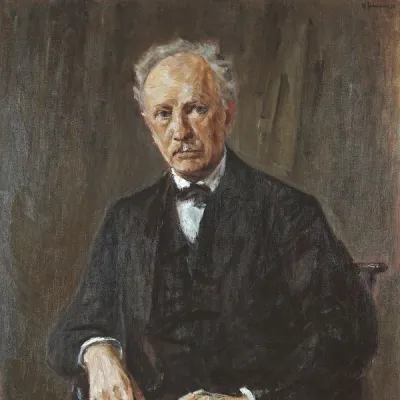
Richard Strauss
Human Design Chart
Biography
The Human Design of Richard Strauss: Manifesting Generator 4/6
Manifesting Generator 4/6 — Design at a Glance
Richard Strauss was someone who could achieve results quickly by skipping steps. His design as an Manifesting Generator combined the constant sacral energy of a Generator with the direct action of a Manifestor. This configuration allowed him to pull things into his life rapidly rather than progressing slowly.
However, this speed carried risks. Strauss tended to skip important stages or work on multiple projects simultaneously. If he initiated actions himself instead of responding to inner impulses, it quickly led to frustration – his specific Non-Self theme. The solution lay in the strategy of Reacting: He had to wait for life to speak to him and then check if his sacral center gave a clear „Yes“. Only this internal confirmation secured him the necessary energy.
With correct application of this dynamic – that is, by constantly testing consent and accepting change – Strauss found deep satisfaction. He worked effectively in „Play Mode“, where parallel activities were not a burden but a source of creative power. His success thus did not depend on linear planning but rather on aligning his hybrid nature of speed and reactive energy.
Emotional Authority
Richard Strauss showed a decision-making stance that required strategic waiting. His inner authority was Emotional Authority, carried by the defined Solar Plexus Center. This mechanism caused permanent ups and downs in feelings; the world appeared colored by his current mood. In one moment he could be enthusiastic about something, in the next view it negatively.
This emotional wave did not mean that immediate feeling was truth. It was merely a snapshot, a first impression. Quick, spontaneous decisions stemming directly from this transient emotion carried high risk for negative consequences. The mechanics of his configuration thus demanded patience and conscious delay.
To reach clarity felt as true, Richard Strauss had to give time for intense feelings to subside and emotional distance to arise. This often happened through „sleeping on“ decisions. Only when initial intensity subsided and calm entered was the process complete and a well-founded choice possible. This strategy of waiting was particularly crucial for long-term life decisions, ensuring that not just transient mood but deeper emotional wisdom guided direction. The priority of this emotional navigation over other defined centers shaped his way to orient himself in life and assess action spaces.
The 4/6 Profile — Opportunist / Role Model
Richard Strauss showed throughout his life the inner conflict between a deep desire for belonging and later calling to detached wisdom. In his first thirty years, he intensely experimented with relationships and friendships, driven by the energy of Line 4 in Profile 4/6 (Networker/Roles Model). This phase served to find one's place in the community, while the heart remained cautious not to get hurt through false bonds.
With maturity, his dynamics fundamentally changed. Gate 22 in Head Center activated Line 6 and brought forth qualities of metamorphosis and nonconformist leadership. Strauss became predictably a role model that worked through cooperation but maintained some distance to reflect on the meaning of life. Simultaneously, he used the ability of Gate 45 in Heart to recognize auspicious opportunities for his „tribe“ and direct material actions so they benefited the collective. This configuration created tension: While the heart continued seeking connection, the head demanded a higher, almost mutatoric social order. Strauss brought this mutation into life by using his experience to establish new models without fully abandoning the intuitive basis of his earlier network phase. His effectiveness lay in learning to transform youthful experimentation into wise, formative leadership.
Single Definition — Defined & Open Centers
Richard Strauss was a person with a constant mental structure, firm identity, and personal willpower. His design showed a tendency towards reactive life energy, coupled with emotional authority through the waiting wave as well as spontaneous intuition. At the same time, he was situationally exposed to inspiration and external stress.
His defined Ajna Center gave him a consistent way of thinking; he processed data and creativity in a trustworthy manner without being easily influenced by others. This mental clarity flowed into his defined Throat Center, allowing him to reliably express his messages – whether from mind, emotion, or identity. The also defined G Center provided him with a firm sense of self-identity and direction in life, while the Heart Center gave him access to willpower and the ability to keep promises and determine resources for himself.
As a guardian of immense power, he had a defined Sacral Center. His energy was only available when responding to questions; initiatives without prior invitation often led to frustration or exhaustion. His emotional authority came from his defined Solar Plexus Center: Richard Strauss needed time to wait out the emotional wave before gaining clarity and making decisions. Spontaneous judgments in the moment were supported by his defined Spleen Center, which offered him intuition and instinct for health and well-being.
In contrast, Head and Root Centers were open. The open Head Center meant that he did not have a constant source of inner inspiration; instead, he tended to absorb mental pressure from the environment or be influenced by others' doubts. He had to learn not to interpret this pressure as his own claim. Similarly, his open Root Center absorbed external stress and adrenaline. Richard Strauss was susceptible to amplifying the pressure of his surroundings, which could lead to restlessness if he tried to follow this foreign drive rather than simply recognizing it as an external phenomenon and letting go.
Channels for inspiration, rhythm, emotion, will, structure.
Richard Strauss showed a tendency towards inspiration through authentic presence in his design. This effect relied on the Inspiration Channel 1-8, connecting the G Center with the Throat Center. Gate 1 allowed for individual expression of mutative perspectives, while Gate 8 promoted contribution to the group. Strauss lived this art of individuation; he drew attention by showcasing his unique creative identity rather than explaining it. His authority stemmed from inner truth, not social adaptation.
This role-modeling was reinforced by the Beat Channel 14-2. This connected the Sacral Center with the G Center and utilized Gate 14 for power competence as well as Gate 2 for higher knowledge. This configuration gave him the strength to initiate new directions and set others in motion through his healthy aura. He trusted his generative energy to materialize innovations.
Additionally, the Openness Channel 12-22 shaped his emotional expression. Through the Solar Plexus Center (Gate 22) and Throat Center (Gate 12), he acted passionately and dramatically but only in harmony with his inner wave. His voice served as a catalyst for emotional changes in listeners when his timing was right.
His technical mastery resulted from the Wave Length Channel 16-48. Here, the Spleen Center (Gate 48) connected intuitive depth with the dexterity of the Throat Center (Gate 16). Strauss perfected his skills through repeated practice, developing his talent into a unique frequency.
The Structuring Channel 23-43 helped him to clearly and efficiently express complex insights from the Ajna Center (Gate 43). He formed innovative perspectives that mutated others' thinking. Finally, the Money Line Channel 21-45 contributed to material implementation. Through the Heart Center (Gate 21) and Throat Center (Gate 45), he exercised willpower to secure resources and take responsibility for his creation.
Individual Circuitry — Circuit Signature
Richard Strauss was marked by a synthesis of individual transformation, rational structuring, and cooperative resource formation. His design did not isolate these aspects but rather connected them as an integrated system of expression formation. The Knowledge Circuit formed the foundation: Here inspiration (Channel 1-8), rhythmic openness (12-22) and structural clarity (43-23) converged. This energy united Ajna, Throat Center, Solar Plexus, Identity, and Sacral Centers into a single stream. From this emerged the ability to carry new, unique insights emotionally grounded and acoustically impactful into the world – a pulsating force of personal transformation.
Parallel to this, the Understanding Circuit worked through Channel 16-48 ("The Wave Length"). It connected Throat Center with Spleen Center, enabling focused, emotionless ratio. This energy served logical structuring and strategic improvement of circumstances free from conditioned patterns to clearly share insights.
Completing this picture was the Ego Circuit. With Channel 21-45 ("The Money Line") he linked Throat Center with Heart Center. This stood for the ability to cooperate and create resources in a tribal context. It was about balanced giving and taking as well as material security, where pauses were necessary due to no direct connection to the Sacral Center.
Together these circuits formed a mechanism in Richard Strauss that connected individual creativity with rational precision and social resource formation. The energy flowed from inner inspiration over logical clarification to cooperative implementation, always carried by the emotional depth of Solar Plexus and strategic foresight of mind.
Right Angle Cross of Rulership 2
Richard Strauss carried the archetypal energy of the 'Right Governing Cross'. This deeply influenced his underlying motivations and life destiny. It was a dynamic of authority and leadership, coupled with responsibility for others in a structural or systemic context.
This configuration described less an individual trait than a fateful pattern. It worked like an inner mission that unfolded throughout his life. The orientation focused on leadership roles and the necessity to establish order or exercise power. This formed the central theme of his path.
While other influences might have shaped personal traits, this energy was a deeper current. It challenged him to engage with questions of hierarchy and influence. It was about how he perceived and exercised authority, not just in private but also in public space. This structure dictated that leadership and responsibility for the community or system were inevitably part of his experience. It was not an optional feature but a defining aspect of his design influencing his actions and decisions at a fundamental level.
Saturn Return · Uranus Opposition · Chiron Return · 2nd Saturn Return — Life Cycles
Richard Strauss's design was marked by phases of maturation, rebellion, and fulfillment, manifesting in concrete career milestones. The first Saturn Return often signified the moment when years of groundwork condensed into a viable result. This was evident in 1893, at age 29, with the premiere of Hänsel und Gretel in Weimar – a success based on this structural condensation.
The Uranus Opposition around his 40th year brought a phase of rebellion and new beginnings. Here, the design sought new forms of expression beyond established structures. Richard Strauss founded Die Musik series in 1904 at age 40. This step aligned with the drive to forge independent paths and open new creative spaces.
The Chiron Return around his 50th year is a fulfillment cycle where the Incarnation Cross unfolds, making meaning tangible. It's not about healing old wounds but about the blossoming of one's destiny. Richard Strauss composed and premiered Festive Prelude for large orchestra and organ op. 61 in 1913 at age 49. This work stood central to this phase of self-realization and purposeful living.
The second Saturn Return around his 58th year signaled another stage of maturation and consolidation. Richard Strauss experienced the first performance of Three Hymns by Friedrich Hölderlin for a high voice and large orchestra op. 71 in 1921 at age 57. This milestone underscored the ongoing deepening of his artistic path within the cycles prescribed by his structure.
Manifesting Generator · Emotional Authority — Synthesis
Richard Strauss lived a life shaped by the dynamic connection between creativity and authority. The defined sacral center provided constant energy (Design), while emotional authority compelled him to let decisions mature over longer periods – a process that nourished his profound, conceptual thinking (Ajna Center) and the need for authentic expression (Channel Inspiration). His profile as a Networker/Role Model reinforced this tendency by encouraging both connections and a unique perspective. His ability to attract attention through creative contribution and transform knowledge (Knowledge Circuit) was evident in documented successes correlated with significant life cycles.
A central paradox lay in the tension between the desire for belonging (Line 4) and the drive for individual reflection (Line 6). This inner conflict led to a constant interplay of heart and head, a search for harmony between social interaction and introspective contemplation. The ability to quickly initiate things (Manifesting Generator) clashed with the need for emotional clarity – a tension that compelled him to skip steps and then return to ensure his impulses truly aligned with his truth.
6 Defined Channels
Incarnation Cross - Right Angle Cross of Rulership 2
Solar Return
The Solar Return shows the moment when the sun returns to its exact birth position - your personal solar year.
Life Cycles
Discover the life cycles with a detailed triple view (birth chart, cycle chart, composite).
Human Design Profile
- Strategy
- To respond - wait for something to respond to
- Authority
- Emotional Authority
- Profile
- 4/6 - Opportunist / Role Model
- Definition
- Single Definition
- Incarnation Cross
- Right Angle Cross of Rulership 2
- Date of Birth
- 11.06.1864 06:00
- Place of Birth
- München, Germany
Frequently Asked Questions
What was Richard Strauss' Human Design type?
What Profile did Richard Strauss have in Human Design?
What Authority did Richard Strauss possess?
What incarnation cross did Richard Strauss have?
When was Richard Strauss born?
Discover your own Human Design
Are you also a Manifesting Generator? Find out in a personal reading how to unfold your multi-talents and direct your energy wisely.
More Personalities
Back to overviewAaliyah

Aldair

Alexia

Alizée

Angèle

Angeli
