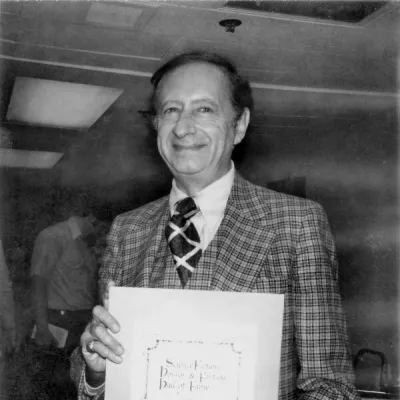
Robert Bloch
Human Design Chart
Biography
He became interested in Weird Tales in 1932, and began to publish in 1934 as a contributor to sci-fi and fantasy magazines. He worked in advertising in the 1940s while writing. In 1944, he wrote 39 episodes of a radio horror show, Stay Tuned for Terror. His first novel was The Scarf, but it was Psycho that made him famous when it was made into a classic movie thriller in 1960. After his success, he moved to Hollywood and continued with teleplays, screenplays and thrillers.
He died of cancer on 23 September 1994 at age 77 in Los Angeles, California.
Robert Bloch as a Generator 1/3 in Human Design
Generator 1/3 — Design at a Glance
Robert Bloch's design showed a tendency towards great endurance if he allowed himself to be guided by external impulses. As a Generator, he had much sacral energy that made him extremely strong and resilient like a workhorse – but only when this power flowed into tasks that appealed to him. His life force did not unfold through self-initiation but rather through reacting to signals from the environment. The motto was clear: wait until life asks a question, then answer it from the gut.
This principle brought two specific stumbling blocks with it. If he continuously carried out things he had no interest in, he wasted his energy and tended towards burnout. Conversely, it led to frustration when someone held him back from his heart project even though he still wanted to continue working full of power. He was only successful if he reacted to an external signal and his sacral center gave a clear
Sacral Authority
Robert Bloch based his decisions on an inner, physical resonance rather than intellectual analysis. His design dictated that he waited for external stimuli and accepted the spontaneous reaction of his body as a valid basis. This mechanism was steered by his sacral authority, which is exclusively available to Generator types. Since his emotional center remained open, this authority could clearly manifest itself in the form of gut feelings or sudden surges of energy. Robert Bloch learned to pay attention to bodily signals such as grunts, hums, or a nodding
The 1/3 Profile — Investigator / Martyr
Robert Bloch's design leaned towards a cyclical process of theoretical learning and practical verification through trial and error. As someone with Profile 1/3, the Explorer and Experimentator, he was naturally inclined to always want to learn more and try new things – comparable to a character like Indiana Jones who combines science and adventure. His life revolved around this dynamic: Sometimes the energy of Line 1 took control, leading to fear about implementation due to feeling that there wasn't enough knowledge yet. This conflicted with the urgent need of Line 3 for action and experience. Authenticity emerged for him only through mistakes; his judgment was trustworthy only when it was both theoretically grounded and practically tested. The first line emphasized developmental lines and shock management through experience and willpower, marked by Pluto and Venus. The third line, connected to Gate 54, indicated that ambition was strengthened through secret interactions while Pluto represented experimenting and sticking around. Venus in the case meant persistent belief in official channels as well as enhanced attraction for overcoming obstacles. Self-earned insights were thus his central theme; when Robert Bloch deemed something good, he had thoroughly examined it both theoretically and practically.
Split Definition — Defined & Open Centers
Robert Bloch's Design indicates a tendency towards high energetic density and consistent presence, supported by four defined centers: Sacral, Root, Ajna, and Throat. As a Generator, he had an inexhaustible supply of vitality that was only available through appropriate reactions to external stimuli; initiatives led to frustration and exhaustion for him. This sacral energy flowed directly into his communication (Throat) and mental conceptualization (Ajna), creating a consistent, trustworthy manner of thinking and expression. The defined Root Center provided the constant pressure and endurance needed to assert himself in the material world and handle stress.
At the same time, he was extremely sensitive to external influences through five open centers: Head, G, Heart, Solar Plexus, and Spleen. He did not have a fixed identity or direction (open G), but found these situational through the right place and people. He absorbed emotions from his surroundings without owning them himself (open Solar Plexus) and never had to make promises or prove willpower (open Heart). Additionally, he was open to inspiration but vulnerable to mental confusion (open Head), and developed wisdom through experiencing fears rather than spontaneous intuition (open Spleen). The challenge lay in not dissipating the immense inner power of his defined centers under the pressure of his open centers.
Channels for logical acceptance and cyclical maturation.
Robert Bloch's design inclines towards logical organization and detailed communication. His mind was constantly engaged in ordering details into his own mental system. The Channel of Accepting 17-62 connected the Ajna Center with the Throat Center. Gate 17 visualized patterns as "right eye," while Gate 62 translated these and created language. Everything he integrated into his inner perspective could be understood; what did not fit remained incomprehensible. This generated a constant pressure in the Throat Center to share opinions and explanations. Successful communication required the right timing and openness from listeners to avoid resistance.
Parallel to this, there was a need for cyclic learning through experience. The Channel of Maturation 42-53 connected the Root Center with the Sacral Center. This process required that each new experience be fully processed and then reflected upon to gain wisdom. Gate 53 marked beginnings, while Gate 42 indicated growth. Prematurely ending a cycle meant it had to be repeated. Reflection helped reveal valuable lessons and build on past experiences. Expectations were avoided as a source of frustration; instead, he engaged with experiences for their own sake.
Additionally, Gates like 51 (Willpower, Adaptability), 57 (intuitive clarity), and 54 (connection between the worldly and mystical) played roles. Gate 24 brought mental mutations and renewal in the rhythm of the pulse. Gate 41 drove evolutionary development through specific experiences. Gate 60 linked acceptance of limitations with transcendence. Gate 56 enabled abstraction of mental processes into pictorial narratives. This configuration shaped a lifestyle based on logical classification for understanding and fully traversing experience-based cycles.
Collective Circuitry — Circuit Signature
Robert Bloch's Design established a tendency towards duality: two separate, non-directly connected energetic systems existed in parallel. This resulted from his Split Definition, which formed two isolated groups. The first group linked the Ajna Center with the Throat Center through the Understanding Circuit. Here, Channel "Accepting" (Gate 17–62) was active. This configuration focused on sharing logical and rational insights and strategies for improving the future. It was a cool ratio, free from emotional conditioning, structurally aimed at communicating ideas clearly and visually.
The second, completely independent group linked the Sacral Center with the Root Center through the Purpose Circuit. Here, Channel "Maturity" (Gate 42–53) was active. This energy revolved around emotions and experiences from the past. It followed a wave-like, cyclical pattern with a beginning, middle, and end. The goal was to reflect on past events, give them meaning, and share these felt insights with the collective to learn together.
Since there was no connection between these two groups, the future-oriented ratio and the emotion-driven reflection of the past operated as parallel forces. They did not flow into each other but existed side by side. Robert Bloch thus exhibited the simultaneous presence of these two modes: the impulse for clear, strategic communication stood in contrast to the process of emotionally finding purpose from past experiences. Both systems were structurally separate yet collectively shaped his energetic landscape.
Right Angle Cross of Penetration 1
Robert Bloch's design indicated a tendency towards direct and penetrating impact. He was someone who did not avoid obstacles but actively broke through them to achieve clarity. This attitude stemmed from the right cross of Penetration 1 in his Human Design chart.
This configuration combines specific energetic patterns that describe a deep need for authenticity and the ability to reduce complex situations to their essence. It was not superficial analysis, but an intuitive, almost physical way of understanding. Robert Bloch lived with an inner urgency that led him to engage directly with the core issues rather than getting lost in trivialities.
The mechanics of this cross promoted a kind of presence where words and actions were precise and goal-oriented. It was about uncovering truths that would otherwise remain hidden, and communicating them with a certain sharpness. This shaped his way of perceiving the world: not as a passive observer but as an active participant who questioned structures and influenced through his own being. The energy was always focused on the essential, which helped him find a clear path in chaotic environments. This penetrating power was a central aspect of his inner disposition and largely determined how he dealt with challenges.
Saturn Return · Uranus Opposition · Chiron Return · 2nd Saturn Return — Life Cycles
Robert Bloch's life story showed distinct turning points marked by external recognition and breakthrough successes. This structure aligned with the dynamics of his Uranus opposition: A cycle often accompanied by sudden breaks or unexpected opportunities to free individuals from familiar patterns and guide them into new paths. In 1959, at age 42, this effect became evident. He received the Hugo Award for the short story “That Hell-Bound Train” and achieved literary breakthrough with the novel “Psycho,” which centered on the serial killer Norman Bates. This moment not only marked a career peak but also confirmed his individual expression to a broader audience.
Later, this pattern of external validation repeated during his second Saturn return. The second Saturn return is a period of deep reflection and consolidation where earlier achievements are re-evaluated and often recognized by established institutions. In 1974, at age 57, Robert Bloch received the Forry Award. This recognition underscored the enduring relevance of his work and affirmed his status within his community. Both events – the explosive early success in his forties and the established recognition in his fifties – illustrate how astrological cycles can structure concrete milestones in life: once as an impulse for breakthrough, another time as confirmation of attained position.
Generator · Sacral Authority — Synthesis
Robert Bloch was a Generator whose life was marked by deep, sacral energy and the need to respond to the right signal from the environment. This responsiveness, coupled with defined mental clarity, created a unique ability to process information and pour it into stories – a process amplified by the cyclic nature of the Ripe Channel (Gate 53/42). He gathered experiences, reflected on them, and shared his insights with others, earning recognition.
A central paradox in his design lay in the interplay between defined mental clarity (Ajna Center) and open heart center. While he possessed a pronounced ability to develop complex ideas logically, he lacked the constant inner guidance that a defined G-Center provides. This led to an ongoing search for validation through external stimuli while simultaneously generating profound insights and sharing them with others – a tension between internal distance and external expression.
2 Defined Channels
Incarnation Cross - Right Angle Cross of Penetration 1
Solar Return
The Solar Return shows the moment when the sun returns to its exact birth position - your personal solar year.
Life Cycles
Discover the life cycles with a detailed triple view (birth chart, cycle chart, composite).
Human Design Profile
- Type
- Generator
- Strategy
- To respond - wait for something to respond to
- Authority
- Sacral Authority
- Profile
- 1/3 - Investigator / Martyr
- Definition
- Split Definition
- Incarnation Cross
- Right Angle Cross of Penetration 1
- Date of Birth
- 05.04.1917 21:20
- Place of Birth
- Chicago, IL, United States
Frequently Asked Questions
What was Robert Bloch's Human Design type?
Which Profile did Robert Bloch have in Human Design?
What Authority did Robert Bloch possess?
What incarnation cross did Robert Bloch have?
When was Robert Bloch born?
Discover your own Human Design
Are you also a Generator? Find out in a personal reading how to use your sacral energy correctly and discover deep satisfaction.
More Personalities
Back to overviewAaliyah

Alexia

Angèle

Anne-Marie

Arcángel

Arno