
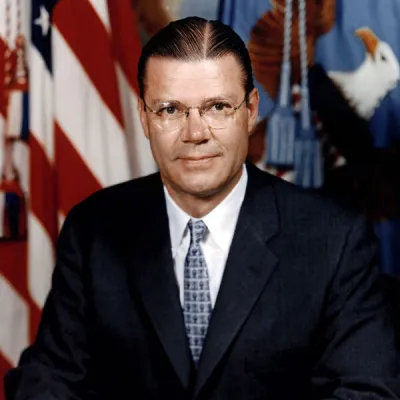
Robert McNamara
Human Design Chart
Biography
McNamara graduated from the University of California, Berkeley, and Harvard Business School. He served in the United States Army Air Forces during World War II. After World War II, Henry Ford II hired McNamara and a group of other Army Air Force veterans to work for the Ford Motor Company, reforming Ford with modern planning, organization, and management control systems. After briefly serving as Ford's president, McNamara accepted an appointment as secretary of defense in the Kennedy administration.
McNamara became a close adviser to Kennedy and advocated the use of a blockade during the Cuban Missile Crisis. Kennedy and McNamara instituted a Cold War defense strategy of flexible response, which anticipated the need for military responses short of massive retaliation. During the Kennedy administration, McNamara presided over a build-up of U.S. soldiers in South Vietnam.
The Human Design of Robert McNamara: Generator 2/4
Generator 2/4 — Design at a Glance
Robert McNamara was someone who possessed immense and enduring work capacity, comparable to a strong workhorse. His Generator design established a foundational structure based on the utilization of large amounts of sacral energy. This energy was not available to him through arbitrary initiative but became effective when he responded to impulses from his environment. The central dynamic of his character lay in waiting for signals and only then taking action when his inner center gave clear confirmation.
This mechanism of reaction rather than initiation shaped his ability to act. When he pursued tasks that aligned with this inner resonance, he could work with great endurance and efficiency. Conversely, ignoring these inner signals or imposing activities without inner consent led to energy loss and frustration. His design offered him the potential for deep satisfaction, provided he acted in harmony with these sacral impulses. The danger always lay in either wasting energy on inappropriate goals or being held back from his actual projects, even though his inner strength was still present. Thus, his strength did not lie in planning but in the powerful response to what was presented to him.
Emotional Authority
Robert McNamara was someone whose inner decision-making was inseparably linked to the rhythm of his feelings. His design carried emotional authority, meaning that his defined Emotional Center was the sole source of his truth – regardless of which other centers were also defined. This configuration was subject to a constant emotional wave, a permanent up and down of moods. The world appeared to him always colored by his current emotional state: enthusiastic about something one moment, then negatively evaluating the same situation the next.
Since the immediate feeling was only a snapshot and not a final judgment, spontaneous decisions made in this heat often had negative consequences. His mechanism required patience and time to gain clarity. Only through repeatedly sleeping on decisions and waiting until the intense feelings subsided did he gain the necessary emotional distance. This process of calm was crucial for all long-term steps that significantly influenced his life course. Quick reactions were postponed in favor of a deeper, more comprehensive understanding until the emotional turbulence had subsided and a stable foundation for action was established.
The 2/4 Profile — Hermit / Opportunist
Robert McNamara was someone who oscillated between a deep need for withdrawal and a drive for social connection. His design as a 2/4 Profile, the 'Natural Talent/Networker', established an inner tension: On one hand, he sought solitude to gain clarity, on the other hand, he needed the exchange with familiar people. This dynamic required him to clearly communicate his boundaries – when he wanted company and when he needed to be left alone. In his alone time, he immersed himself in internal processes to regenerate. Once this need was satisfied, he returned to his network.
This structure allowed him to reflect on knowledge from his environment and develop new ideas from it. Line 2, the 'Tribe Leader', gave him an aura that was perceived as readiness for leadership. He checked for congruence and developed methods that served others, but he refused to accept foreign approaches that contradicted his interests. At the same time, Line 4 ensured sensitivity and social openness. He paid attention to mood and tone to recognize the right moment for something new. He avoided excessive formality, recognizing that rigid mechanisms suffocate relationships. Thus, he combined analytical distance with the ability to integrate into groups and read their dynamics.
Split Definition — Defined & Open Centers
Robert McNamara revealed himself as someone who possessed a constant, reliable voice speaking from a deep inner identity and direction. His defined G Center gave him a clear sense of his higher self and the ability to guide others onto new paths without being dependent on them. This inner alignment culminated in his defined Throat Center, which served as a focal point to translate messages of love and identity into the world. His communication was thus not merely a product of the mind but an expression of his personal truth and mission.
At the same time, he had a tremendous vital energy source in his defined Sacral Center. This energy drove him to be active and engage in tasks to which he responded with a clear "yes". The combination of sacral endurance and defined communication allowed him to fulfill commitments with ease and honesty, as long as he listened to his inner response. His defined Root Center provided the necessary pressure to move forward in the material world and master existential challenges, while his defined Solar Plexus enabled him to gain emotional clarity through waiting rather than acting impulsively.
In contrast, he was open and vulnerable to conditioning in several areas. His open Head Center tended to be overwhelmed by doubts and the search for inspiration from others, which could distract him. The open Ajna Center meant that he did not have firm conceptual answers but rather absorbed ideas from the environment, making him flexible but also vulnerable to foreign theories. His open Heart Center lacked consistent willpower, so he could try to prove himself through promises rather than trusting his inner authority. Finally, his open Spleen Center revealed a deep survival fear that led him to cling to things or people that were not good for him to simulate a sense of security and well-being, rather than making spontaneous decisions.
Channels for transformation, reflection and emotional recognition.
Robert McNamara revealed himself as someone who worked deeply underground to initiate evolutionary change, paired with a stance of the patient observer. His design featured the Channel of Mutation 60-3, connecting the Root Center with the Sacral Center. This connection between the Gate of Limitation (60) and the Gate of Ordering (3) generated a pulsing, often melancholic energy. It required accepting limitations and moving beyond the confusion of a new beginning to bring about innovations. This process was unpredictable and urged him to bring change into his environment, often accompanied by inner tension when the pulse ceased.
Parallel to this, the Channel of the Lost Son 13-33, linking the G Center with the Throat Center, was at work. Through the Gate of the Listener (13), he gathered information and secrets, while the Gate of Withdrawal (33) prompted him to withdraw to reflect on these experiences. This created a cyclical process of maturation: he listened, stored memories, and later shared them as deep truths, bringing continuity and stability to his development. His strength lay in understanding the past and drawing lessons from it, not in predicting the future.
The Channel of Perception 41-30 connected the Root Center with the Solar Plexus Center. The Gate of Limitation (41) generated restlessness and a drive for new experiences, while the Gate of Perception of Feelings (30) fueled this longing emotionally. This led to an intense need to embrace new situations, waiting for the emotional wave to pass to gain clarity.
Additionally, individual Gates shaped his Profile: Gate 45 in the Heart Center expressed willpower and royal hierarchy, while Gate 26 promoted innovations within a conservative branch. Gate 22 enabled calm listening, Gate 47 helped to derive meaning from past experiences. Gate 6 regulated biological limits, Gate 53 initiated new cycles, and Gate 49 brought about upheaval and sacrifice. Gate 31 transferred leadership, Gate 39 provoked mutation, Gate 56 told collective stories, Gate 35 promoted change through interaction, and Gate 15 established logical societal rhythms.
Collective Circuitry — Circuit Signature
Robert McNamara showed himself through a split definition, which created two parallel, not directly connected energetic streams in his design. One stream connected the Sacral with the Root Center, the other the Identity with the Throat Center. This separation meant that his life force and his emotional reactions did not automatically flow into his self-presentation.
In the Knowledge Circuit, he activated the Channel of Mutation between Sacral and Root Center. This gave him a pulsating, acoustic energy aimed at going his own unique way and bringing about change through deviation from the known. His identity was strengthened by this mutative force, which transformed new knowledge.
The Meaning Circuit consisted of two separate parts in him. The first connected the Throat with the Identity Center through the Channel of the "Lost Son." This allowed him to express his unique identity through the Throat Center. The second part connected the Solar Plexus with the Root Center through the Channel of "Recognition." Here, reflecting on the past and finding meaning in past events was the focus. These emotional waves, which flowed in a wave-like manner, served to share insights with the collective and learn together from the past. Since the Centers of the two circuits and the Groups of the split definition were not connected to each other, these forces existed as parallel, independent systems. Robert McNamara had to consciously integrate these separate energies, as there was no automatic flow between his life force, his emotions, and his self-presentation.
Right Angle Cross of Rulership 2
Robert McNamaras design points towards a tendency towards strategic control and structured action. This configuration, known as the right cross of governance, describes an inner architecture geared towards organizing complex systems through clear hierarchies and defined processes. It was not about spontaneous impulses, but rather a thoughtful approach to power and responsibility. The underlying mechanics promoted the ability to penetrate large organizations or societal structures and reshape them according to one's own logical principles. Efficiency and assertiveness were prioritized over emotional adaptability. Robert McNamara was someone who created order by establishing rules and ensuring their compliance. This attitude shaped his interaction with his environment: he sought levers to exert influence and ensure results. The right cross of governance conveyed a deep understanding of how authority functions and how it can be used to achieve long-term stability. It was about the art of management in the broadest sense – steering resources, people, and information with a clear goal in mind. This energetic alignment supported a lifestyle based on planning, control, and the avoidance of chaos.
Saturn Return · Uranus Opposition · Chiron Return · 2nd Saturn Return — Life Cycles
Around 1965, Robert McNamara showed a significant career turning point that corresponded with his inner development. At the age of 49, when Lockheed won the contract for the C-5A Galaxy, a specific cycle began: the Chiron Return. This period does not mark a process of wound healing in Human Design but rather a phase of fulfillment and bloom. Here, the individual's incarnation cross increasingly unfolds in everyday life, provided the person has lived according to their strategy and authority beforehand. Meaning and purpose become experiential, not through external validation alone, but through the inner resonance with one's life mission. For Robert McNamara, this moment deepened his professional identity, with the success at Lockheed serving as an expression of this inner alignment. The mechanics of the Chiron Return show that between the ages of 49 and 51, long-term development condenses. It is a moment when what was previously seen as a task or challenge becomes a source of confirmation. Robert McNamara did not experience this phase as a search for a new direction but as confirmation of the path he had already chosen. The contract for the aircraft project was not an isolated event but a reflection of the ongoing internal integration. Through this experience, his role in the company was not only stabilized but also placed in a larger context that went beyond mere business success.
Generator · Emotional Authority — Synthesis
Robert McNamara was a Generator whose life was marked by deep, sacral energy. He embodied the endurance and strength inherent to this type, yet always in the tension field between the need to engage in heart projects and the risk of wasting energy in unsatisfying work. This dynamic was evident in the tendency to delve into processes characterized by limitations and new beginnings (Channel 3-60) and in the ability to bring about transformation through interaction with the world (defined Throat Center). His profile as a natural talent and networker reinforced this pattern by making him oscillate between withdrawal into internal processes and the desire for exchange with others.
A central paradox in his design lay in the combination of emotional authority and the pulsating, present format of the knowledge circuit. While he needed time for emotional decision maturation, the energy of the circuit urged him to act quickly and realize new ideas. This tension between inner maturity and the drive for innovation led to a life marked by profound changes and a constant quest for knowledge, with a notable event in connection with a career decision illustrating how this process could unfold.
3 Defined Channels
Incarnation Cross - Right Angle Cross of Rulership 2
Solar Return
The Solar Return shows the moment when the sun returns to its exact birth position - your personal solar year.
Life Cycles
Discover the life cycles with a detailed triple view (birth chart, cycle chart, composite).
Human Design Profile
- Type
- Generator
- Strategy
- To respond - wait for something to respond to
- Authority
- Emotional Authority
- Profile
- 2/4 - Hermit / Opportunist
- Definition
- Split Definition
- Incarnation Cross
- Right Angle Cross of Rulership 2
- Date of Birth
- 09.06.1916 05:45
- Place of Birth
- Oakland, California, United States
Frequently Asked Questions
What was Robert McNamara's Human Design type?
What Profile did Robert McNamara have in Human Design?
What Authority guided Robert McNamara's decisions?
Which incarnation cross characterized Robert McNamara?
When was Robert McNamara born?
Discover your own Human Design
Are you also a Generator? Find out in a personal reading how to use your sacral energy correctly and discover deep satisfaction.
More Personalities
Back to overviewAaliyah

Alexia

Angèle

Anne-Marie

Arcángel

Arno
