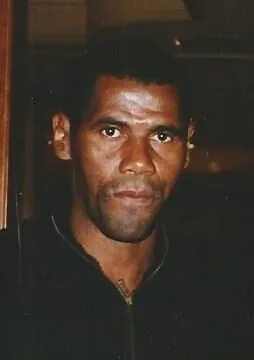
Photo: Wikimedia Commons
Roger Marche
Human Design Chart
Biography
He died of an accident in which he had a blunt trauma to the head, 1 November 1997, Charleville-Mezieres, France.
The Human Design of Roger Marche: Generator 4/6
Generator 4/6 — Design at a Glance
Roger March's design showed a tendency towards great endurance and energy, provided he engaged in tasks that intrinsically interested him. As a Generator, he had a strong sacral center, which gave him the strength to translate things sustainably into reality – comparable to a workhorse that, when properly utilized, can pull immense loads. However, his path was marked by the necessity of not initiating himself but reacting to signals from his environment. This strategy of 'reacting' rather than 'acting' was crucial: Only when his inner self gave a clear 'yes' to an impulse could he efficiently use his energy and experience deep satisfaction.
If he lived against this principle, for example by forcing himself to do things he had no interest in, or if he was prevented from pursuing his heart project despite still having full power, this quickly led to frustration and energy loss. The risk of burnout lurked where he wasted his strength on foreign goals. His design challenged him to act from the gut and wait for what truly appealed to him. In this harmony between inner signal and outer action lay his true strength and the source of his fulfillment.
Emotional Authority
Roger March's inner compass was emotional authority, carried by his defined solar plexus center. This configuration fundamentally determined his decision-making: He was subject to a natural wave movement of emotions, which showed in constant ups and downs. His perception of the world was always colored by his current mood; something could appear extremely attractive in one moment, yet be negatively evaluated in the next. For Roger March, however, this immediate emotional reaction was only a snapshot, not yet the deeper truth.
The mechanics of his design therefore required patience. Quick, spontaneous decisions made directly from intense emotions often risked negative consequences, as they were based on fleeting impulses. Instead, it was crucial for him to let decisions mature. Through conscious hesitation and repeatedly 'sleeping on' important questions, he gained emotional distance. Over time, the intense feelings subsided, and only then did the necessary clarity and calmness set in. This process of delay was not an obstacle but the essential mechanism to reach his true inner truth, especially in long-term life decisions.
The 4/6 Profile — Opportunist / Role Model
In the first three decades of his life, Roger March was seen as someone who sought his identity through intense experimentation, particularly in relationships and friendships. His design as Profile 4/6 still appeared like a pure Line 3 in this early phase, which fostered his curiosity and the testing of different social roles. This phase served to learn through direct experience and mistakes before the deeper wisdom of Line 6 awakened.
With the return of Saturn, that is after the age of 30, his inner focus fundamentally shifted. Roger March now found himself in the characteristic conflict between heart and head: On the one hand, he felt the strong desire of Line 4 to belong to a community and seek connection. On the other hand, Line 6 pulled him onto a metaphorical mountain to contemplate the meaning of life from a distance. This contradiction between belonging and spiritual solitude shaped his later years.
From his environment, he was expected to take on the role of a wise role model. He had to learn to cautiously open his big heart to avoid being hurt by false bonds. Line 6 also taught him to see unforeseen events and uncertainty not as obstacles but as catalysts for his growth and ego development. He had to accept that productivity was not always planable but often arose in the universal flow of the unexpected.
Triple Split Definition — Defined & Open Centers
Roger Marche lived with a constant, internal mental pressure. His design linked the Head and Ajna Centers, creating a permanent source of inspiration, questions, and doubts. This state was not a choice but a mechanical given: His mind was constantly active, forming concepts and understanding connections. However, since these centers did not have their own energy for implementation, the attempt to immediately turn these thoughts into actions often led to frustration. Instead, he acted as a catalyst; his aura put others, especially those with an open Head Center, under the pressure to think. His task was to accept the mental pressure without giving in to it or projecting it outward, and to wait for the right moment to pass on his ideas.
His drive came from the defined Sacral Center. As a Generator, he possessed a vast, vital energy source that was only available through reaction. He was most effective when he waited until life spoke to him and then reacted with a clear yes or no answer. Initiating actions that did not base on this sacral response led to resistance and exhaustion. This energy was directed by his defined G Center, which gave him a firm, reliable self-identity and a clear sense of his own direction. He knew who he was and could show others new perspectives without becoming dependent on them.
At the same time, he experienced an emotional wave, as his Solar Plexus Center was defined. His inner authority lay in emotion; truth revealed itself to him only over time. Impulsive decisions in the highs or lows of his mood often led to chaos. Patience and waiting for emotional clarity were essential for his correct judgments.
Challenges arose through his open centers. His undefined Throat Center tended to suffer under the pressure to gain attention or to speak constantly, leading to unpredictable statements. His open Heart Center lacked consistent willpower; he was not designed to make promises or prove himself. The attempt to simulate willpower or to endure competitive pressure led to spirals of self-deprecation. His strength did not lie in enforcing will but in trusting his sacral energy and emotional clarity.
Channels for meaning, self-expression, doubt and emotional depth.
Roger Marche's design was characterized by a critically analytical mind that tested patterns for their consistency before accepting them. This attitude stemmed from the Logic Channel 63-4, which connected the Head Center with the Ajna Center. Here, the Gate of Doubt (63) worked together with the Gate of Formulation (4), creating a mind that used skepticism as a necessary filter. For Roger Marche, an answer was only valid if it proved consistent and verifiable in practice; unfounded belief had no place in this mechanical process.
At the same time, a deep anchoring in self-determination and the search for individual meaning was evident. The Channel of Exploration 34-10 connected the Sacral Center with the G Center. Through the Gate of Power (34) and the Gate of Self-Action (10), he possessed the inner strength to follow his own convictions and honor himself, independent of external expectations. This fostered an authentic presence that encouraged others to live their unique individuality.
Moreover, the energy of his design was marked by a constant striving for significance. The Channel of Life Struggle 38-28 connected the Root Center with the Spleen Center. The Gate of the Fighter (38) drove him to defend his individual integrity against external distractions, while the Gate of the Player (28) helped him recognize which struggles had value. This channel endowed him with the resolve to walk his own path and find a deeper life meaning in the challenges of everyday life.
Emotionally, Roger Marche moved in a pulsating wave between passion and melancholy. The Channel of Emotional Release 39-55 connected the Root Center with the Solar Plexus Center. The Gate of Provocation (39) and the Gate of the Mind (55) set an emotional dynamic in motion that used moodiness as a creative and mutative factor. He learned to accept these moods rather than rationalize them and used his emotional depth to sharpen the perception of the mind in himself and others. Additional facets like the temporal clarity of Gate 64 or the rhythm of Gate 5 rounded off his complex inner structure.
Individual Circuitry — Circuit Signature
Roger Marche's design featured a Triple Definition, creating three separate, parallel operating energy blocks that were not connected to each other. In the Knowledge Circuit, the channels 'Life Struggle' and 'Emotional Release' connected the Spleen, Root, and Solar Plexus Centers. This created a pulsating, acoustic energy that responded to intuition and emotional waves to express new identity.
A second, isolated block formed the Centering Circuit. Here, the channel 'Exploration' connected the Sacral with the Identity Center. This connection fostered inner strength and individual convictions, but lacked a direct connection to the Throat Center, often making the expression of this inner strength difficult.
The third block was the Understanding Circuit. The channel 'Logic' connected the Head and Ajna Centers. This allowed focused, rational thought processes and strategic planning, free from emotional coloring.
Since these three groups were energetically separate from each other, Roger Marche had to learn to integrate these different forces – intuitive emotion, inner conviction, and rational logic – as separate, coexisting systems rather than experiencing them as a continuous flow.
Right Angle Cross of Consciousness 1
Roger Marche's Human Design indicated a tendency towards a clear, reduced perception focused on the essentials. His chart featured the right cross of consciousness 1, which described a life task characterized by a direct, unadorned way of being. It was an energy that did not beat around the bush but took things as they were. Roger Marche was someone who could reduce complex situations to their core points. This ability helped him remain action-oriented in daily life without being overwhelmed by unnecessary details. The right cross of consciousness 1 conveyed a kind of clarity that was not intellectually constructed but intuitively given. It allowed him to quickly recognize what was truly important and what was merely distracting. In his interactions, this trait acted as a stabilizing factor, radiating a certain groundedness and authenticity. Roger Marche lived with this inner compass needle that always pointed to the essentials. It was not a search for hidden depths but a presence in the here and now. This attitude shaped his approach to challenges: he did not seek complicated solutions but the simplest, most direct path. His design promoted a kind of transparency that made it easier for others to trust him, as no hidden agendas were apparent. Roger Marche was someone who, through this clarity, was able to bring calm and order to his environment by accepting reality without distortion.
Saturn Return · Uranus Opposition · Chiron Return · 2nd Saturn Return — Life Cycles
Roger Marche was someone whose energy and endurance were marked by clear, cyclical phases of condensation and letting go. His design laid out a structure where inner maturation and outer recognition were intricately intertwined, with certain planetary cycles acting as catalysts for significant life turning points.
In 1953, at the age of 29, he achieved his second French master's title and won the Coupe Latine. This coincided precisely with his first Saturn return. In Human Design mechanics, this cycle often marks the point where years of groundwork and discipline condense into a tangible, visible result. For Roger Marche, this was no coincidence but the natural consequence of a phase where structure and responsibility led to concrete success.
A decade later, in 1962 at the age of 38, he ended his professional career. This corresponded with the Uranus opposition, a cycle that requires deep changes and letting go of old structures. While the Saturn return brought confirmation and consolidation, the Uranus opposition demanded transformation. Roger Marche followed this inner dynamic by concluding his active competitive phase. His path illustrates how these mechanical cycles did not act as external fates but as inner rhythms that guided the form of his career from its peak to a necessary realignment.
Generator · Emotional Authority — Synthesis
Roger Marche was a Generator whose life was marked by a deep, sacral energy (Generator type). This energy always sought tasks in which it could unfold, yet he lived in a constant tension between the urge to engage in community (Line 4 in Profile) and the need for introspective reflection and finding a deeper meaning (Line 6). Emotional authority required him to not rush decisions but give them time to ripen in the emotional wave – a process that further complicated his desire for quick action and engagement in the community.
A central paradox in his design lay in the combination of the defined Head and Ajna Centers (Logic Channel) and emotional authority. On one hand, he was subjected to constant mental pressure to question and challenge patterns, on the other hand, he needed time to emotionally process these questions and arrive at a clear answer. This led to an inner conflict between the need for intellectual clarity and the necessity to surrender to emotional truth, which was reflected in the successes and turning points of his life cycles.
4 Defined Channels
Incarnation Cross - Right Angle Cross of Consciousness 1
Solar Return
The Solar Return shows the moment when the sun returns to its exact birth position - your personal solar year.
Life Cycles
Discover the life cycles with a detailed triple view (birth chart, cycle chart, composite).
Human Design Profile
- Type
- Generator
- Strategy
- To respond - wait for something to respond to
- Authority
- Emotional Authority
- Profile
- 4/6 - Opportunist / Role Model
- Definition
- Triple Split
- Incarnation Cross
- Right Angle Cross of Consciousness 1
- Date of Birth
- 05.03.1924 13:00
- Place of Birth
- Villers Semeuse, France
Frequently Asked Questions
What was Roger Marche's Human Design type?
What Profiles did Roger Marche have?
What Authority did Roger Marche have?
What incarnation cross did Roger Marche have?
When was Roger Marche born?
Discover your own Human Design
Are you also a Generator? Find out in a personal reading how to use your sacral energy correctly and discover deep satisfaction.
More Personalities
Back to overviewAaliyah

Aldair
Alexia

Angèle

Anne-Marie

Arcángel