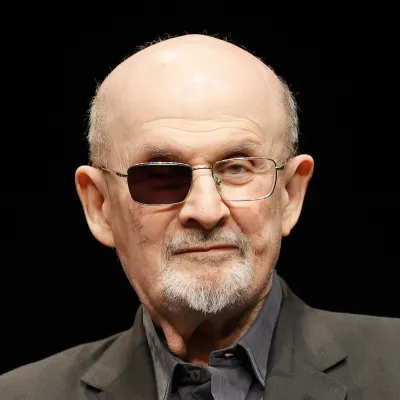
Salman Rushdie
Human Design Chart
Biography
Muslims accused him of blasphemy over certain parts of The Satanic Verses, creating such a storm that a death contract was put out on him. Naturally the publicity created a best-seller as he fled incognito to England where the British government put Rushdie under police protection. The danger was real; his Japanese translator was murdered; his Italian translator was beaten and stabbed; his Norwegian publisher was shot and wounded.
His other books include The Moor's Last Sigh (1995) and The Ground Beneath Her Feet (1999). His book Fury was released in late 2001 by Random House and was promptly reviewed as a "stunningly lousy novel."
In March 1999 Rushdie had surgery to lift the upper folds of his eyes. A genetic defect gave him his heavy lidded look and the lack of tone had become so severe that he literally had to hold his lids up with his fingers to see.
He married American writer Marianne Wiggins in 1988. They began living apart six months after he went into hiding and divorced on 2 March 1993. In 1997 he married editor Elizabeth West and the couple had a son in May 1999. Still married to West, Rushdie became a couple with 29-year-old Indian model, author and New York City society girl Padma Lakshmi in early 2000. They married in Manhattan on 17 April 2004 in a traditional Hindu ceremony.
Salman Rushdie — Manifesting Generator with Profile 5/1
Manifesting Generator 5/1 — Design at a Glance
Salman Rushdie revealed himself as someone who combined the constant power of a Generator with the explosive speed of a Manifestor through a hybrid energy configuration. His design indicated a tendency to quickly draw things into his life and skip steps in the process. This ability for rapid initiation from reactions fundamentally shaped his work style.
As a Manifesting Generator, he had a defined Sacral Center, which provided him with constant energy. However, the central advice remained the same as for all Generators: Do not initiate on your own but react to external impulses. Only when an internal 'yes' came from the sacrum should action be taken. With the additional connection of a Motor Center to his Throat Center, he could implement these reactions with great speed and pursue multiple projects in parallel.
This configuration carries specific risks: The tendency to move too quickly led to important intermediate steps being overlooked. In such cases, Salman Rushdie often had to backtrack and make up for missed stages, which could cause frustration – a classic sign of the non-self theme of this type. Furthermore, he tended to respond simultaneously to many different impulses. If strategy and inner authority did not match, his creative drive quickly turned into overburdening. With correct application, however, by constantly checking sacral approval, he could draw deep satisfaction from his diverse, playful creation process and enjoy parallelism without being blocked.
Sacral Authority
Salman Rushdie revealed himself as someone whose decision-making was based on direct, physical resonance. His design established Sacral Authority – a mechanism exclusive to the Generator type and whose strategy is inseparable from this inner guidance. This simplified his process: He did not need abstract analysis but listened to his 'gut feeling'. This manifested as a surge of energy or an acoustic signal like a grunt or an affirming 'Mhm' immediately after an external stimulus. Such impulses signaled vitality and inexhaustible energy; they were the anchor for enthusiasm and satisfaction in his activities, without the compulsion towards purposefulness. Additionally, his activated Spleen Center acted as a supportive instance. Through its connection to the Sacral Center, this enabled quick, spontaneous reactions and reliable access to instinctive perception as well as physical wellbeing. Rushdie could thus be directly guided by these deep physiological signals, which allowed him to immerse himself fully in his tasks and experience natural joy arising from immediate confirmation of his inner authority.
The 5/1 Profile — Heretic / Investigator
Salman Rushdie's design indicated a tendency to appear as an expert who uses profound knowledge to offer solutions to others. As a 5/1 – Hero/Researcher – he was magnetic: Others sought answers from him and set expectations that he often had to regulate with pragmatic withdrawal or cautious distance. This dynamic reflects Line 5, which combines social skillfulness with the necessity of clear boundaries to avoid overburdening.
Simultaneously, an internal tension was evident through the first line, marked by Gate 25 and its focus on selfless, spontaneous action without hidden motives. This fostered a centered approach towards challenges but also uncertainty in dealing with projections from his environment. The combination of pragmatic crisis management from Line 5 (Gate 12) and shamanic, experimental energy from Line 1 (Gate 25) shaped his way of switching between intensive research for himself and the public role as problem solver. Rushdie had to learn to say no to maintain balance between the need for withdrawal to process emotional experiences and external expectations. His design thus describes a path from initial dispersion through social projections towards conscious selection of when he shares his knowledge and when he protects himself.
Single Definition — Defined & Open Centers
Salman Rushdie's design tends towards a consistent but limited form of self-expression. His defined throat acts as a pivot point for messages from the body; it does not speak arbitrarily, but rather translates information from other centers into clear communication and action. This voice is reliable, yet it requires trust in one's own strategy to avoid impulsive speech or giving away energy at every impulse.
This expressive ability stems from a deep source: his defined sacral center. As the guardian of an immense reservoir of power, his design generates a specific amount of vitality daily, felt as a constant hum. This sacred energy is only available for reactive decisions – through yes or no tones in response to external requests. Initiating actions without prior questioning disrupts this connection and leads to resistance or exhaustion. The persistence to master skills was built into this energy, provided it was set in motion correctly through reaction.
Additionally, Salman Rushdie has a defined G center, which gives him a fixed sense of self-identity and direction. He can love others without becoming dependent and show natural paths to them without restricting their freedom. His open heart center, however, is not designed; it is strong-willed in the sense of ego competition – it does not need to prove anything to be valuable.
His open head and open Ajna center make him vulnerable to mental pressure waves and the absorption of foreign concepts. He tends to get caught up in other people's thoughts or seek inspiration when inner clarity is lacking. The open solar plexus center also absorbs emotional moods from the environment, which can cause confusion if he personalizes these feelings. Similarly, his open root center takes on external stress that he does not generate himself but amplifies – a pressure that one can only confront by letting go or using it correctly.
Channels for reflection, experimentation and powerful execution.
Salman Rushdie's design tends towards patient observation before sharing insights. The Lost Son 13-33 connects the G Center with the Throat Center: Gate 13 listens and stores secrets, while Gate 33 withdraws to distill deeper truths from these memories. This channel completes a cyclical process of maturation; Rushdie is someone who collects experiences, sorts them, and only then shares when the lesson is clear. The challenge lies in timing – not revealing prematurely but waiting for the magic of completion.
Parallel to this, Channel 48-16 works, linking intuitive depth (Gate 48) with technical skill (Gate 16). This creates an inner need to perfect skills through repeated practice. Talent here does not arise solely from inspiration but from dedication to a pattern until mastery becomes freedom. Recognition and resources are necessary to maintain this process of refinement; without them, the development of talent remains difficult.
The energy of reflection and perfection finds expression through Charisma 34-20. This channel connects the Sacral Center (Gate 34) with the Throat Center (Gate 20). Here generative life force meets the ability to act in the present moment. Rushdie's design shows charismatic power, which only works correctly when guided by sacral reaction – inner guidance and enthusiasm for action. Without this connection, the energy threatens to break out chaotically; with it, a self-reinforcing influence is created that inspires others without him having to submit to them. The combination of reflected wisdom, perfected craftsmanship, and direct expression power shapes his way of entering the world.
Collective Circuitry — Circuit Signature
Salman Rushdie's design tends towards clear, structured communication that unites rational insights with emotional depth. As a person with simple definition, he shows an energetic flow between G-, Throat-, Spleen-, and Sacral centers in a continuous stream. This connection enables him to directly translate logical strategies into words. The Understanding Circuit, active through the Wave Length Channel (Gates 16/48), connects the Throat- with the Spleen Center. This promotes the ability to share visual and strategic insights free from emotional conditioning – an
Left Angle Cross of Education 1
Salman Rushdie's Human Design shows a tendency towards profound and often painful learning curves shaped by external circumstances and relationships. This configuration is known as the left cross of education. It does not describe a smooth development path but rather a journey where the individual is forced to draw fundamental lessons through obstacles, conflicts, or unexpected adversities.
For Rushdie, this means that his inner growth did not occur in a vacuum but was directly triggered by external friction. The design illustrates a mechanism where the environment – whether through people, societal structures, or unforeseen crises – acts as a teacher. Each challenge served not only as an obstacle but also as a catalytic element breaking deeply rooted patterns and forcing new perspectives.
This dynamic shaped his life approach: the realization that true maturity often emerges from failure or confrontation with the unexpected. It is not about passive endurance but active, albeit sometimes reluctant, integration of experiences one would never have chosen for themselves. The left cross of education underscores that these lessons often come late or become effective in moments of greatest pressure, leading to a robust identity hardened by experience. Rushdie's chart reflects a life task of becoming wise from every endured pressure and using the insights gained as a foundation for future actions.
Saturn Return · Uranus Opposition · Chiron Return · 2nd Saturn Return — Life Cycles
Salman Rushdie's Human Design shows a tendency towards profound and often confrontational turning points. In 1988, at age 41, 'The Satanic Verses' was published followed by Khomeini's death sentence – a classic Uranus opposition cycle. This phase marks a sudden rupture where old structures break to make way for new reality; it acts as a catalytic crisis paving the way for fundamental changes.
At age 50 (1997), he married Elizabeth West. This fell during his Chiron Return, a fulfillment cycle of blooming. Here, one's incarnation cross increasingly unfolds in life; meaning and purpose become experiential if strategy and authority are lived. It is not a healing process of old wounds but the maturation towards full realization of personal purpose.
In 2004 (age 57), he married Padma Lakshmi. This coincided with his second Saturn Return, a phase of consolidation and redefinition of responsibility. After earlier breaking moments, life structure here condenses again into a sturdy foundation. Rushdie's chart reveals a sequence of radical change followed by inner maturation and ultimately new stabilization – a pattern marked by these specific astronomical transits.
Manifesting Generator · Sacral Authority — Synthesis
A central red thread runs through the design: the dynamic tension between the urge for rapid initiation and the need to heed internal impulses. As an Manifesting Generator (with defined Sacral Center), he has a constant energy source and can accelerate processes, yet simultaneously his authority demands not to initiate himself but to react to life – a continuous balancing act between action and reception. This tendency towards acceleration is reinforced by Channel The Lost Son (13/33), which accumulates and reflects experiences but also requires cyclical maturation that takes time. His Profile as Hero/Researcher (5/1) underscores this process: deep knowledge is gathered to be shared with others, yet clear boundaries are required to avoid overextension.
The central paradox lies in the combination of a defined Throat Center – signaling a desire for expression and communication – and sacral authority that refers to physical reactions as decision-making criteria. This leads to a tension between the need to convey messages (throat) and the necessity to first listen to one's body before acting. Crisis events, such as the documented event in 1988, seem to mirror this dynamic: a quick step (publication) led to immediate consequences requiring reflection and adaptation.
3 Defined Channels
Incarnation Cross - Left Angle Cross of Education 1
Solar Return
The Solar Return shows the moment when the sun returns to its exact birth position - your personal solar year.
Life Cycles
Discover the life cycles with a detailed triple view (birth chart, cycle chart, composite).
Human Design Profile
- Strategy
- To respond - wait for something to respond to
- Authority
- Sacral Authority
- Profile
- 5/1 - Heretic / Investigator
- Definition
- Single Definition
- Incarnation Cross
- Left Angle Cross of Education 1
- Date of Birth
- 19.06.1947 02:30
- Place of Birth
- Bombay, India
Frequently Asked Questions
What is Salman Rushdie's Human Design type?
What profile does Salman Rushdie have in Human Design?
What authority does Salman Rushdie have?
What is Salman Rushdie's incarnation cross?
When was Salman Rushdie born?
Discover your own Human Design
Are you also a Manifesting Generator? Find out in a personal reading how to unfold your multi-talents and direct your energy wisely.
More Personalities
Back to overviewAlain-Fournier

Aldair

Alizée

Angeli

Arletty
Artus