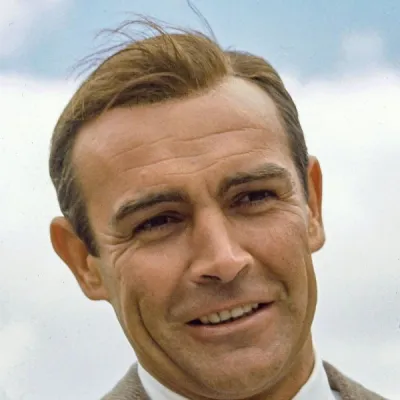
Sean Connery
Human Design Chart
Biography
Connery is also known for his work with directors such as Alfred Hitchcock, Sidney Lumet and John Huston. Their films in which Connery appeared included Marnie (1964), The Hill (1965), The Offence (1973), Murder on the Orient Express (1974) and The Man Who Would Be King (1975). He also acted in Robin and Marian (1976), A Bridge Too Far (1977), Time Bandits (1981), Highlander, The Name of the Rose (both 1986), Indiana Jones and the Last Crusade (1989), The Hunt for Red October (1990), Dragonheart, The Rock (both 1996) and Finding Forrester (2000). His final film roles were The League of Extraordinary Gentlemen (2003) and Sir Billi (2012).
Connery received numerous accolades. For his role in The Untouchables (1987), he received the Academy Award for Best Supporting Actor (making him the first Scottish actor to win a major Oscar) and the Golden Globe Award for Best Supporting Actor – Motion Picture.
Sean Connery as a Manifesting Generator 2/4 in Human Design
Manifesting Generator 2/4 — Design at a Glance
Sean Connery's design showed a tendency towards hybrid energy: the constant power of a Generator paired with the lightning-fast, step-skipping dynamics of a Manifestor. He was someone who knew immense creative joy in a 'play mode', but lived in the tension between this ease and the risk of frustration.
This configuration described a Manifesting Generator. With his defined Sacral Center, he had constant energy and should respond to impulses rather than initiate them. Unlike pure Generators, however, he could skip steps and quickly draw things into his life. This speed carried two risks: First, it led to important steps being skipped, causing backtracking, frustration – the non-self theme of this type. Second, he tended to pursue multiple impulses simultaneously. Without strategic alignment, his creative joy would quickly turn to frustration.
To make his speed useful, the same strategy applied as for Generators: react to life and only act when the Sacral Center responded with a clear 'yes'. Regular review of projects by inner authority was crucial. If this was in place, he drew deep satisfaction from his work. Parallel working on various ventures then became no hindrance but a source of strength, so long as variety and fun were at the forefront. The compulsion to finish one thing before starting another would have slowed rather than fostered his energy.
Emotional Authority
Sean Connery's design inclined towards emotional detachment in decision-making; spontaneous impulses proved deceptive. He showed himself to be someone who consciously let decisions ripen overnight, gaining clarity and calm from the wave motion of feelings.
This stance came from his emotional authority. With a defined emotional center, he was subject to constant waves of mood swings: the world always appeared colored by current emotions – one moment's enthusiasm could shift into deep skepticism in the next. This immediate feeling was only a snapshot, not necessarily his truth. Quick, spontaneous judgments out of this emotional heat often had negative consequences.
The mechanics required patience and multiple overnight reviews of important questions. Over time, intense feelings subsided, giving him the necessary distance. Only then did true clarity set in. This process was especially crucial for long-term life decisions, ensuring actions were based on a stable inner foundation rather than fleeting moods. Sean Connery used this time to find calm through the emotional storm.
The 2/4 Profile — Hermit / Opportunist
Sean Connery's design laid a fundamental tension between his deep need for withdrawal into internal processing and his desire to connect with his community. As a 2/4 Profile, combining natural talent and networking skills, he showed in constant alternation: first withdrawing to create clarity; only when this alone time was satisfied did he re-emerge into the social space to nurture relationships. This mechanism required clear, loving communication of needs to the environment – explicitly signaling when company was desired and when withdrawal for regeneration was essential. This prevented misunderstandings and enabled the productive synthesis of solitude and community. In his 'me-time', he immersed in internal processes, using the protective walls of Line 2 (Gate 59-2) to find calm. Once this phase was complete, he emerged from his 'cave', driven by the teacher line of Line 4 (Gate 20). Here, he conveyed knowledge not just theoretically but practically and intuitively, reinforcing others in the community and seeking exchange with favorite people. His design described a cycle: withdrawal to reflect on network wisdom, followed by an appearance in the social space to share these insights and reinforce them through action.
Single Definition — Defined & Open Centers
Sean Connery's design indicated a tendency towards constant, powerful radiance. His defined Heart Center endowed him with persistent willpower and a strong ego; he preferred to determine his life himself and expected recognition for his contribution. This energy flowed into his defined Throat Center, making his communication not just words but direct manifestation of his will – he spoke from the 'I want' perspective. This was supported by the defined Sacral Center, an inexhaustible source of vital energy that responded to answers and gave him the strength to pursue commitments until mastery. His emotional rhythm was shaped by the defined Solar Plexus Center; he had a deep emotional authority whose truth only revealed itself over time. Additionally, his defined Spleen and Root Centers ensured acute intuition in the moment as well as constant inner pressure for forward movement.
In contrast, his mental and identity-related areas were open. The open Head and Ajna Centers meant that he did not have a fixed mental structure but reacted flexibly to inspiration from the environment. He tended to wonder if he had to find answers that were actually not his problem, and could easily become mentally confused when internalizing others' pressure. Similarly, his G Center was also open; Sean Connery did not have a set identity or direction. Instead, he adapted to his surroundings and took on the qualities of those around him like a mirror. This allowed for enormous adaptability but also made him feel lost in the wrong place, as his sense of 'Who am I?' was determined from outside.
Channels for emotional intensity, powerful intuition and life resilience.
Sean Connery's design showed someone whose life force was characterized by an urgent restlessness. The Channel of Charisma 34-20 connected his sacral energy with the Throat Center, translating raw physiological power into expression immediately. This configuration made it difficult for him to sit still; the speed at which generative power reached manifestation often bypassed conscious reaction. His achievements were impressive, yet this driving energy could become obsessive if not guided by inner leadership. Therefore, it was essential for him to only engage in things he truly enjoyed to conserve his vitality and avoid being carried away like a misfired rocket.
This direct expressiveness was supported by the Channel of Eureka 57-20. Here intuitive insight flowed directly from the Spleen Center into the Throat Center, giving him the ability to speak clear truths in the moment and encourage others to awaken their own inner intelligence. His spontaneous verbal outbursts reached the core of a matter faster than many others, having a profound impact on his surroundings.
Additionally, the Channel of Life Struggle 38-28 was at work. It connected the pressure for individual integrity with awareness of appropriate struggles. Sean Connery sought meaning in his confrontations and stubbornly resisted expectations when it came to his own truth. This determination helped him find significance in difficulties and inspire others through his example.
The Channel of Power 34-57 rounded out this profile by linking sacral reaction with existential intuition, keeping him alert and enabling quick decisions for survival. His energy was geared towards staying independent and physically fit while selectively responding to external input to protect his own vitality.
Individual Circuitry — Circuit Signature
Sean Connery's design indicated a tendency toward individual transformation supported by intuitive perception. His simple chart connected all defined centers in one continuous energetic flow: Throat, Sacral, Spleen, Root, Solar Plexus Centers, and the Heart Center were directly linked.
The Knowledge Circuit shaped him through the Channel of Eureka (20-57), Life Struggles (28-38), and Emotional Release (55-39). This connected Throat, Spleen, Root, and Solar Plexus Centers. It was about forming an expression of new individual identity through emotional waves and innovative impulses in the present moment.
Parallel to this, the Meaning Circuit worked through the Channel of Maturation (42-53), connecting Sacral and Root Centers directly. Here, processing past experiences focused on gaining emotionally charged insights from them and sharing these cyclically with others.
In the Ego Circuit, only the Channel of Money Line (45-21) was active, linking Throat and Heart Centers. This promoted cooperative resource creation and material security through giving and taking. Since this circuit did not connect to the Sacral Center, this dynamic cooperation required necessary pauses for regeneration of life force.
The Integration supported this pattern as an individual stream. The Channels of Charisma (20-34) and Power (34-57) connected Throat, Sacral, and Spleen Centers. They enabled drawing strength from reacting to life, guiding it through intuitive knowledge, and making it effective in the present moment. The Intuition Stream (Spleen) underscored the ability to quickly and accurately recognize what is essential for personal survival and individual alignment.
Right Angle Cross of the Sleeping Phoenix 3
Sean Connery's Design carried the imprint of the right Sleeping Phoenix Cross 3. This configuration established a specific inner dynamics that structured his experience and actions. The right Sleeping Phoenix Cross 3 describes in Human Design mechanics a particular energetic alignment deeply rooted in the system. It did not manifest as a superficial trait but rather as a fundamental driving force that determined his reactions to life events. Sean Connery lived with this built-in architecture, which granted him a unique access to himself and his environment. The mechanics of this cross are complex and require a precise examination of the channels and centers contained within it to grasp its full significance. For Sean Connery, this meant that he interacted with energy and made decisions in specific ways influenced by this deep structure. It was not arbitrary behavior but rather a natural expression form of his design. This inner order shaped his path through life and significantly formed his identity. Sean Connery revealed himself as someone who embodied this particular energetic signature, setting him apart from others and granting him a unique place within human diversity.
Saturn Return · Uranus Opposition · Chiron Return · 2nd Saturn Return — Life Cycles
Sean Connery's design did not reveal specific Human-Design mechanics such as defined centers or channels that would allow for a character classification within this system. Instead, astrological transits marked decisive life phases where external circumstances intensified. In 1971, at the age of 41, he was hit by the Uranus opposition. That year, his multi-million-dollar salary from the film "James Bond 007 – Diamonds Are Forever" flowed entirely into the Scottish International Educational Trust. This act showed a realignment of resources, typical for disruptive periods that often lead to structural breaks or new commitments.
Ten years later, in 1981 at the age of 51, Sean Connery went through his Chiron return. In this fulfillment cycle where one's inner purpose unfolds, he took on the role of Marshal in the science fiction thriller "Outland – Starship Troopers". This career decision reflects the intensity of this phase, during which one's true nature increasingly manifests in daily life and work.
The second Saturn return followed in 1987 at the age of 57. This transit condensed long-term efforts into a sustainable result: Sean Connery received an Oscar for Best Supporting Actor for "The Untouchables". This award stood for maturity and confirmation, which this cycle often brings when earlier efforts bear full fruit. Without specific HD data, these events remained visible as external milestones that shaped his life path without being traceable to an inner strategy or authority.
Manifesting Generator · Emotional Authority — Synthesis
Sean Connery lived a life path marked by a profound inner dynamism. His Human Design as an Manifestor with defined Sacral Center indicated someone who had constant energy available but was not primarily meant to initiate – rather, he responded to impulses. This sacral foundation, coupled with the ability to skip steps and attract things quickly, shaped a character that was both powerful and impatient. The Profile of Natural Talent and Networking amplified this trait by creating a continuous oscillation between the need for withdrawal into internal processes and the desire to connect with others.
A central paradox lay in the combination of emotional authority and this fast, sacral-driven energy. While the defined Emotional Center required a maturing wave to gain clarity, his Manifestor component allowed him to act swiftly. This likely led to an inner tension between the need to weigh decisions carefully and the urge to react immediately – a dynamic that manifested in documented events such as founding a charity (1971) or winning an Oscar (1987).
7 Defined Channels
Incarnation Cross - Right Angle Cross of the Sleeping Phoenix 3
Solar Return
The Solar Return shows the moment when the sun returns to its exact birth position - your personal solar year.
Life Cycles
Discover the life cycles with a detailed triple view (birth chart, cycle chart, composite).
Human Design Profile
- Strategy
- To respond - wait for something to respond to
- Authority
- Emotional Authority
- Profile
- 2/4 - Hermit / Opportunist
- Definition
- Single Definition
- Incarnation Cross
- Right Angle Cross of the Sleeping Phoenix 3
- Date of Birth
- 25.08.1930 18:05
- Place of Birth
- Edinburgh, Australia
Frequently Asked Questions
What was Sean Connery's Human Design type?
What Profile did Sean Connery have in Human Design?
Which Authority guided Sean Connery?
What incarnation cross did Sean Connery have?
When was Sean Connery born?
Discover your own Human Design
Are you also a Manifesting Generator? Find out in a personal reading how to unfold your multi-talents and direct your energy wisely.
More Personalities
Back to overviewSissy Spacek
Aldair

Alizée

Anémone
Angeli

Ann-Margret