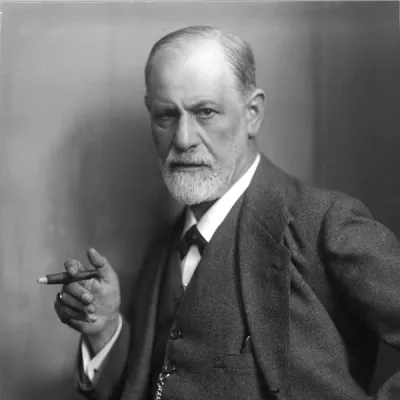
Sigmund Freud
Human Design Chart
Biography
Freud was born to Galician Jewish parents in the Moravian town of Freiberg, in the Austrian Empire (now Příbor, Czech Republic). He qualified as a doctor of medicine in 1881 at the University of Vienna. Upon completing his habilitation in 1885, he was appointed a docent in neuropathology and became an affiliated professor in 1902. Freud lived and worked in Vienna, having set up his clinical practice there in 1886. Following the German annexation of Austria in March 1938, Freud left Austria to escape Nazi persecution. He died in exile in the United Kingdom in September 1939.
In founding psychoanalysis, Freud developed therapeutic techniques such as the use of free association. Freud's redefinition of sexuality to include its infantile forms led him to formulate the Oedipus complex as one of the central tenets of psychoanalytical theory.
Sigmund Freud as a Manifesting Generator 4/6 in Human Design
Manifesting Generator 4/6 — Design at a Glance
Sigmund Freud appeared as a person with a unique energy combination: He possessed the constant power of a Generator, yet he also had the ability to skip steps and achieve results quickly. This design combined Manifestor speed with sacral endurance.
As a Manifesting Generator, Freud was subject to the advice not to initiate things himself but rather to respond to external impulses. Yet his specific configuration allowed him to bring things into his life that would have taken others much longer. However, this speed carried risks: Often he was too quick and skipped important intermediate steps, which led him to return later and make up for them. This process could trigger deep frustration as it went against his natural drive towards efficiency.
Moreover, Freud tended to pursue multiple projects simultaneously by responding to various impulses at once. Without inner consent, his creative enthusiasm quickly turned into frustration. Crucial for him was therefore the strategy of only starting when his sacral center gave a clear "yes." Regular checks to see if he was still satisfied with his undertakings were essential. When these conditions were met, Freud found deep satisfaction in his work. The compulsion to finish one thing before beginning another hindered his access to his power. Instead, he reached his highest performance and contentment through variety and a playful mode.
Emotional Authority
Sigmund Freud was governed by an emotional wave with constant ups and downs in his feelings. His inner authority carried the defined Solar Plexus Center. This meant that he always had to follow this emotional instance when making decisions, regardless of which other centers were defined in his design. The emotional authority always took precedence over all other internal voices.
Freud saw the world through the tint of his current mood. At one moment something could totally excite him, and in the next, the same thing seemed completely negative to him. However, his feeling at that moment was only a snapshot, a first impression, which did not necessarily represent his truth yet. Quick, spontaneous decisions made from such an emotion could therefore have negative consequences.
Instead, his design showed the necessity of time and patience for the ripening process. He should sleep on decisions multiple times and take his time. Over time, intense feelings subsided, allowing him to gain emotional distance. Clarity and calmness set in. This process was primarily important for long-term, life-influencing decisions. Only after going through this cycle of excitement and calming down could he make a deeper, more comprehensive insight. The emotional authority thus did not demand immediate action but rather waiting for the calm after the storm to recognize the true truth.
The 4/6 Profile — Opportunist / Role Model
Sigmund Freud's Design laid a deep inner conflict: between the heart seeking belonging and the head striving for detached wisdom. In his first thirty years, the experimental energy of Line 4 dominated, connected with the early expression of Line 6 as Line 3. He tested relationships and friendships, often vulnerable and open to new experiences.
This phase ended with Saturn's return. From then on, the full power of Line 6 was activated. Sigmund Freud now faced the lifelong task of integrating the contradiction between the desire for community (Line 4) and the wish for meaningful distance (Line 6). His design challenged him to evolve from an experimenting young adult into a wise role model.
This transformation was marked by increased Venus: Higher goals stood above personal recognition. He learned that cooperation with others was key to taking on this role. At the same time, his big heart had to remain cautious; it could not open to everyone to avoid getting hurt. The mechanics of his lines required discretion and precise timing for direction changes. A loose mouth would have provoked conflicts; instead, silence fostered his spiritual insight.
In later life, he unwaveringly hoped for openness and better relationships, driven by the belief that a better world was possible. This attitude united pessimism with deep optimism: Every interaction was a necessary step towards greater unity. Sigmund Freud thus showed himself to be someone who fulfilled his role as a mentor through listening and hope for knowledge, without losing the necessary distance.
Split Definition — Defined & Open Centers
Sigmund Freud showed himself to be someone with a deeply rooted inner structure and a clear, consistent identity. His defined G Center gave him a firm sense of his own direction and the feeling of being lovable without relying on others. This inner security formed the foundation of his personality.
His energy balance was marked by a defined Sacral Center. This meant an enormous vital force that could only be activated in response to external requests. Initiation was not available; only when he was asked or invited could his Sacral Center respond with a clear "yes" or "no," thereby providing energy for satisfaction. Without this correct integration, frustration and exhaustion threatened.
Freud did not make decisions impulsively but waited for the emotional wave of his defined Solar Plexus Center to pass. This center functioned as his inner authority. Truth revealed itself to him only over time, after emotions had run their cycles and clarity emerged. Instead, spontaneous judgments in the moment came from his defined Spleen Center, which provided intuitive warnings or confirmations "in the now." His expression was steady and reliable through a defined Throat Center, allowing him to communicate his truth easily if he trusted his strategy.
At the same time, Freud was open to environmental influences in other areas. His open Head and Ajna Centers meant mental flexibility without constant focus; he tended to absorb inspirations from the environment but could also get lost in doubts or confusion when not listening to his inner authority. The open Heart Center showed a vulnerability to feeling pressured to prove himself or make promises he couldn't keep, lacking consistent willpower. Instead, he often mirrored others' egos. Additionally, his open Root Center absorbed external stress and adrenaline from the environment rather than generating its own pressure. This led him at times to be driven by external pace, even though this pressure did not belong to himself. The wisdom of his design lay in using these open centers as mirrors rather than identifying them as his reality.
Channels for inspiring presence, emotional depth and caring preservation.
Sigmund Freud showed himself as someone who worked through authentic presence and mood-driven expression. His design indicated a tendency towards individual leadership that did not rely on social adaptation but rather on being a living example. This primarily occurred through the Channel of Inspiration 1-8. This mechanism connected the G Center with the Throat Center: Gate 1 stood for bold, creative self-expression from an individual truth, while Gate 8 made this potential publicly accessible. The effect was not achieved through explanations but by living his unique identity and thus inspiring others to live out their own uniqueness. It was a co-creation between his dedication to this individuality and public recognition.
Parallel to this, the Channel of Openness 22-12 worked as an emotional ventilator. It connected the Solar Plexus Center with the Throat Center, where Gate 22 stood for passionate, sometimes melancholic or dramatic outbursts, while Gate 12 added a cautious regulation. His social interaction was strongly dependent on the "ebb and flow" of his emotional wave. Only at the right time could he communicate openly; forced openness led to harshness because the emotional authority of the Solar Plexus required patience until the mood suited effective communication.
A third level was added by the Channel of Preservation 27-50. It connected the Sacral Center with the Spleen Center and brought care as well as responsibility for traditional values into play. Gate 27 provided selfless interest in the welfare of others, while Gate 50 ensured the preservation of tribal laws and order. This support was based on "enlightened selfishness": he only cared for others when they asked and his own energy allowed it, which meant conditional but deep support for the tribe.
Individual Circuitry — Circuit Signature
Sigmund Freud's Design presented itself as a tension field between individual transformation and instinctive protection. This divided definition meant that his energies were not consistently active but had to be triggered situationally by environment or partnership. Two distinct circuits structured this dynamic.
The Knowledge Circuit connected his Throat, Solar Plexus, and Identity Centers into a common flow. Through the Channel of Inspiration (Gate 1–8), he received acoustic, pulsating impulses for new paths. The Channel of Openness (Gate 12–22) promoted the willingness to emotionally process and express these unique insights. This drove his inherent path: gaining new knowledge, transforming himself, and bringing change into the world through authentic expression.
Parallelly, the Archer Circuit directly connected his Sacral and Spleen Centers. The Channel of Preservation (Gate 27–50) created a primal connection between life force and instinct. This energy served to protect family and genetics. It manifested in themes of nurturing, preserving, and defending – classical "mother" and "father" energies meant to ensure the survival of his lineage.
While the Knowledge Circuit aimed at novelty and individual identity, the Archer Circuit focused on timeless instincts for care and preservation. These two separate parts of his design existed side by side: one driving personal evolution through expression, the other a deep commitment to protecting biological and familial heritage. Both aspects required external triggers to fully unfold their effects.
Right Angle Cross of the Sphinx 2
Sigmund Freud's Design established a tendency towards a deep, often unconscious connection with archetypal patterns. He was someone whose inner compass was shaped by the structure of the Right Arm Cross of Sphinx 2. This configuration formed the fundamental life energy and imprinting of his character.
The Right Arm Cross of Sphinx 2 describes a specific energetic alignment. It is not about superficial actions but rather an underlying force that permeates the entire experience. This energy worked as a constant background factor in his life, determining how he received and processed impulses regardless of external circumstances or conscious decisions.
The emphasis was on the archetypal nature of this structure. Archetypes are ancient, universal patterns deeply rooted in human consciousness. For Sigmund Freud, this meant that his reaction to the world often came from these deeper layers. It was an inner logic that did not always lend itself to rational explanation but still significantly influenced his actions and feelings. This imprinting was not a transient state but a persistent part of his design. It created a framework within which his experiences took place. Through this lens, it was easier for him to recognize connections that remained hidden to others, as he himself was carried by this archetypal energy.
Saturn Return · Uranus Opposition · Chiron Return · 2nd Saturn Return — Life Cycles
Sigmund Freud's development proceeded through clear phases marked by planetary cycles. In 1883, at the age of 27, after completing his studies, he laid the groundwork for his own research in the therapeutic field at Meynert's clinic. This corresponded to his first Saturn return: a time when years of preparatory work condenses into a solid result and professional structures are strengthened.
The Uranus opposition in 1895 brought a turning point in his private life: Martha Freud gave birth to their sixth child, Anna. This cycle often signals unexpected changes or breaks in established patterns, here concretely realized through the expansion of the family.
Especially significant was his Chiron return in 1905. At age 49, Freud published "Three Essays on the Theory of Sexuality." This fulfillment cycle marked a blooming period when his incarnation purpose increasingly unfolded and became experientially meaningful – provided he lived according to his strategy. The publication signified the maturation of his work.
His second Saturn return in 1913 further solidified these achievements. At age 57, essays appeared under the title "Totem and Taboo." This cycle deepened the foundations laid during the first Saturn return and anchored his theoretical contributions sustainably within his life's work. The recurring cycles structured Freud's development from initial professional anchoring through family changes to full realization of his intellectual purpose.
Manifesting Generator · Emotional Authority — Synthesis
He was a Manifesting Generator with emotional authority, whose life was marked by a constant interplay between internal perception and the urge for rapid implementation. The sacral energy (defined in the Sacral Center) provided a steady driving force, yet his connection to the Throat Center enabled him to take initiatives and bring ideas into the world – often at the speed of a Manifestor. This dynamic was evident in how he developed new insights and then made them accessible to a broad audience through publications (Channel 1-8), with knowledge always arising from deep feeling (emotional authority).
A central paradox in his design lay in the conflict between the desire for community (Line 4 in Profile) and the necessity of acting as an independent role model (Line 6). The cycles confirm this: While he laid early foundations for collaboration (Saturn Return 1), phases of intense personal confrontation and groundbreaking publications followed (Chiron Return, Saturn Return 2). Thus, he lived out an inner contradiction – between the need for recognition within a group versus the drive to develop and communicate his own, transformative perspectives.
3 Defined Channels
Incarnation Cross - Right Angle Cross of the Sphinx 2
Solar Return
The Solar Return shows the moment when the sun returns to its exact birth position - your personal solar year.
Life Cycles
Discover the life cycles with a detailed triple view (birth chart, cycle chart, composite).
Human Design Profile
- Strategy
- To respond - wait for something to respond to
- Authority
- Emotional Authority
- Profile
- 4/6 - Opportunist / Role Model
- Definition
- Split Definition
- Incarnation Cross
- Right Angle Cross of the Sphinx 2
- Date of Birth
- 06.05.1856 18:30
- Place of Birth
- Freiberg, Germany
Frequently Asked Questions
What was Sigmund Freud's Human Design type?
Which Profile did Sigmund Freud have in Human Design?
What Authority guided Sigmund Freud?
What incarnation cross did Sigmund Freud have?
When was Sigmund Freud born?
Discover your own Human Design
Are you also a Manifesting Generator? Find out in a personal reading how to unfold your multi-talents and direct your energy wisely.
More Personalities
Back to overviewAldair

Alizée

Angeli

Arletty
Artus

Balthus