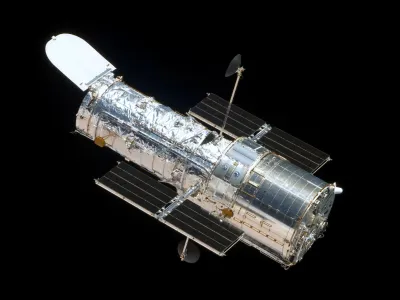
Foto: Ruffnax (Crew of STS-125) / Public domain — Wikimedia Commons
Space: Hubble Space Telescope (Launch)
Human Design Chart
Biography
Hubble's orbit outside the distortion of Earth's atmosphere allows it to take extremely high-resolution images with almost no background light. Hubble's Deep Field has recorded some of the most detailed visible-light images ever, allowing a deep view into space and time. Many Hubble observations have led to breakthroughs in astrophysics, such as accurately determining the rate of expansion of the universe.
Although not the first space telescope, Hubble is one of the largest and most versatile, and is well known as both a vital research tool and a public relations boon for astronomy. The HST was built by the United States space agency NASA, with contributions from the European Space Agency, and is operated by the Space Telescope Science Institute. The HST is one of NASA's Great Observatories, along with the Compton Gamma Ray Observatory, the Chandra X-ray Observatory, and the Spitzer Space Telescope.
Space telescopes were proposed as early as 1923. Hubble was funded in the 1970s, with a proposed launch in 1983, but the project was beset by technical delays, budget problems, and the Challenger disaster. When finally launched in 1990, Hubble's main mirror was found to have been ground incorrectly, compromising the telescope's capabilities. The optics were corrected to their intended quality by a servicing mission in 1993.
Hubble is the only telescope designed to be serviced in space by astronauts. After launch by Space Shuttle Discovery in 1990, four subsequent Space Shuttle missions repaired, upgraded, and replaced systems on the telescope. A fifth mission was cancelled on safety grounds following the Columbia disaster.
The Human Design of Space: Hubble Space Telescope (Launch): Projector 3/5
Space: Hubble Space Telescope (Launch) is a Projector in Human Design – a non-energy type designed to guide and direct others. Projectors make up about 20% of humanity and have a special gift for recognizing and directing the energies and talents of others.
The Projector's strategy is to wait for the right, respectful invitation before contributing their guidance. Without an invitation, the Projector's wisdom is often unrecognized or even rejected.
When Space: Hubble Space Telescope (Launch) lives in alignment with their design, they experience success and recognition. The Projector's not-self theme is bitterness – a sign that their wisdom and guidance isn't being valued.
Space: Hubble Space Telescope (Launch) has Splenic Authority – a spontaneous, intuitive authority. The Spleen speaks softly and only once, in the moment. It manifests as instinctive knowing, a subtle body signal that immediately recognizes what is healthy and safe. Those with this authority must learn to trust the first impulse.
Space: Hubble Space Telescope (Launch) carries the profile 3/5 – Martyr / Heretic. The 3rd line represents the Experimenter: learning through trial and error, embracing life as a practical experiment and growing wise through experience. The 5th line represents the Hero and Savior: others project expectations and hopes onto this line, which can deliver practical solutions for universal problems.
The incarnation cross "Right Angle Cross of the Unexpected 1" describes the overarching life purpose and direction of Space: Hubble Space Telescope (Launch) in Human Design. It consists of the four gate activations of Sun and Earth (personality and design) and only becomes felt when one lives their strategy and authority.
Im Bodygraph von Space: Hubble Space Telescope zeigt sich eine Einfache Spaltung (Split Definition).
Von den 9 Zentren im Bodygraph sind bei Space: Hubble Space Telescope 4 definiert: G-Zentrum, Kehlzentrum, Milzzentrum und Wurzelzentrum. 5 Zentren bleiben offen.
Schaltkreis-Verteilung: Kollektiv (Verstehen, Sinnfinden): 2 Kanäle, Individuell (Wissen): 1 Kanal. Space: Hubble Space Telescope ist damit besonders im Bereich "Kollektiv" geprägt - das Teilen von Erfahrungen und Wissen mit der Gemeinschaft.
3 Defined Channels
Incarnation Cross - Right Angle Cross of the Unexpected 1
Solar Return
The Solar Return shows the moment when the sun returns to its exact birth position - your personal solar year.
Life Cycles
Discover the life cycles with a detailed triple view (birth chart, cycle chart, composite).
Human Design Profile
- Type
- Projector
- Authority
- Splenic Authority
- Profile
- 3/5 - Martyr / Heretic
- Definition
- Split Definition
- Incarnation Cross
- Right Angle Cross of the Unexpected 1
- Date of Birth
- 24.04.1990 08:33
- Place of Birth
- Cape Canaveral, FL, United States
Frequently Asked Questions
What Human Design type is Space: Hubble Space Telescope (Launch)?
What Human Design profile does Space: Hubble Space Telescope (Launch) have?
How does Space: Hubble Space Telescope (Launch) best make decisions?
When and where was Space: Hubble Space Telescope (Launch) born?
What is Space: Hubble Space Telescope (Launch)'s incarnation cross?
Discover your own Human Design
Are you also a Projector? Find out in a personal reading how to unfold your leadership qualities and recognize the right invitations.
More Personalities
Back to overviewAlain-Fournier

Anémone

Ann-Margret

Bourvil
Hergé

Jasraj