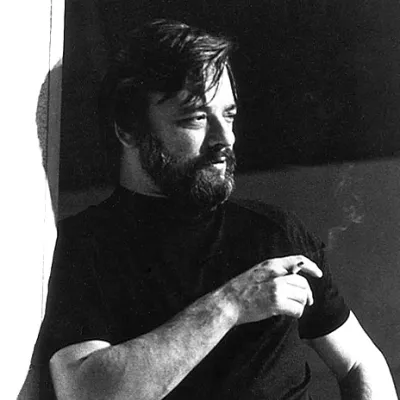
Photo: Wikimedia Commons
Stephen Sondheim
Human Design Chart
Biography
Sondheim was the only child of a father who was a prominent New York dress manufacturer, and a rejecting and controlling mother, Janet, known to friends and associates as "Foxy", first a fashion designer and then an interior decorator. A precocious child, he picked out tunes on the piano at the age of four and in first grade read his way through the New York Times. His life was in upheaval when, at age ten, his parents divorced and his mother sent him to military school. His dad remarried and produced two younger stepbrothers. His mother threatened to jail his dad if Sondheim ever saw his stepmother because she was an "immoral woman," while Foxy was the one who acted in an inappropriately seductive way with her son.
Military school agreed with Sondheim because he loved rules and order. After the divorce he and his mother moved to Doylestown, Pennsylvania where Oscar Hammerstein II, an old friend of the family, had a farm. The Hammersteins had a son, Jimmy, who was Sondheim's age and he spent so much of his spare time at the celebrated lyricist's home that the Hammersteins became a surrogate family to him. Hammerstein introduced him to the musical theatre and at the age of 15 Sondheim and two classmates wrote a musical, By George, for the George School. Showing his score to his mentor, he asked him to criticize it objectively.
What does Projector 4/6 mean for Stephen Sondheim?
Projector 4/6 — Design at a Glance
Stephen Sondheim appeared as a Projector whose design predisposed him to radiate with a focusing aura towards his surroundings. His nature resembled that of a bright light beam shining into dark corners, instantly recognizing weaknesses or flaws in the system around others. However, this immediate perception of dysfunction was only effective when experienced not confrontationally but as an attractive presence. Instead of directly addressing problems, which often led to resistance, his true strength lay in attracting others through his own harmony and clarity, leading them to seek advice independently.
Since Projectors do not have a defined Sacral Center, Stephen Sondheim lacked a constant intrinsic source for life energy. His energy flow followed cyclical patterns: phases of high productivity and rapid workability alternated with necessary rest periods to prevent burnout. The conventional model of continuous performance was at odds with this biological rhythm. His strategy involved waiting for honest, appreciative invitations from his environment before bringing in leadership skills. When he adhered to the path of waiting and recognition, it led to success and reward. Ignoring his design, however, brought about the theme of bitterness, a feeling of disappointment over others' inability to recognize his worth.
Splenic Authority
Stephen Sondheim exhibited a decision-making stance based on immediate intuitive perception. His design carried the authority of the Spleen Center, meaning that his inner knowledge acted as a spontaneous signal for health and safety. With both the Emotional and Sacral Centers open – a prerequisite for only Projectors or Manifestors to carry this authority – he had to rely on this fine impulse.
This Spleen Center served as his alarm system. It provided him with information in each moment about whether a situation, person, or place was right for him. This initial impulse directly served his well-being and allowed him to rigorously distance himself from harmful influences. However, this signal was very subtle and came only once. There was the risk that other voices or considerations might drown out this quiet call. Therefore, his decision-making required high vigilance; often a brief retreat helped him hear the original impulse.
Since what is right became known only in the moment, his plans changed frequently on short notice. Long-term commitments were difficult for his system as they contradicted its flexible, immediate knowledge. Instead, he needed much freedom and the ability to act spontaneously to avoid stifling his inner intuition.
The 4/6 Profile — Opportunist / Role Model
Stephen Sondheim was marked by Profile 4/6, characterized by a lifelong tension between the deep need for belonging and the later emerging urge towards distant, broad perspective. In the first three decades of his life, Line 6 still resembled a Line 3; during this phase he frequently and intensely experimented with relationships and friendships, driven by the social curiosity of the Four-Line.
With the activation of the Six-Line, a character conflict emerged: The Heart (Line 4) yearned for connection while the Head (Line 6) demanded withdrawal to gain an overview. This dynamic shaped his development towards the role of a Role Model. In later years, he was expected to fulfill the high standards of a wise figure and stand out through cooperation with others. His heart remained cautious throughout; it only opened to selected individuals to avoid injuries from false bonds. The Six-Line went through phases of martyrdom and roof phase before entering an authenticity phase after age 50, where perfect behavior was no longer seen as hypocrisy but as individual survival behavior.
Single Definition — Defined & Open Centers
Stephen Sondheim was marked by a defined Spleen Center, which gave him a deep intuitive connection to the present moment. This center guided his survival awareness and health through spontaneous, non-rational judgments in the "now." This was complemented by his defined Root Center, providing constant adrenalized pressure – not as disruptive stress but as driving force for material existence and correction. This combination allowed him to connect existential intuition with physical drive, enabling active and alert movement in the world.
In contrast, his design revealed several open centers making him receptive to external influences. His open Head Center lacked steady mental inspiration; instead, Sondheim tended to be overwhelmed by doubts or foreign questions when he did not trust his inner authority. His open Ajna Center meant conceptual thinking was flexible but prone to interpreting others' answers as personal truth or getting lost in theoretical labyrinths.
Especially defining were the open G-, Heart, and Sacral Centers. His open G-Center lacked a fixed identity; Sondheim did not actively seek direction but let his environment initiate him to discover who he was. His open Heart Center led to an inability to prove his worth through willpower and avoiding promises due to lacking consistent energy for it. Finally, his open Sacral Center reflected no personal generative life force; instead, it absorbed the energy of others, which could exhaust him if he did not pause. These opennesses made him a sensitive mirror for identity, will, and vitality in his environment while his defined centers formed a stable core of intuition and pressure.
Channels for meaningful life struggle.
Stephen Sondheim was marked by a stubborn determination to follow his own path. The Life Struggle Channel 38-28 connected the Root Center with the Spleen Center, giving him the ability to find meaning in everyday struggles. Gate 38 exerted pressure to defend individual integrity against external distractions, while Gate 28 intuitively recognized which conflicts were truly worthwhile. This configuration drove him to resist expectations and risk security to fight for values that mattered to him. His design promoted a mutative force that challenged the status quo and could enforce individualization.
Additionally, specific gates influenced his development. Gate 25 brought a spiritual stance of innocence and mystical centering, where the shaman in this gate tested innocence in the process. Gate 46 demanded full commitment to the process and saw the physical body as a temple of the personality crystal; success here arose through engagement and presence in the now. In the G Center, complex Gate 10 was active, feeding integration processes and genetically setting behavioral patterns for describing his profiles. Gate 15 steered collective behavior and established logical flows by adapting to natural rhythms, coupled with humility.
On the design side, Gate 44 supported awareness and responsiveness; transformation occurred through unconditional interaction and stored experiences from cellular memory. Gate 54 connected worldly success with mystical insight, where a partner or buddy supported development. Finally, Gate 53 enabled freedom for new experiences and the beginning of developmental cycles, allowing him to pioneer leaving old paths behind, even if the lack of closure could lead to depression. These elements collectively shaped his unique expression.
Individual Circuitry — Circuit Signature
Stephen Sondheim revealed through his design as someone whose inner security and intuitive perception were inseparably linked to overcoming life's struggles. His Spleen Center, the center for intuition and what is truly important, was in direct energetic connection with the Root Center, the place of fear and survival energy. This configuration through Channel 28-38 meant that he did not experience instincts and fears as separate phenomena. Instead, the energy of both centers flowed together: His intuitive perception was sharpened by the pressure of life circumstances, while his survival strategies were guided by a deep inner wisdom.
The knowledge circuit to which this connection belongs generally revolves around one's inherent path and the transformation of new insights. For Stephen Sondheim, however, only the specific aspect of "life struggle" was active. The other channels in this circuit, which are associated with creative flashes or inspiration, were not present for him. Therefore, his focus was less on generating novel ideas through inspiration and more on how he dealt with the challenges of his existence and transformed them into a sustainable inner stance. As a simply defined type, he possessed this one continuous power line between Spleen and Root. This shaped his experiential world: He learned through life itself by intuitively sensing what was necessary to master the pressure of existence. His strength lay in deriving a clear, instinctive direction from the struggle to overcome life without being distracted by external expectations.
Right Angle Cross of the Vessel of Love 1
Stephen Sondheim's Human Design indicated a tendency towards profound emotional connections. He was someone who not only sought relationships but saw them as central, almost structural in importance. This orientation stemmed from the right cross of the Love Vessel 1. In Human Design mechanics, this configuration marks an intense need for mutual dependence and emotional security. Stephen Sondheim lived with the imprint that his well-being depended heavily on whether he felt loved and needed in a relationship. It was not about superficial attraction but a deep desire for merging and affirmation from another person. This mechanism acted as an inner compass: it directed his attention to partnerships that could offer him this emotional anchoring. At the same time, it carried potential for strong bonds that brought both stability and challenges. Stephen Sondheim navigated his life through this filter of emotional intensity. His way of loving and being loved was marked by this specific energetic signature that viewed closeness not as optional but essential to his inner alignment.
Saturn Return · Uranus Opposition · Chiron Return · 2nd Saturn Return — Life Cycles
Stephen Sondheim showed himself to be someone who underwent a profound transformation in his middle years, which profoundly shaped his creative expression. His design indicated a tendency towards an intense internal reorientation when certain planetary cycles became active. This was evident in 1971 at the age of 41: The premiere of “Follies” marked the peak of the Uranus opposition. This cycle often brings sudden, unexpected changes or a break with previous patterns. For Sondheim, this meant not only a new work but also a fundamental shift in his artistic identity, driven by the need to question and redefine established structures.
Earlier, the first Saturn return in 1957 at the age of 27 had played its part: In that year he wrote the lyrics for “West Side Story”. The Saturn return is a period when years of groundwork condenses into a solid foundation for further life. For Sondheim, this was the moment when his early work became professional reality, giving him recognition and structure. Both events show how his Human Design responded to external milestones: First through the consolidation of his position (Saturn), later through a radical renewal of his creative process (Uranus). This sequence underscores the dynamic between anchoring and change in his life.
Projector · Splenic Authority — Synthesis
Stephen Sondheim was a Projector whose life was marked by a deep ability to recognize patterns and flaws in his environment (Spleen Center as Authority). This sharp gaze consistently focused on uncovering hidden dynamics – not to criticize but to create healing or at least clarity through understanding. This showed repeatedly in his work, where complex relationships and societal structures were dissected (Channel 38-28: Life Struggle). He lived a process of constant searching for meaning and value in the face of challenges, which drove him to continually seek new paths.
A central paradox in his design lay in the interplay between heart and mind (Profile 4/6). On one hand, he longed for belonging and connection (Line 4), on the other, he was an independent thinker who reflected on life from a distant perspective (Line 6). This internal conflict led to a constant oscillation between the desire to be part of a community and the need for intellectual freedom. The premiere of a work (trigger event) could thus express both connection as well as a manifestation of his unique perspective.
1 Defined Channel
Incarnation Cross - Right Angle Cross of the Vessel of Love 1
Solar Return
The Solar Return shows the moment when the sun returns to its exact birth position - your personal solar year.
Life Cycles
Discover the life cycles with a detailed triple view (birth chart, cycle chart, composite).
Human Design Profile
- Type
- Projector
- Strategy
- Wait for the respectful invitation
- Authority
- Splenic Authority
- Profile
- 4/6 - Opportunist / Role Model
- Definition
- Single Definition
- Incarnation Cross
- Right Angle Cross of the Vessel of Love 1
- Date of Birth
- 22.03.1930 21:00
- Place of Birth
- New York, NY, United States
Frequently Asked Questions
What was Stephen Sondheim's Human Design type?
Which Profile did Stephen Sondheim have?
What was Stephen Sondheim's Authority?
What incarnation cross did Stephen Sondheim have?
When was Stephen Sondheim born?
Discover your own Human Design
Are you also a Projector? Find out in a personal reading how to unfold your leadership qualities and recognize the right invitations.
More Personalities
Back to overviewSissy Spacek
Aaliyah

Alain-Fournier
Alexia

Alizée

Anémone