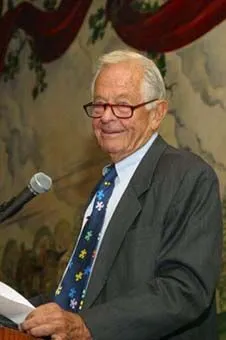
T. Berry Brazelton
Human Design Chart
Biography
Brazelton died in Barnstable, Massachusetts on the morning of 13 March 2018, aged 99.
T. Berry Brazelton as a Generator 6/3 in Human Design
Generator 6/3 — Design at a Glance
T. Berry Brazelton was someone with immense inner endurance and strength who effectively used his energy when responding to impulses from his environment. His Generator design provided him with a clear strategy: not to initiate himself but to wait for life's signals, then respond accordingly. This approach allowed him to channel his large sacral energy meaningfully.
The mechanics of his type emphasized the importance of this gut reaction. When he engaged with authentic signals that his inner self confirmed with a clear 'yes', he could push projects forward sustainably and experience deep feelings of fulfillment. Conversely, ignoring these internal resonances or compulsively tackling tasks without inner consent often led to frustration and energy loss.
His success depended largely on not working against his natural rhythm. By learning to wait for the right moments and then acting with full force, he avoided typical burnout pitfalls or suppressing his creative drive. This ability to distinguish between meaningful action and necessary pause shaped his work style and ensured that he remained capable of action in the long term as long as he adhered to this reactive strategy.
Emotional Authority
T. Berry Brazelton demonstrated decision-making that did not exhaust itself in the first impulse but was characterized by a distinctive emotional up-and-down pattern. His inner authority lay in the defined Emotional Center, meaning he was subject to emotional waves. The world appeared colored by his current mood: A moment of enthusiasm could quickly be replaced by a negative outlook. However, this initial impression did not necessarily represent the truth. Quick, spontaneous decisions based on such emotions often had negative consequences for him. Instead, his design required patience and conscious hesitation. He took time to let decisions mature, slept on them multiple times, and asked himself repeatedly. This process served to even out intense feelings and gain emotional distance. Only then did clarity and calmness set in. This approach was particularly important for long-term decisions that influenced the course of his life. Emotional authority always had precedence over other defined centers in his chart, regardless of what else might be activated. This mechanism ensured a deeper and more comprehensive understanding by filtering out initial emotional noise and finding true inner guidance.
The 6/3 Profile — Role Model / Martyr
T. Berry Brazelton was someone who sought an extraordinary life away from conventional standards. His design laid down permanent internal restlessness driven by the search for the perfect path, which seemed never quite within reach. This attitude stemmed from his 6/3 Profile, which made him act as an experimenter in the first thirty years of his life. He went through numerous self-experiments to find the right form.
Although this intense experimentation should have slowed down after the first Saturn Return, it never ended entirely. The line of the Adventurer remained active and continued to promote new experiences. At the same time, awareness for responsibility and wisdom grew with age. T. Berry Brazelton used his unusual life experiences to become a visionary role model. Humor accompanied this development as a counterbalance to often felt dissatisfaction.
The mechanics of his profile described a tension between the need for security and readiness for change. While he wanted to maintain an overview, he had to learn either to accept or reject mutation. This was a crucial stance for his individuality. Simultaneously, his design addressed the confrontation with outdated structures. It was about questioning old principles and destroying them once reservations were overcome. This process could lead him to break away from earlier commitments where he no longer fit in. Thus, his experimental nature combined with his later role as a wise model who learned and passed on from his experiences.
Split Definition — Defined & Open Centers
T. Berry Brazelton emerged as someone with a clear inner direction and a consistent way of self-expression. His defined G Center gave him a firm sense of self-understanding and purpose, enabling him to show others new paths without being dependent on them. This inner security aligned with his defined Throat Center, which served as a pivot point for translating messages from various body parts into clear communication and action. His voice was reliable, shaped by the connection to his inner sources, allowing him to express his truth with honesty and ease.
As a Generator with a defined Sacral Center, T. Berry Brazelton possessed an enormous vital energy source that felt like a constant hum within him. For him, it was essential to respond to questions rather than initiate them in order to use this energy correctly and avoid frustration or exhaustion. His emotional authority lay in his defined Solar Plexus Center, teaching him to wait out the waves of his feelings before making decisions. This patience allowed for deep emotional clarity and a comprehensive understanding of himself and others. The defined Root Center provided the necessary pressure needed to move forward in the world and manage stress healthily.
In contrast, his Head, Ajna, and Heart Centers were open. This meant that he did not have consistent mental processing and was easily influenced by doubts or confusion from others. He tended to imagine questions that weren't his own and had to learn not to seek constant inspiration. His open Heart Center led him to lack willpower and risk getting caught in a cycle of promises and disappointment if he tried to prove his worth. Instead, he could develop wisdom by perceiving the vibrations of other egos and learning whom to trust. His open Spleen Center made him sensitive to well-being and fears in his environment, helping him intuitively recognize who or what was good for him as long as he did not act impulsively.
Channels for change, presence and emotional clarity.
T. Berry Brazelton emerged as someone deeply involved in the process of transformation and radiated a clear, authentic presence. His design indicated a tendency to not only receive evolutionary impulses but also to make them effective through self-assured action in the here and now.
This dynamic was significantly shaped by Channel 60-3, connecting the Root Center with the Sacral Center via Gate 60 (Limitation) and Gate 3 (Order). It brought a powerful, pulsating energy often accompanied by melancholy when no new idea immediately appeared. Brazelton had to learn to patiently endure these internal pauses rather than rationalizing them away. The channel forces one to accept limitations and move beyond the confusion of a fresh start to enable evolutionary change. This energy also deeply conditioned his environment.
Parallel to this, Channel 10-20, connecting the G Center with the Throat Center, was at work. Through Gate 10 (Appearance) and Gate 20 (Now), it expressed fundamental self-affirmation: "I am." This channel fostered the ability to love and accept oneself, helping him bypass resistance and inspire others through his clarity to be themselves as well. It was less an intellectual recognition than a living demonstration of confidence in every moment.
Additionally, Channel 30-41 propelled his actions forward. Linking the drive from the Root Center (Gate 41, Limitation) with the emotional wave of the Solar Plexus (Gate 30, Feeling Awareness), it generated intense restlessness and an unquenchable thirst for new experiences. Brazelton actively sought ways to transform inexperience into wisdom, learning to give the emotional wave time before acting to gain clarity rather than mere impulsiveness.
Further nuances were provided by prioritized gates: Gate 1 emphasized unique creativity without limitations at the right timing, while Gate 2 represented receptivity as a foundation for new evolutionary directions. Gate 49 called for obedience to principles within the tribe, and Gate 45 expressed regal hierarchy and willpower. These configurations collectively formed his Profile as someone who initiated change through authentic presence and emotional depth.
Individual Circuitry — Circuit Signature
T. Berry Brazelton's design established a tendency towards separate, parallel energetic streams. With "split definition," there exist two independent groups of centers that are not directly connected to each other but coexist as separate energy fields.
One group includes the Sacral, Root, and Solar Plexus Centers. Here, the Knowledge Circuit operates through Channel 3-60 (Mutation), which promotes deviations from the known and clears new paths. Parallel to this, the Meaning Circuit flows through Channel 30-41 (Recognition). This connects the emotional wave of the Solar Plexus Center with the Root Center, reflecting past experiences and sharing their significance for the collective. Both streams work in the realm of intuition, survival, and emotional processing but remain energetically independent from each other.
The second group encompasses the G and Throat Centers. Here, the Integration Circuit operates through Channel 20-10 (Awakening). This connects identity in the G Center directly with expression in the Throat Center, allowing for the articulation of intuitive knowledge and proper behavior in the present moment to express highest individuality. This connection does not have a direct energetic flow to the first group from Sacral, Root, and Solar Plexus Centers.
T. Berry Brazelton thus moves between two distinct worlds: on one hand, deep emotional processing of past experiences and mutation; on the other hand, clear identity-forming expression in the present moment.
Left Angle Cross of Defiance 1
T. Berry Brazelton exhibited a fundamental stance marked by a profound inner tension between the desire for individual validation and the necessity to integrate into larger communal structures. His design indicated a lifelong struggle with the question of how to maintain one's own voice without losing contact with the group. This configuration did not describe simple harmony but rather an ongoing process of balancing: The impulse to assert oneself as an independent personality was always in dialogue with the need for belonging and social embedding.
For T. Berry Brazelton, this meant that his path did not follow a linear progression but consisted of constant adaptations. He had to learn how to articulate his individual needs in such a way that they were accepted by his environment without betraying his core self. This dynamic created a unique sensitivity for the boundaries between Self and Other. His life was characterized by attempts to synthesize these two poles – the Individual and the Collective – into a personal synthesis. It was an internal challenge that pushed him to always seek ways to make his uniqueness visible within the fabric of the community without becoming isolated or completely dissolving.
Saturn Return · Uranus Opposition · Chiron Return · 2nd Saturn Return — Life Cycles
T. Berry Brazelton's design shaped a life path where structural milestones synchronized with inner maturation. His first Saturn Return in 1943 at age 25 marked the completion of his medical studies with a doctorate degree. This point condensed years of academic effort into a solid foundation, as typical for this cycle: The internal structuring found its external confirmation through the earned degree.
A second crucial moment occurred in 1973 when T. Berry Brazelton at age 55 developed the Neonatal Behavioral Assessment Scale (NBAS). This second Saturn Return confirmed and stabilized his professional authority further. The development of this instrument was not a sudden impulse but the result of long-term, condensing expertise. Both events show how T. Berry Brazelton acted in phases of maturity and confirmation: He built upon previous work to create measurable, lasting structures in his field. His strategy involved using these cyclical phases of condensation to not only acquire knowledge but pour it into practical, applicable forms that had an impact beyond the individual.
Generator · Emotional Authority — Synthesis
T. Berry Brazelton lived a life marked by a deep connection to the pulsating energy of creation. As a Generator with emotional authority and the Profile Role Model/Experimentator, he followed an inner rhythm driving him to continually explore new paths (Channel 3-60). This energetic dynamic was evident in a constant search for optimal solutions, which were always accompanied by an emotional wave requiring thorough maturation processes. The ability through the defined Throat Center to transmute and articulate messages allowed him to share insights about others' development and thus initiate transformation – particularly regarding early childhood.
A central paradox lay in the combination of experimental joy and the need for wisdom and responsibility. While the Profile suggested a constant search for extraordinary experiences, emotional authority indicated that profound decisions required time and inner reflection. This led to a tension between the urge to try new things and the necessity to filter these impulses through feeling and integrate them into established structures – an interplay evident in successes during formative life cycles (Saturn Returns).
3 Defined Channels
Incarnation Cross - Left Angle Cross of Defiance 1
Solar Return
The Solar Return shows the moment when the sun returns to its exact birth position - your personal solar year.
Life Cycles
Discover the life cycles with a detailed triple view (birth chart, cycle chart, composite).
Human Design Profile
- Type
- Generator
- Strategy
- To respond - wait for something to respond to
- Authority
- Emotional Authority
- Profile
- 6/3 - Role Model / Martyr
- Definition
- Split Definition
- Incarnation Cross
- Left Angle Cross of Defiance 1
- Date of Birth
- 10.05.1918 03:27
- Place of Birth
- Waco, TX, United States
Frequently Asked Questions
What was T. Berry Brazelton's Human Design type?
What profile did T. Berry Brazelton have?
Which authority guided T. Berry Brazelton?
What incarnation cross did T. Berry Brazelton have?
When was T. Berry Brazelton born?
Discover your own Human Design
Are you also a Generator? Find out in a personal reading how to use your sacral energy correctly and discover deep satisfaction.
More Personalities
Back to overviewAaliyah

Alain-Fournier

Alexia

Angèle

Angeli

Anne-Marie