
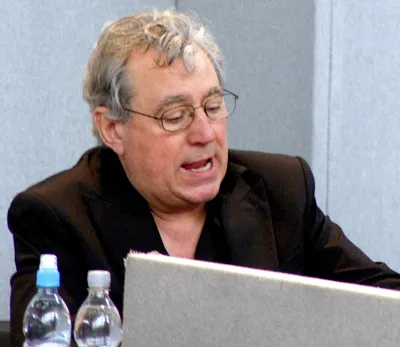
Terry Jones
Human Design Chart
Biography
Jones married twice and had three children. After living for several years with a degenerative aphasia, he gradually lost the ability to speak. He died on 21 January 2020 at age 77 from complications of dementia at his home in North London.
Human Design Analysis: Terry Jones as Manifestor 5/1
Manifestor 5/1 — Design at a Glance
Terry Jones revealed himself as someone who wanted to actively push the world forward. His Human Design type was that of a Manifestor, an archetype serving as a pioneer and visionary. Similar to an emperor in ancient Rome, he had a clear vision of what should be but did not lead the necessary battles himself. Instead, he delegated tasks to others to achieve his goals.
This style of leadership often polarized people. Since manifestors usually think further ahead than their surroundings, they were frequently misunderstood. Some followed his great dreams enthusiastically while others rejected or even hated these visions. This conflict between followership and rejection formed a central pain point in his life.
To minimize this resistance, it was crucial for Terry Jones to apply his strategy of informing others before acting. Before he took action, he had to clarify his intentions with others. This helped the right group of people find him and follow him. If he followed this strategy, his design rewarded him with a sense of inner peace. Acting against this nature often resulted in deep, lasting anger. Therefore, his path involved implementing his vision into reality through clear communication without exhausting himself in constant battles against misunderstandings.
Ego Authority
Terry Jones revealed himself as someone whose inner truth lay in will – specifically in what he spoke spontaneously and unfiltered. His Human Design carried the rare 'authority in ego'. This configuration is possible only for projectors or manifestors, requiring that the emotional, sacral, and spleen centers be open while the ego center is defined.
This great openness of his chart made him susceptible to influence and distractions but also created a clear source for decisions: his own will. The challenge was to distinguish the mind – which often represents others' interests in the open centers – from the authentic voice of the ego. What came directly out of his throat was his truth; thought considerations served the non-self.
When Terry Jones did something that truly mattered to him, he had the necessary willpower to achieve his goals and fulfill promises. This consistent following of his own will could appear selfish externally but was essential for his well-being. He always aimed for actions that rewarded him – whether through material success or the urge to transcend boundaries and be first in new directions.
A central mechanism of his authority was the necessity of a pause after goal achievement. Continuous work led to unwanted results in this configuration, inevitably resulting in exhaustion and illness. His design required a rhythm between effort and recovery to remain healthy and effective.
The 5/1 Profile — Heretic / Investigator
Terry Jones revealed himself as someone who gathered deep knowledge to offer solutions to others' problems. His Human Design Profile 5/1 shaped this attitude: Line 1 drove him towards intensive research and learning new challenges, while line 5 gave him a nearly magnetic aura. Others often sought his advice for solutions, confirming his gifts but also posing risks. Without clear boundaries, this demand could lead to overexertion, similar to an expert exhausted after hours of consultation. The mechanics of his design therefore required the ability to say no to maintain a healthy balance between private research and public service.
Additionally, in his design, Gate 19 with its fifth line highlighted readiness for sacrifice during crises. This could manifest as a tendency to serve greater purposes sometimes with a certain condescension or emotional instability. The first line of Gate 1 also emphasized the need for patience in creative processes. Creation and mutation followed their own laws here, independent of personal will. Terry Jones had to learn to respect these inner rhythms and allow creativity to arise without steering it through ego or compulsion. This configuration described a life task: uncovering hidden connections and passing them on to others, always balancing the need for solitude in research with the expectations of his environment.
Split Definition — Defined & Open Centers
Terry Jones was characterized by a life marked by constant inner mental tension. His design featured defined Head and Ajna centers, which created a continuous pressure towards inspiration, questioning, and conceptual thinking. This mental process was ongoing; he thought constantly, processed data, and formulated concepts. However, since these centers did not have their own energy source, the attempt to immediately implement these thoughts often led to frustration or hasty decisions. Instead, his strength lay in pressuring others through his specific way of thinking or inspiring them, particularly those with undefined Head Center.
His communication was reliable and structured, supported by a defined Throat Center that drew directly from Ajna. He articulated what his mind conceptualized and could thus clearly manifest his ideas. Additionally, he had a firm identity and willpower through the defined G- and Heart Centers. This gave him strong self-esteem, a clear sense of direction, and the ability to keep promises as well as control resources autonomously. He enjoyed working independently and sought recognition for his contribution.
At the same time, Terry Jones was vulnerable to external influences in areas without personal definition. His open Sacral Center made him sensitive to the vital energy of his environment; he tended to overextend himself on borrowed energy and had difficulty setting limits or knowing when enough was enough. The open Solar Plexus Center absorbed emotions from others, which could lead to experiencing foreign moods as his own and avoiding emotional confrontations to maintain stability. Furthermore, his open Spleen Center made him susceptible to fears and a need for security through others, while the open Root Center amplified external stress, driving him into cycles of frenzy and exhaustion if he did not learn to observe rather than follow this pressure.
Channels for reflection, inspiration, success and abstraction.
Terry Jones was someone who drew attention from others with his blore existence and individual style. His design featured the Inspiration Channel 1-8, connecting G- and Throat Centers. This mechanism worked primarily by living and demonstrating his unique identity rather than through words or explanations. As an example, he inspired others to express their own creativity; it was a process of co-creation where his authentic presence met with recognition from the environment.
Parallel to this, Terry Jones gathered experiences as a witness to life. The Lost Son Channel 13-33 also connected G- and Throat Centers but focused on reflection. Here he listened, stored secrets and memories (Gate 13) and withdrew to process them in peace (Gate 33). Only after this patient maturation did he share his insights further. This configuration conveyed the wisdom that life ultimately makes sense if one simply observes the sequence of events rather than pushing for results out of frustration.
In the material world, the Life Line Channel 21-45 shaped him in his design. This mechanism connected Heart and Throat Centers and emphasized the will to control resources and work. Terry Jones sought independence to follow his own rhythm and avoid stress on the heart. It was about taking responsibility ("I have or I don't"). He worked best when he himself was the boss and retained control over his actions.
Mentally, the Abstraction Channel 47-64 drove him. He filtered every experience through a kaleidoscope of mental images to understand underlying connections. This mind sought stories and perspectives that it could then communicate. Although this process could sometimes be confusing, patience led to sudden clarity or an inspiring story or new perspective emerging from many details, which he passed on to others.
Collective Circuitry — Circuit Signature
Terry Jones brought new ideas into the world through emotional clarity. His design connected Throat with Identity Center in the Knowledge Circuit via the Inspiration Channel. This promoted creative flashes and the expression of a unique individuality. Parallel to this, he sought meaning in past experiences. The Meaning Circuit in him linked two separate parts: Head with Ajna Center for abstract thoughts as well as Throat with Identity Center to share felt insights. This configuration underscored the need to learn from the past and connect knowledge with others. Additionally, Terry Jones possessed the ability to acquire resources in the Ego Circuit. The channel between Heart- and Throat Centers supported cooperation and mutual aid within a community. Since his design featured a Shared Definition, two independent energy groups existed: one connected Identity, Throat, and Heart; the other Head and Ajna. These centers did not work together but as separate fields of power. Terry Jones utilized these structures to express inspirations, reflect past emotions, and organize material support in social contexts. His energy was pulsing in expression, cyclical in meaning-making, and traditional in cooperation.
Left Angle Cross of Refinement 2
Terry Jones demonstrated a fundamental approach based on precise refinement and subtle differentiation. His design suggested that he did not work with broad strokes but rather carefully shaped details to achieve clarity. This tendency aligned with the mechanics of the left Refinement Cross: it was about transforming raw material into something fine and valuable through patience and attention. Terry Jones lived this attitude by focusing on the quality of execution, rather than just quantity or quick results. The energy of this cross fostered an inner discipline that enabled him to unravel complex connections and present them in a comprehensible form. He sought out the essence of things and removed all superfluous elements to reveal the core. This process was not a constraint for him but a natural expression of his creativity. Through this fine tuning, he could perceive nuances that were hidden from others. His approach was methodical yet flexible; it allowed room for adjustments as long as the integrity of the whole was maintained. Terry Jones understood how to extract deep meaning from simple elements through targeted refinement. This ability to refine shaped his entire work style and made his contributions enduringly effective.
Saturn Return · Uranus Opposition · Chiron Return · 2nd Saturn Return — Life Cycles
Terry Jones showed himself to be someone whose creative expression was characterized by a clear capacity for structuring ideas. His design indicated that he did not just generate ideas but brought them into tangible, organized forms – often coinciding with the first Saturn Return cycle. This period typically marks the transition from an experimental phase to sustainable responsibility and formal recognition.
In 1971, at the age of 29, Terry Jones appeared as a screenwriter and actor in “Monty Python’s Flying Circus.” For his design, this was a characteristic moment: The first Saturn Return condensed years of groundwork into a viable outcome. Instead of getting lost in experimentation, he found here a stable platform for his creative energy. The mechanics of the Saturn Ring around the Creative Center or Project (depending on chart configuration) fostered the ability to pour complex concepts into well-thought-out structures. Terry Jones used this phase not only to express his visions but also to make them institutionally and publicly effective. This was no mere coincidence, but the natural effect of his inner architecture on his external life path: structure created space for freedom, discipline enabled innovation.
Manifestor · Ego Authority — Synthesis
Terry Jones was a Manifestor whose life was marked by a profound drive towards initiation and the expression of unique visions. His design showed rare authority in the ego that made him speak spontaneously and uncensored – an internal compass helping him to recognize his truth while simultaneously being vulnerable to external influences due to openness. As Explorer/Researcher (5/1 Profile), he acquired knowledge with great depth and shared it willingly, making him a starting point for problem-solving. This thirst for knowledge and the ability to spread inspiration (Channel 1-8) were central elements of his work, reinforced by a defined Head Center that created a constant mental pressure towards exploration and understanding.
However, Jones’ design also contained a central paradox: His manifesting energy and desire for influence clashed with an openness to other people’s energies. The knowledge circuit emphasized his individuality and creativity while simultaneously making him susceptible to emotional fluctuations and external stimuli through the open Emotional Center. This tension between driving change forward and being receptive to others shaped his path, as evidenced by a notable event (1971) showing how he transformed creative energy into concrete projects.
4 Defined Channels
Incarnation Cross - Left Angle Cross of Refinement 2
Solar Return
The Solar Return shows the moment when the sun returns to its exact birth position - your personal solar year.
Life Cycles
Discover the life cycles with a detailed triple view (birth chart, cycle chart, composite).
Human Design Profile
- Type
- Manifestor
- Strategy
- To inform others before acting
- Authority
- Ego Authority
- Profile
- 5/1 - Heretic / Investigator
- Definition
- Split Definition
- Incarnation Cross
- Left Angle Cross of Refinement 2
- Date of Birth
- 01.02.1942 11:00
- Place of Birth
- Colwyn Bay, United Kingdom
Frequently Asked Questions
What was Terry Jones' Human Design type?
What Profile did Terry Jones have in Human Design?
Which Authority guided Terry Jones?
What incarnation cross did Terry Jones have?
When was Terry Jones born?
Discover your own Human Design
Are you also a Manifestor? Find out in a personal reading how to use your initiation power peacefully and dissolve resistance.
More Personalities
Back to overviewSissy Spacek

Anémone

Ann-Margret

Arletty

Arno

Artus
