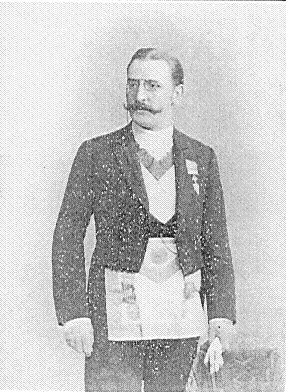
Photo: Wikimedia Commons
Theodor Reuss
Human Design Chart
Biography
He was a professional singer in his youth, and was introduced to Ludwig II of Bavaria in 1873. He took part in the first performance of Wagner's Parsifal at Bayreuth in 1882. Reuss later became a newspaper correspondent, and travelled frequently as such to England, where he became a Mason at the Pilger Loge No. 238 of the United Grand Lodge of England in 1876. He also spent some time there as a journalist and as a music-hall singer under the stage name "Charles Theodore."
In 1876, Reuss married a woman ten years his senior, Delphina Garbois from Dublin, and moved to Munich in 1878. Their marriage was annulled, due to bigamy. They had a son, Albert Franz Theodor Reuss (1879–1958), a self-educated zoologist who lived in Berlin.
In 1885, in England, Reuss joined the Socialist League. He had been quite involved as a librarian and labour secretary. On 7 May 1886 he was expelled as a police spy in the pay of the Prussian Secret Police
While in England, he became friends with William Wynn Westcott, the Supreme Magus of the Societas Rosicruciana in Anglia and one of the founders of the Hermetic Order of the Golden Dawn. Westcott provided Reuss with a charter dated 26 July 1901 for the Swedenborgian Rite of Masonry and a letter of authorization dated 24 February 1902 to found a High Council in Germania of the Societas Rosicruciana in Anglia. Gérard Encausse (a.k.a. Papus) provided him with a charter dated 24 June 1901 designating him Special Inspector for the Martinist Order in Germany. In 1888, in Berlin, he joined with Leopold Engel of Dresden, Max Rahn and August Weinholz in another effort to revive the Illuminati Order.
Human Design Analysis: Theodor Reuss as Manifestor 3/5
Manifestor 3/5 — Design at a Glance
Theodor Reuss revealed himself as a pioneer and visionary whose design clearly pointed towards leading the world into a new future. His Human Design type was the Manifestor, a configuration that presented him more as a leader than as an executive organ. Similar to an emperor in ancient Rome, who carried the vision of a great empire but did not lead the wars himself, but sent soldiers to conquer lands, Reuss acted strategically through others. This role, however, came with a specific pain point: He was often misunderstood and polarized his environment. Because he thought further ahead than many others, he was loved and followed by some, while others rejected or even hated him due to his great visions. To find the right followers, it was crucial for his design to inform others timely and precisely about his plans. This strategy of informing was the key to his inner state. Living according to this guideline and his authority rewarded him with a feeling of inner peace. Acting against his design, he instead felt a persistent, deep anger. His life was thus characterized by this tension field between visionary leadership and the necessity to clearly communicate these visions to minimize resistance and gain peace.
Splenic Authority
Theodor Reuss showed himself as someone who made decisions not through prolonged thinking but through an immediate, physical impulse. His inner authority lay in the Spleen Center, the center for health and survival intelligence. For this authority to be effective, his Emotional and Sacral Centers were open, which is typical for Projectors or Manifestors.
The Spleen Center functioned as a fine alarm system. It provided him with spontaneous inner knowledge about whether a situation, an environment, or a society was right and healthy for him. This impulse, however, was very subtle and only appeared once at the moment. It could easily be overshadowed or ignored by other influences, making high vigilance necessary. Sometimes a short retreat helped to clearly hear this fine signal.
Since Theodor Reuss only knew what was right for him in the moment, his plans often changed at short notice. Long-term commitments were difficult and did not fit his nature. He needed a lot of freedom and flexibility. The first, spontaneous impulse served directly his health and enabled him to rigorously distance himself from harmful influences. He thus effectively cared for himself by relying on this momentary intuition rather than on abstract future planning.
The 3/5 Profile — Martyr / Heretic
Theodor Reuss revealed himself as someone who did not accept knowledge until he had tested it himself. His design pointed towards a tendency towards experimental approach: he learned through trial and error, gathered practical experiences, and later presented these to others. This Profile 3/5 combined the line of the Adventurer with that of the Hero. Reuss initially believed little in preordained truths; instead, he had to try things himself to understand them. From these personal experiments and also from failures, he drew conclusions that he then used to solve problems for others.
The line 3 in his chart emphasized a learning process through direct practice. External pressure or forced inactivity often acted as catalysts, sharpening his concentration. Reuss was grateful for such challenges, as they forced him to practice. At the same time, he carried the burden of line 5, which brought hierarchies and mutual dependence into focus. For him, the recognition of his position within a structure was crucial for order and harmony. His ability to synthesize complex relationships made him attractive to others who wanted to learn from his experiences. This role of the Hero, who passed on knowledge, flattered him, but could be painful if public attempts failed. Reuss lived this dynamic: he gathered treasures of life experience and shared them to give others orientation, while he himself constantly re-examined what really worked.
Split Definition — Defined & Open Centers
Theodor Reuss was characterized by a persistent mental activity. His design connected the Head and Ajna Centers, creating a constant pressure to question and form concepts. This mental process was not just a skill for him but a constant companion that he could not directly put into action, as these centers do not have their own energy source. Instead, his mental work served to inspire or pressure others by posing questions to the world whose answers he did not need to provide himself.
This intellectual structure culminated in a defined Throat Center connected to the Ajna Center. Theodor Reuss thus spoke what he thought. His communication was the manifestation of his conceptual world. Parallel to this, he had a defined Heart Center, which gave him a clear willpower and the ability to keep promises and assert his own value. He tended to determine his life and control resources, which gave him a certain authority that was, however, filtered through the mental burden of his Head-Ajna Channel.
Another defined element was his Spleen Center, which gave him a spontaneous, intuitive sense for health and well-being. It allowed him to judge in the moment and protect himself from what was not beneficial. His Root Center was also defined, giving him a set way to deal with stress and the pressure of survival.
In contrast, his G Center, his Sacral Center, and his Solar Plexus Center were open. The open G Center meant that Theodor Reuss did not have a fixed identity but reflected himself in relationships and environments. He was prone to orienting himself externally to understand who he was. The open Sacral Center made him sensitive to the energy of others; he could easily overload himself by taking in the vital energy of his environment without generating it himself. The open Solar Plexus Center made him absorb and amplify the emotions of his environment, making him emotionally vulnerable and prone to interpreting foreign feelings as his own. These open centers required him to not identify with the energy and emotions of his environment but only to observe them.
Channels for logic, acceptance, judgment and material values.
Theodor Reuss was someone whose mind was marked by relentless skepticism. His design laid a tendency to analytical distance, manifesting through the Logic Channel 63-4. This channel connected the Head Center with the Ajna Center and ensured that Theodor Reuss constantly filtered patterns to test their consistency. Doubt here was not an obstacle but the prerequisite for logical validity; only what practically proved itself as consistent was considered true. Unfounded belief found no space in this mechanism.
This critical attitude culminated in the ability to structure complex information. The Acceptance Channel 17-62 connected the Ajna Center with the Throat Center and allowed Theodor Reuss to translate visual patterns into precise language. He mentally organized details to integrate them into a coherent worldview. Anything that could not be logically categorized remained incomprehensible to him. This process created a foundation to clearly present theories and hypotheses so that they could be tested for feasibility.
In addition to analysis, an inner drive for perfectionism propelled him. The Judgment Channel 58-18 connected the Root Center with the Spleen Center and gave him a sharp sense of what needed correction. Theodor Reuss sought out errors in existing patterns to improve them. This impulse to correct served the collective good by ensuring that systems remained functional and satisfactory.
He mastered the material plane through the Money Line Channel 21-45, which connected the Heart Center with the Throat Center. Here his will to take responsibility and gain control over resources was evident. Theodor Reuss worked best when he held the leadership and could determine his own rhythm to both protect his interests and serve others.
Additionally, individual Gates shaped his orientation: Gate 52 demanded a self-imposed pause for focus on pattern correction. Gate 24 caused mental mutations and renewal in the individual pulse. Gate 44 enabled transformation through mindful interaction. Gate 23 promoted assimilation through amoral understanding. Gate 16 drove experimentation in the collective forward.
Collective Circuitry — Circuit Signature
Theodor Reuss showed a tendency towards rational structuring and strategic planning, separate from emotional impulses. His design featured a split definition, meaning two parallel, non-directly connected energy fields.
The first field, the Understanding Circuit, connected Head, Ajna, and Throat Centers as well as Spleen and Root Centers. Through the channels of Logic, Acceptance, and Judgment, an emotionless ratio operated here, aimed at improving things through focus and strategy. This energy served to share rational insights, free from conditioning, with an eye on future developments. Parallel to this was a separate connection between Spleen and Root, linking intuitive security with the ability to endure.
The second, independent field formed the Ego Circuit, which in Theodor Reuss was only active through the channel 'The Money Line'. This connected the Throat with the Heart Center. This was not about individual ego but about clan dynamics: the joint creation and accumulation of resources. As there was no connection to the Sacral Center, the constant life force was lacking; pauses were necessary to maintain energy for material support and mutual aid in the collective.
These two systems – the rational, future-oriented structuring on one hand and the resource-oriented cooperation on the other – existed side by side without directly flowing into each other. Thus, Theodor Reuss moved between logical analysis and the practical, material security of his environment.
Right Angle Cross of Service 2
Theodor Reuss was marked by the right cross of service, a configuration that oriented his actions towards the well-being of others. This design characteristic determined his inner orientation: he did not act out of personal ambition or the desire for individual recognition, but rather saw his purpose in helping others and fulfilling their needs. His energy flowed where it was needed to provide support and bear burdens.
In Human Design, the right cross of service describes a specific life task. It characterizes people whose main drive is to prove themselves in the service of others. It is not about subservience, but about a deep, often silent dedication to the common good or to individual people to whom one feels committed. Theodor Reuss lived this mechanism by putting himself aside to make space for others. His identity was closely linked to the ability to serve and support. This shaped his interactions and decisions significantly. He did not seek the limelight, but worked in the background where his efforts were needed. This attitude was not a coincidence, but an expression of his energetic structure. It prompted him to take responsibility for others, often at the cost of his own needs. His design challenged him to grow through service and find his confirmation in the satisfaction of those he helped. Thus, the right cross of service became the central theme of his work.
Saturn Return · Uranus Opposition · Chiron Return · 2nd Saturn Return — Life Cycles
Theodor Reuss’ design showed a tendency towards structured authority and the integration of knowledge into formal systems. He appeared as someone who not only sought knowledge but also embedded it in established hierarchies. This attitude crystallized in 1882, at the age of 27, during his first Saturn return. At that time, he worked as a foreign correspondent in Bosnia and Herzegovina – a moment when years of groundwork solidified into a solid professional foundation.
His path led him further into spiritual structures. In 1895, at the age of 40, he joined the Theosophical Society in America. This occurred during the Uranus opposition, a phase often marked by the need for new, revolutionary perspectives or the delineation from old bonds. Reuss used this energy to anchor himself in an organization that explored hidden connections.
The full bloom of his design came in 1904, during his Chiron return at the age of 49. In this fulfillment cycle, he received a letter of guarantee from Yarker, confirming his authority regarding the rituals. Here, his incarnation purpose became tangible: the assumption of a leading role in an esoteric system. The structuring of this authority was completed in 1912, at the age of 57, during his second Saturn return. The establishment of a National Grand Lodge for Slavic countries and his leadership as an O.T.O. member of the X° showed how his design was geared towards pouring knowledge into enduring, hierarchical institutions.
Manifestor · Splenic Authority — Synthesis
Theodor Reuss lived a life as a Manifestor with defined Spleen authority, marked by a strong inner drive to initiate and shape the new. The Profile of the experimenter and hero (3/5) indicates that he learned through his own experiences and made this knowledge available to others. The constant mental pressure (defined Head and Ajna centers) intensified the need to question and understand things, making him an indefatigable researcher. This combination of initiatory power, instinctive direction, and the need for knowledge formed a red thread running through his professional stations – from journalistic work to his role in certain organizations – driving him to explore new paths and disseminate knowledge.
Reuss’ design contained a central paradox: the connection between logical thinking (the logic channel) and the intuitive, spontaneous knowledge of Spleen authority. On the one hand, he was eager to recognize patterns and understand them through rational analysis, while on the other hand, he relied on his inner instinct to make decisions. This apparent tension between mind and intuition generated a dynamic force that enabled him both to engage in careful scrutiny and to act swiftly and decisively, with the mind always filtering and validating the spontaneous impulses of the Spleen.
4 Defined Channels
Incarnation Cross - Right Angle Cross of Service 2
Solar Return
The Solar Return shows the moment when the sun returns to its exact birth position - your personal solar year.
Life Cycles
Discover the life cycles with a detailed triple view (birth chart, cycle chart, composite).
Human Design Profile
- Type
- Manifestor
- Strategy
- To inform others before acting
- Authority
- Splenic Authority
- Profile
- 3/5 - Martyr / Heretic
- Definition
- Split Definition
- Incarnation Cross
- Right Angle Cross of Service 2
- Date of Birth
- 28.06.1855 14:00
- Place of Birth
- Augsburg, GER
Frequently Asked Questions
What was Theodor Reuss's Human Design type?
What profile did Theodor Reuss have?
What authority did Theodor Reuss have?
What incarnation cross did Theodor Reuss have?
When was Theodor Reuss born?
Discover your own Human Design
Are you also a Manifestor? Find out in a personal reading how to use your initiation power peacefully and dissolve resistance.
More Personalities
Back to overviewAaliyah

Alexia

Alizée

Angèle

Anne-Marie

Arcángel