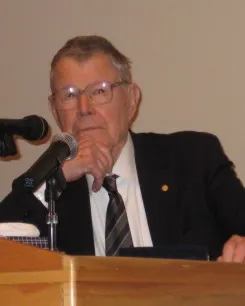
Thomas Crombie Schelling
Human Design Chart
Biography
He died 13 December 2016.
Thomas Crombie Schelling as a Generator 5/1 in Human Design
Generator 5/1 — Design at a Glance
Thomas Crombie Schelling had a Generator with immense, sacral energy that endowed him with great endurance. His design worked most effectively when he did not initiate actions himself but responded to impulses from his environment. This strategy of 'reacting' was the key to channeling his power productively and avoiding frustration.
When he encountered a life signal and responded with a clear 'yes' from within, he could transform this energy into concrete actions. This led to a deep sense of fulfillment. Conversely, if he acted against this nature – for example, by constantly initiating or ignoring internal resistance – he risked a lack of energy or persistent frustration.
Two main risks characterized his energetic profile: First, the wastage of energy on tasks that did not resonate internally, which could lead to long-term exhaustion. Second, the interruption of work on tasks that truly motivated him, even though he was still full of power. His success depended on not forcing this sacral energy but using it as a response to external stimuli. Thus, he became a driving force, materializing his goals through consistent action in response to his inner signals, without exhausting himself.
Emotional Authority
Thomas Crombie Schelling was someone who did not make decisions in the first moment but took time to go through his emotional wave. His design carried Emotional Authority, meaning his defined Emotional Center served as the inner compass for all life decisions – regardless of whether other centers in his chart were also defined. This authority was subject to constant ups and downs of feelings; the world appeared colored by the current mood. What seemed inspiring in one moment could appear negative in the next. His immediate feeling was only a snapshot, not a final judgment. Quick, spontaneous decisions based on such emotions could have negative consequences for him, as they did not yet reflect his deeper truth. Instead, his mechanism required patience and the repeated consideration of important questions. The more time he took, the deeper he could see. Intense feelings subsided over time, emotional distance gained clarity and calm. Only then, after this process had run its course, did true decision-making certainty arise. This approach was particularly crucial for long-term, life-defining decisions, as it ensured that not just the passing impulse but the stable emotional truth was acted upon.
The 5/1 Profile — Heretic / Investigator
Thomas Crombie Schelling was someone who explored deep, often hidden connections to derive practical solutions for complex problems. His Human Design Profile 5/1, the 'Hero/Researcher' profile, established a specific dynamic: The inner Line 1 drove him to intense, often withdrawn engagement with foundations and limitations. This formed the foundation of his knowledge. The outer Line 5, on the other hand, gave him a nearly magnetic aura that attracted others and prompted them to seek answers.
This configuration created a natural tension. While Thomas Crombie Schelling sought harmony and acceptance of limits in the research phase (Line 1), he was often perceived as an expert or problem solver due to his outer appearance (Line 5). Others sought his advice, which could lead to high stress if clear boundaries were not set. Similar to a scientist who is exhausted after long conferences because they constantly answer questions, Thomas Crombie Schelling had to learn to balance the need for withdrawal for self-realization with the expectations of his environment. His strength lay in managing crises through mature knowledge, but this required the ability to also say 'no' to preserve his energy and avoid being drained by constant questioning from others.
Split Definition — Defined & Open Centers
Thomas Crombie Schelling revealed himself as someone with immense, self-generated vitality, paired with a clear willpower. His design indicated a tendency towards independent resource utilization: He determined his life and controlled his means himself, which was enabled by his defined Heart Center. This center gave him the ability to make promises and keep them, thereby building trust and strengthening his self-esteem. At the same time, he had permanent access to sacral energy, which worked as a constant hum within him. This vital force, however, required him to respond to questions rather than initiate, to avoid frustration and exhaustion.
His decision-making was characterized by emotional authority. His defined Solar Plexus meant that he had to wait for the emotional wave to gain clarity, rather than acting impulsively. This patience allowed him to gain deeper insights and carefully examine relationships. Additionally, he had a defined Spleen Center, which gave him a reliable, spontaneous intuition in the present moment. This instinct protected him and promoted his well-being by guiding him towards what was existentially correct. The constant inner pressure of his defined Root Center drove him forward, enabling him to rise materially and master challenges.
In contrast, his open Head Center revealed a vulnerability to mental confusion and the pressure to find answers to foreign questions. He tended to get entangled in intellectual pursuits that were not his own, which could distract him from the correct process. His open Ajna Center made him susceptible to concepts and opinions from the environment without owning them as his own truth. This could lead to uncertainty when he tried to be certain of his ideas. His open Throat Center showed a tendency to seek attention through excessive speaking or interrupting, rather than waiting for the invitation to speak. Finally, his open G Center reflected the identities and directions of others, which led him to lose himself in relationships and environments if he was not in the right place. This openness required him to wait for external initiations to find his own direction.
Channels for change, care, community and maturation.
Thomas Crombie Schelling revealed himself as someone who delved deeply into the process of experience to gain wisdom. His design was marked by the Maturity Channel 53-42, which drove him to complete cycles and reflect upon them before starting anew. This energy connected the Root Center with the Sacral Center and created a collective history from which humanity could learn.
Alongside this deep reflection, a powerful, mutative energy worked through the Mutation Channel 60-3. This channel also connected Root and Sacral but brought an unpredictable, melancholic frequency. Thomas Crombie Schelling had to learn to accept limitations and move beyond the confusion of new beginnings to enable evolutionary change. This energy was pulsing and could be felt as internal tension or melancholy during phases of stillness until the next mutation broke through.
Another central element was the Preservation Channel 27-50, which connected the Sacral Center with the Spleen. Through the Gate of Care (27) and the Gate of Values (50), a strong need to protect and nourish the clan was evident. Thomas Crombie Schelling automatically attracted trust and took responsibility for others, whether through the defense of traditional values or the direct provision of people. However, this energy required him to first take care of himself to effectively help others.
In interpersonal relations, the Community Channel 37-40 shaped his way of forming relationships. This channel connected the Solar Plexus with the Heart and emphasized the importance of fair agreements and mutual recognition. Thomas Crombie Schelling sought his place in the whole and built bridges between individuals to create a harmonious community where everyone could make a respected contribution.
Additionally, individual Gates like the Continuity Gate (32), which sought stability and material success, and the Inspiration Gate (56), which translated mental processes into vivid narratives, were at work. The Player Gate (28) demanded decisions in the here and now, while the Friction Gate (6) regulated emotional waves. The Fulfillment Gate (55) brought extreme mood swings, and the Inaction Gate (52) required concentrated pauses for pattern correction. This combination created a complex web of reflection, mutation, care, and community spirit.
Tribal Circuitry — Circuit Signature
Thomas Crombie Schelling revealed himself through his design as someone who oscillated between two separate energetic poles. His Split Definition divided his forces into two non-connected groups: a combination of Sacral, Root, and Spleen Centers, and a separate connection of Heart and Solar Plexus Centers. These centers worked in parallel without direct exchange.
In the first area, the Knowledge Circuit drove him through the Mutation Channel (3-60) to explore new paths and break away from the old. Parallel to this, the Meaning Circuit via the Maturity Channel (42-53) fostered the ability to reflect on past experiences and draw emotional depth from them. Both circuits connected his Sacral and Root Centers, generating a pulsing, urgent energy. The Archer Circuit complemented this through the Preservation Channel (27-50), which linked Sacral and Spleen Centers. This gave him an instinctive, primal power for protection and preservation of his genetics.
Completely independently, the Ego Circuit acted. Through the Community Channel (37-40), it connected Heart and Solar Plexus Centers. Here, it was about cooperation, giving and taking, and the joint creation of resources. Since this circuit was not connected to the life force of the Sacral Center, Thomas Crombie Schelling needed pauses here to regenerate his social and material energies. His design thus presented a clear separation between his individual, instinctive, and protective base on one hand, and his cooperative, resource-oriented social interaction on the other.
Left Angle Cross of Limitation 1
Thomas Crombie Schelling's design indicated a tendency towards strict internal boundaries. He was someone who carefully channeled his energy and attention to avoid diffuse scattering. This attitude resulted from the configuration of the left cross of limitation. In Human Design, this structure marks a focus on the essential, connected with the necessity to consistently filter out distractions and unnecessary commitments. It was not a passive restraint, but an active, disciplined selection of what was truly important. Thomas Crombie Schelling used this limitation to maintain clarity in his actions. Instead of being overwhelmed by all possible options, he focused on a narrow but deep path. This focus protected him from the distraction that often accompanies broad knowledge or many interests. By consciously limiting his horizon to the necessary, he could direct his full power towards chosen goals. It was a strategy of efficiency through reduction. Thomas Crombie Schelling lived these principles by not letting external expectations drive him, but setting his own, clearly defined standards. This inner discipline allowed him to maintain a calm and determined orientation despite potential complexity in his environment. His way of setting boundaries was thus not a lack of possibilities, but a conscious decision for depth and substance over breadth and superficiality.
Saturn Return · Uranus Opposition · Chiron Return · 2nd Saturn Return — Life Cycles
Thomas Crombie Schelling showed in his early phase as someone seeking structural clarity and establishing his intellectual foundation on solid, verifiable grounds. This attitude crystallized in 1951, at the age of 30, when he was awarded his doctorate at Harvard University. For his Human Design, this was a typical moment: the first Saturn Return marks often the transition from the experimental youth phase to a defined, sustainable life structure. At this point in the life cycle, the design tends to transform years of groundwork and learning processes into a concrete, recognized result. The doctorate was here not only an academic conclusion, but the expression of an inner maturity that was now ready to take responsibility for its own knowledge. The Saturn Return acts in Human Design like an anchoring process that helps to clearly recognize one's own strengths and limitations and to shape them into a sustainable form. Thomas Crombie Schelling used this cycle to organize his intellectual resources and to create a basis for future developments that relied on constancy and depth.
Generator · Emotional Authority — Synthesis
Thomas Crombie Schelling was a Generator whose life was marked by a deep rhythm of energy creation and emotional maturation. The sacral energy (Generator type) seemed to draw him into a continuous cycle of engagement and endurance, especially when he was truly touched by a task. This was reinforced by his emotional authority, which compelled him not to make decisions impulsively, but to let them ripen through the natural wave of his feelings. His profile as a Hero and Researcher (5/1) indicates that he collected knowledge and made it available to others, using the depth of his insights to solve problems – a process that was promoted by the channel of Mutation (3-60) and the associated ability to handle limitations.
A central paradox in his design lay in the tension between the need to dive deeply into his projects and invest his energy, and the emotional wave that forced him to take a step back and look at things from different perspectives. While he tended as a Generator to lose himself in work, his emotional authority required a conscious slowing down and sleeping on decisions. This led to an inner dynamic in which he was driven both by the urge to create and by the necessity to examine things from a distanced, emotional perspective.
4 Defined Channels
Incarnation Cross - Left Angle Cross of Limitation 1
Solar Return
The Solar Return shows the moment when the sun returns to its exact birth position - your personal solar year.
Life Cycles
Discover the life cycles with a detailed triple view (birth chart, cycle chart, composite).
Human Design Profile
- Type
- Generator
- Strategy
- To respond - wait for something to respond to
- Authority
- Emotional Authority
- Profile
- 5/1 - Heretic / Investigator
- Definition
- Split Definition
- Incarnation Cross
- Left Angle Cross of Limitation 1
- Date of Birth
- 14.04.1921 17:50
- Place of Birth
- Oakland, CA, United States
Frequently Asked Questions
What was Thomas Crombie Schelling's Human Design type?
What Profile did Thomas Crombie Schelling have in Human Design?
What Authority guided Thomas Crombie Schelling?
What incarnation cross did Thomas Crombie Schelling have?
When was Thomas Crombie Schelling born?
Discover your own Human Design
Are you also a Generator? Find out in a personal reading how to use your sacral energy correctly and discover deep satisfaction.
More Personalities
Back to overviewAaliyah

Alexia

Angèle

Anne-Marie

Arcángel

Arno