
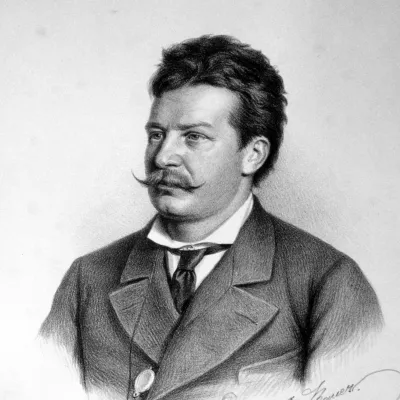
Thomas Koschat
Human Design Chart
Biography
For most of his life he resided in Vienna. Nonetheless, he was made an honorary citizen of Klagenfurt in 1907 owing to the local nature of his work. Koschat died in Vienna, at his home on Strobachgasse in the 5th district, on 19 May 1914 at age 68.
Thomas Koschat as a Manifesting Generator 3/5 in Human Design
Manifesting Generator 3/5 — Design at a Glance
Thomas Koschat was a Manifesting Generator. His design combined the constant energy of the sacral center with the ability to skip steps and develop immediate action capability. This hybrid nature required a specific strategy: he responded to impulses from life rather than initiating himself. Only when the sacral center gave a clear 'yes' did he act effectively.
His design allowed him to pursue multiple projects simultaneously and fall into a playful mode, which brought him deep satisfaction. The warning to finish one thing before starting another did not suit his nature. Instead, he needed variety and fun to maintain his creative power. However, this speed carried risks. Thomas Koschat tended to skip important steps, which could lead to frustration if he had to catch up later. Handling multiple tasks at once could also lead to exhaustion if strategy and inner authority were not aligned. Regularly checking his resonance with ongoing projects was crucial for him to avoid frustration and secure satisfaction from his work. His path was to find the balance between quick implementation and the necessary response to inner signals.
Emotional Authority
Thomas Koschat showed himself to be someone who did not make decisions based on a first emotional impulse. His design determined Emotional Authority, carried by the defined Solar Plexus Center. This mechanism caused his feelings to ebb and flow in waves, permanently coloring his perception of the world through the current mood. What appeared inspiring in one moment could be perceived negatively in the next. This fluctuating nature of his emotions meant that the immediate impression was often just a snapshot, not the deeper truth.
Therefore, his inner compass required patience. Quick, spontaneous reactions to emotional peaks would often have negative consequences for him. Instead, he used time to let decisions mature. He hesitated, thought things through multiple times, and slept on decisions. This process served to let intense feelings subside and gain emotional distance. Only when these waves subsided did the necessary clarity and calmness set in. This mechanism had absolute priority; regardless of other defined centers in his chart, he was subject to this emotional rhythm. For long-term, life-defining decisions, waiting for emotional calm was essential to recognize the true truth of his inner authority.
The 3/5 Profile — Martyr / Heretic
Thomas Koschat revealed himself through his Profile 3/5 as someone who primarily acquired knowledge through personal experimentation and direct experience. He did not believe anything at face value but tested the world to later solve other people's problems with this self-earned treasure. This attitude made him attractive to his environment, as people wanted to use his practical insights. However, this role could be painful when experiments failed in front of others.
Line 3 of the experimenter drove him to test everything himself, while Line 5 of the hero made him present these solutions. Additionally, the configuration of Line 7.3 shaped his approach to leadership. He learned to question institutionalized orders and sought his own leadership role through trial and error. His skepticism towards established structures grew over time, leading him to distance himself from groups that accepted him uncritically.
His strategic thinking, supported by the intelligence of Line 5, helped him to use resources wisely. However, the challenge lay in taking responsibility and acknowledging the skills of others rather than projecting his own pathfinding competence. Thomas Koschat thus lived in a tension field between the urge to learn through personal experience and the expectation to be perceived as a competent advisor.
Split Definition — Defined & Open Centers
Thomas Koschat revealed himself through a design that combined mental clarity with deep emotional intelligence. His defined Ajna Center gave him a consistent, specific way of thinking; he conceptualized information in a trustworthy manner and was hard to influence by external opinions. This mental structure flowed directly into his defined Throat Center, allowing him to express what he thought. His communication was thus a reliable expression of his inner concepts.
At the same time, he had a firm identity through his defined G Center. He knew who he was and where he was going without imposing this direction on others. His energy source came from his defined Sacral Center: As a Generator, he reacted to life rather than initiating. His truth lay in the immediate yes or no response of his gut, telling him whether energy was available for a task. This sacral power was filtered through his defined Solar Plexus Center, which acted as an inner authority. Thomas Koschat needed time to gain emotional clarity; he patiently waited for the emotional wave to subside before making decisions. His defined Spleen Center also ensured him a spontaneous, intuitive perception of the „now“, while his defined Root Center provided him with a steady, healthy pressure to move forward in the world.
In contrast, his open Head Center revealed a vulnerability to mental pressure. He tended to be inspired or confused by doubts or questions from others rather than trusting his own inner authority. His open Heart Center made him vulnerable to the desire to prove his worth through willpower or promises. The trap was to try too hard to please others or appear competitive, rather than accepting that he had nothing to prove. His strength lay in integrating his defined centers: patiently waiting for emotions to pass, trusting the sacral response, and clearly communicating from the mind, while navigating the pitfalls of the open Head and Heart through his inner authority.
Channels for structure, inspiration, rhythm, intuition and emotion.
Thomas Koschat revealed himself through his design as someone who acted through authentic presence and bold individuality. The Channel of Inspiration 1-8 connected his G Center with the Throat Center and required him to publicly live out his unique identity to inspire others. This did not happen through mere words, but through a exemplary life that drew attention and opened up new perspectives.
His energy source came from the Beat Channel 14-2, which connected the Sacral Center with the G Center. This tantric channel gave him the ability to set innovative directions through trust in his generative responses and to provide resources for mutation. He was called to exert a powerful, mutative influence on his environment through his existence and his reaction to life.
In the development of his abilities, the Channel of Wavelength 48-16 was at work. It connected the intuitive depth of the Spleen Center with the skillfulness of the Throat Center. Thomas Koschat perfected his talents through repeated practice and dedication, with recognition and resources being crucial to refine his technical mastery and express his unique wavelength.
His intellectual expression followed the Channel of Structuring 23-43 between Ajna and Throat Centers. He received spontaneous insights that he communicated clearly and efficiently to promote evolutionary change. This required patience and the right timing so that his innovative thinking could be received and understood by others.
Emotionally and energetically, the Channel of Recognition 30-41 shaped his experience. It connected the Root pressure with the emotions of the Solar Plexus and drove him to seek new experiences. Thomas Koschat had to learn to trust his emotional wave to gain clarity and consciously steer his desires, rather than succumbing to the pressure of restlessness.
Additionally, Gates like Gate 7 (Leadership), Gate 13 (Continuity), and Gate 17 (Logical Consequence) contributed to his complex expression, while Gate 42 emphasized the significance of experience and completion for his development.
Individual Circuitry — Circuit Signature
Thomas Koschat revealed himself through a split definition, which meant two parallel existing, not directly connected energetic systems in his design. This created an internal dynamic between different focus areas that did not work as a continuous flow but as parallel forces.
The Knowledge Circuit formed the first, coherent system. Here, Thomas Koschat's Ajna, Throat Center, Identity, and Sacral Center were directly connected. This configuration promoted the expression of a unique identity through structuring, inspiration, and the inner rhythm. It was about gaining new knowledge and its transformative transfer into the world, supported by emotional waves from the Solar Plexus, which were, however, not part of this specific connection.
The second, separate system consisted of the Understanding and the Meaning-Finding Circuit, which also did not merge at Thomas Koschat but functioned as separate units, as they belonged to different groups of the split definition. In the Understanding Circuit, the Channel „The Wavelength“ connected the Throat Center with the Spleen. This stood for sharing logical, rational insights and strategic improvements, free from emotional influence, with a focus on the future.
Parallel to this, the Meaning-Finding Circuit worked through the Channel „Recognition“, which connected the Solar Plexus Center with the Root Center. Here, the energy revolved around emotions and experiences from the past. These felt insights served to be shared with the collective to learn together from past events. The cyclical nature of these emotions contrasted with the focused rationality of the other system, allowing Thomas Koschat to navigate between processing past feelings and strategic orientation towards future solutions.
Right Angle Cross of the Sphinx 3
Thomas Koschat carried the right Sphinx 3 Cross in his Human Design. This specific configuration established a fundamental disposition characterized by a deep, often silent dedication to a higher truth or mission. It was not about loudly proclaiming ideals, but rather an inner, almost fateful loyalty to a path that transcended the purely personal.
In Human Design, the right Sphinx 3 Cross describes a life task centered on unconditional support and service to a higher order or a greater whole. The person with this design does not find fulfillment in individual fame or self-actualization in the traditional sense, but in the task of being a tool or vessel for something greater. It is an energy of humility and sacrificial dedication that often works in the background to enable the functioning of a system or the realization of a vision.
For Thomas Koschat, this meant that his life was marked by an inner discipline that allowed him to fully dedicate himself to this task. He did not seek external validation, but drew his strength from the certainty of being part of a larger pattern. This attitude required immense inner strength and the ability to set aside personal ego desires for the sake of the mission. His design thus showed a person whose silent work and loyalty to the essential made him unique, though often unnoticed, in his significance.
Saturn Return · Uranus Opposition · Chiron Return · 2nd Saturn Return — Life Cycles
Thomas Koschat entered into marriage with Paula Massek in 1904 at the age of 59. For his design, this marked the second Saturn Return, a phase in which long-term life structures often solidify and stabilize definitively. This cycle represents the maturation of responsibilities and the anchoring of connections that transcend mere emotion into a sustainable form. The marriage at this specific age underscores the tendency of his character to view relationships not as fleeting impulses, but as solid, supportive pillars of existence. The Saturn influence demanded a clear definition of partnership, moving away from uncommitted phases towards a committed, structural unity. It was evident that Thomas Koschat had the energy in this life phase to institutionalize a relationship and give it a long-term perspective. This aligned with the inner logic of his design, which sought and found stability and reliability in interpersonal bonds. The connection with Paula Massek was thus no coincidence, but the logical consequence of a development aimed at durability and clear role definitions. Through this act, he strengthened his life center and created a foundation that provided him support in the following years.
Manifesting Generator · Emotional Authority — Synthesis
Thomas Koschat was a Manifesting Generator, whose life was marked by a dynamic interaction between sacral energy and the need for expression. The constant sacral availability (defined sacral center) endowed him with endurance and the ability to respond to opportunities, yet the Manifestor component allowed him to skip steps and quickly initiate changes. This combination led to a life driven by a spirit of experimentation and the desire to gather experiences (Profile 3/5), as well as the need to share this knowledge. He was a creative mind destined through the channel of inspiration (Gate 1/8) to motivate others and open up new perspectives.
Koschat lived in a tension field between the impulsive action that favored his Manifestor side and the emotional wave (emotional authority) that required mature decision-making. The defined mental center strengthened this inner dialogue by continuously processing concepts and ideas. This inner struggle, coupled with the ability to learn from experiences and share them, shaped his path as someone who continually reinvented himself and inspired others through his stories – a life additionally marked as unconventional and shaped by fateful turns by the right Sphinx 3 Cross.
5 Defined Channels
Incarnation Cross - Right Angle Cross of the Sphinx 3
Solar Return
The Solar Return shows the moment when the sun returns to its exact birth position - your personal solar year.
Life Cycles
Discover the life cycles with a detailed triple view (birth chart, cycle chart, composite).
Human Design Profile
- Strategy
- To respond - wait for something to respond to
- Authority
- Emotional Authority
- Profile
- 3/5 - Martyr / Heretic
- Definition
- Split Definition
- Incarnation Cross
- Right Angle Cross of the Sphinx 3
- Date of Birth
- 08.08.1845 07:00
- Place of Birth
- Viktring, Australia
Frequently Asked Questions
What was Thomas Koschat's Human Design type?
What Profile did Thomas Koschat have in Human Design?
What Authority did Thomas Koschat have?
What incarnation cross did Thomas Koschat have?
When was Thomas Koschat born?
Discover your own Human Design
Are you also a Manifesting Generator? Find out in a personal reading how to unfold your multi-talents and direct your energy wisely.
More Personalities
Back to overviewAaliyah

Aldair

Alexia

Alizée

Angèle

Angeli
