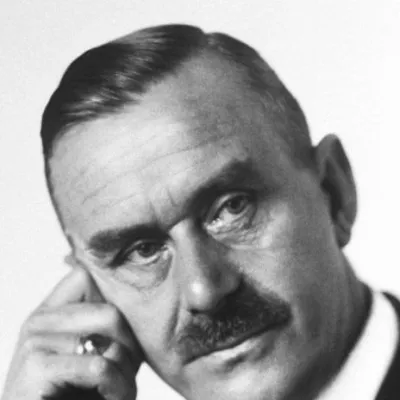
Thomas Mann
Human Design Chart
Biography
The Human Design of Thomas Mann: Generator 5/1
Generator 5/1 — Design at a Glance
Thomas Mann's design revealed a tendency towards high endurance and persistent work capacity. As a Generator, he had a large reservoir of sacral energy that made him seem like a strong working horse – but only under one specific condition: This power was not unleashed by his own initiative, but exclusively released in response to external impulses. His life strategy involved waiting for a signal from the environment and then responding to it.
This mechanism created two extreme states in his life. When he listened to and responded to the inner 'yes' of his sacral center instead of acting independently, he experienced deep satisfaction and a sense of fulfillment. The energy flowed naturally and effectively at that point. Conversely, any deviation from this pattern – whether by ignoring the internal signal or through compulsive actions without inner resonance – led to frustration, energy depletion, and ultimately burnout.
The danger lay in his enormous capacity for materializing projects often being misdirected when he tried to take initiative rather than waiting for the right moment. His success thus depended less on sheer effort alone and more on the precision with which he responded to what truly engaged him. Only in harmony with this reactive nature could his enduring strength fully unfold without exhausting himself or fighting against resistances created by false initiatives.
Sacral Authority
Thomas Mann's design inclined towards intuitive decision-making that did not occur in his head but was deeply rooted within his body. He trusted an inner resonance – often felt as a physical surge of energy or a characteristic grumbling and humming from the abdominal area. This 'gut feeling' reacted directly to external stimuli, signaling whether something was right or wrong.
This mechanism stemmed from his sacral authority, unique to the Generator type. With his emotional center open, he could clearly perceive this bodily guidance. When his sacral motor responded to a situation, Thomas Mann felt vital and energized; he tackled his tasks with great enthusiasm and without compulsion. This allowed him to live in joy and contentment, fully immersed in his activities.
Additionally, his active spleen center acted as a supportive force. In conjunction with the sacral center, this gave Thomas Mann special speed and spontaneity in responding. He had immediate access to his instinctive perception and physical well-being, enabling him to make quick and reliable decisions without much deliberation. His system was designed for efficient and authentic action through this direct bodily response.
The 5/1 Profile — Heretic / Investigator
Thomas Mann's design shaped a tension field between the magnetic presence as a problem solver and the deep need for private knowledge accumulation. As a 5/1 profile, that of the Hero/Researcher, he exhibited an almost attractive quality: Others instinctively sought him out for solutions to their crises. This resulted from Gate 35 in the fifth line, which embodies selflessness and altruistic sharing of experiences – often without direct reward. It required the ability to accept a subordinate position to avoid societal humiliation when attempting to assume an inappropriate role.
Simultaneously, the first line with Gate 22 operated in the background. This gate stands for self-awareness, attention, and the transmission of mutations into society – frequently without immediate recognition. The challenge lay in the constant offer of solutions for others quickly leading to exhaustion, similar to how an expert might feel drained after long conferences while new requests pour in. Thomas Mann's design thus required clear boundaries. Only by learning to say 'no' could he maintain a beneficial balance between his own 'research' and problem-solving for others. This ensured optimal use of his gifts without overwhelming his private research zone.
Single Definition — Defined & Open Centers
Thomas Mann possessed a massive internal stability, characterized by defined G-, Sacral-, Spleen- and Root Centers. His design gave him a clear sense of self-identity and direction (G), connected with a constant source of vital energy (Sacral). He had a strong intuitive protective system for his well-being (Spleen) as well as a persistent existential pressure that propelled him forward (Root). This combination created a person with high physical presence and inner authority.
As a Generator, his strategy was to wait for stimuli to correctly use his sacral energy rather than initiate it. This contrasted with his open centers: Head, Ajna, Throat, Heart, and Solar Plexus. These mirror centers took in environmental stimuli situationally. His open Head Center received mental inspirations that were not constant; he tended to be distracted by doubts or questions from others instead of generating his own consistent thoughts. The open Ajna Center allowed flexible thinking and the uptake of various concepts without needing to hold them as personal truth.
His open Throat led him to not communicate consistently but rather wait for invitations; the pressure to force attention was a non-self theme. His open Heart Center meant that willpower and promises were not constant internal sources; he could feel pressured by the need to prove his worth or the drive to be competitive, though this did not align with his design. Finally, his open Solar Plexus absorbed the emotions of his environment. He was vulnerable to personalizing others' moods and feelings, which could lead to emotional confusion if he didn't recognize them as reflections of the environment. His strength lay in distinguishing between his own defined pressure and these taken-in fleeting stimuli.
Channels for transformation, intuitive elegance and caring values.
Thomas Mann's design showed a tendency towards cyclical change paired with intuitive self-determination and tribal care. These three energies worked as constant physical presence in his life.
The channel of Mutation 60-3 connected his Root Center to the Sacral through the Gate of Limitation (60) and the Gate of Order (3). This brought about evolutionary change, but it depended on accepting limitation and moving beyond the confusion of a new beginning. The energy of this channel was pulsing and came with melancholy; it required patience until new mutations took hold rather than fighting against these moods.
Simultaneously, the channel of Perfect Form 57-10, linking Spleen Center to G Center, enabled intuitive survival. Through the Gates of Intuitive Insight (57) and Behavior of Self (10), Thomas Mann acted spontaneously and appropriately based on deep inner impulses. This created a quality of behavior marked by self-love and dignity without needing external validation. It was a process of integration that helped him move existentially through the world and let go of unfounded future fears.
Furthermore, the channel of Preservation 27-50 provided care and tribal protection. Through the Gate of Care (27) in Sacral and the Gate of Values (50) in Spleen, a sacral reaction aimed at nourishing the tribe and preserving traditional values emerged. This energy automatically attracted trust and took responsibility for those who could not provide for themselves. Thomas Mann lived this care out by prioritizing his own health – only the strong could effectively support and lead others.
Individual Circuitry — Circuit Signature
Thomas Mann's design combined instinctive wisdom with the power of emotional articulation. The Knowledge Circuit worked here through channel 3-60 (Mutation), connecting Sacral Center to Root Center. This created a pulsing energy that used deviations from the known to form new identity and initiate change.
Parallel to this, the Protector Circuit through channel 27-50 (Preservation) ensured connection between Sacral Center and Spleen Center. This configuration concerned the primal need for protection and preservation of genetics as well as family. It was about care, sustenance, and defense of the self – a timeless energy of 'mother and father' that secured survival.
Additionally, channel 10-57 (Perfect Form) linking Identity Center to Spleen Center showed in the realm of integration. Here power came from reacting to life through proper behavior and intuitive knowledge. This connection allowed bundling inner strength and making it effective in the present moment.
Although all four centers were defined, they did not form a single continuous energy flow but three separate streams: the mutating knowledge current (Sacral-Root), the protective family instinct (Sacral-Spleen) and the intuitive self-reinforcement (Identity-Spleen). Thomas Mann lived these parallel forces by expressing his innate individuality through mutation while simultaneously deeply rooted in the instinct of preservation and acting on intuitive knowledge of perfect form. His energy was thus both transformative and stabilizing, driven by a clear yet fragmented inner logic.
Left Angle Cross of Separation 1
Thomas Mann's design carried the structure of the left Separation Cross 1. This configuration established an archetypal foundational stance characterized by a deep need for clear demarcation and individual determination. The left Separation Cross 1 describes in Human Design the process of drawing one's own boundaries and freeing oneself from collective expectations or external definitions. It is not about isolation but rather the necessity to form an independent identity by distinguishing the foreign from the self.
For Thomas Mann, this meant that his inner compass was strongly oriented towards differentiation. The mechanics of this cross promote the ability to examine situations and relationships with a critical, separating gaze in order to gain clarity about one's place in the world. It is a structure that encourages not simply following the flow of the general current but consciously making decisions that emphasize one's uniqueness. Thomas Mann lived this dynamic as an ongoing struggle with the question of who he really was and what set him apart from others. The separation here is not an act of rejection, but a tool for self-discovery. By cutting ties or ideas that were inauthentic, he created space for a deeper, more personal truth. This archetypal structure shaped his way of being: someone who preserved their integrity through clear lines and defined boundaries, establishing himself as an independent individual separate from the noise of the undefined.
Saturn Return · Uranus Opposition · Chiron Return · 2nd Saturn Return — Life Cycles
Thomas Mann's life followed a clear four-phase structure marked by planetary cycles that brought structural consolidation and public recognition. These cycles served as milestones where his inner development outwardly transformed.
The first Saturn Return around age 28 condensed years of groundwork into a solid result. This was evident in 1903 with the two-volume initial publication of 'Buddenbrooks'. The second edition marked a decisive breakthrough, typical for this cycle: anchoring a new life phase through concrete achievement.
The Uranus Opposition around age 39 often demands breaking away from the known to embrace new structures. In 1914, the Mann family purchased a house in Munich. This step symbolized not only a change of residence but also the creation of a stable framework for the coming time, fitting the dynamic energy of this cycle.
The Chiron Return around age 49 marked a blooming phase where his inner purpose increasingly fulfilled itself. In 1924, 'The Magic Mountain' was published and became a great success. This aligned with the nature of the Chiron cycle: unfolding one's essence in a form that resonates and makes sense experientially.
Finally, the second Saturn Return around age 58 further consolidated his achieved position. On February 13, 1933, Richard Wagner's death anniversary was celebrated for its fiftieth time, and Thomas Mann gave a lecture in Munich on this occasion. This event underscored his established role in cultural life, anchored by the fateful weight of the Saturn cycle. Each of these points confirmed the underlying mechanics: inner maturity expressed itself in measurable, public milestones.
Generator · Sacral Authority — Synthesis
Thomas Mann lived deeply rooted in his sacral energy (Generator Type) and used this endurance for continuous learning and knowledge development (5/1 Profile). This ability to engage intensively with topics - fueled by an internal direction and identity (defined G Center) - led to repeated successes (documented cycles), where he formulated new insights and made them accessible to a broad audience. The Channel of Mutation (3-60) points to a process of constant change and the readiness to question conventions, which was evident in his ability to repeatedly explore new creative paths.
Simultaneously, a central paradox revealed itself: His deep connection with his own inner drive (sacral authority) often seemed in tension with the necessity to fulfill others' expectations (5/1 Profile). The knowledge circuit and the associated urge to share knowledge encountered a natural limitation (Gate 60), which could trigger melancholy. This tension between the desire for free exploration and the need for recognition shaped his path and created a pulsating rhythm between creative energy and introspective reflection.
3 Defined Channels
Incarnation Cross - Left Angle Cross of Separation 1
Solar Return
The Solar Return shows the moment when the sun returns to its exact birth position - your personal solar year.
Life Cycles
Discover the life cycles with a detailed triple view (birth chart, cycle chart, composite).
Human Design Profile
- Type
- Generator
- Strategy
- To respond - wait for something to respond to
- Authority
- Sacral Authority
- Profile
- 5/1 - Heretic / Investigator
- Definition
- Single Definition
- Incarnation Cross
- Left Angle Cross of Separation 1
- Date of Birth
- 06.06.1875 10:15
- Place of Birth
- Lübeck, Germany
Frequently Asked Questions
What is Thomas Mann's Human Design type?
What Profile did Thomas Mann have in Human Design?
Which authority guided Thomas Mann?
What incarnation cross did Thomas Mann have?
When was Thomas Mann born?
Discover your own Human Design
Are you also a Generator? Find out in a personal reading how to use your sacral energy correctly and discover deep satisfaction.
More Personalities
Back to overviewAaliyah

Alain-Fournier
Alexia

Angèle

Angeli

Anne-Marie