
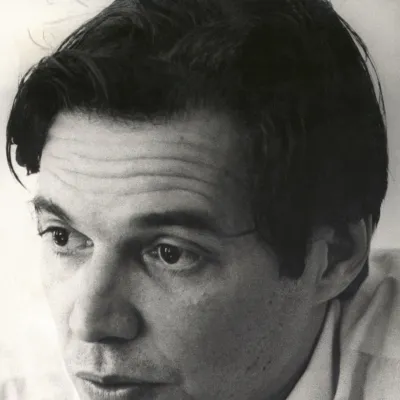
Tom Jobim
Human Design Chart
Biography
He performed in a trio with Villa-Lobos (classical with pop roots) and Carlos Gomex (from Italian operatic inspiration). He is famed for songs which include the whole Bossa Nova book, starting with "The Girl From Ipanema." He was praised by professionals that include Ella Fitzgerald, Frank Sinatra, Stan Getz and more.
Tom Jobim married twice and had four children. He died on 8 December 1994 at 7:00 AM EST in New York, New York. His last album, Antonio Brasileiro, was released posthumously three days after his death.
Tom Jobim — Generator with Profile 4/6
Generator 4/6 — Design at a Glance
Tom Jobim possessed immense, enduring strength, making him seem like a strong workhorse. His Generator design was characterized by a great deal of sacral energy, which he could release not through spontaneous initiatives but by reacting to impulses from his environment. The key dynamic lay in waiting for signals and then, when his inner center clearly said 'yes', responding with concrete action. This strategy of reacting rather than initiating was the key to his effectiveness.
Living in harmony with this mechanism, by only doing what he felt an intrinsic enthusiasm for, he was rewarded with a deep sense of fulfillment. If he tried to work against this nature – whether by constantly initiating without impulse or by completing tasks that found no resonance – he risked wasting his energy. This could lead to frustration or a lack of strength, as his sacral energy was blocked. His success thus depended directly on whether he could prevent himself from being held back by external constraints that distracted him from his true work, and instead follow the inner rhythm that gave him the necessary endurance.
Emotional Authority
Tom Jobim was subject to an emotional wave that was reflected in a constant up and down of his feelings. His inner authority carried the defined Emotions Center; this position always took precedence over all other defined centers in his chart. He saw the world colored by his current mood. At one moment, he was totally enthusiastic about something, the next he viewed the same thing negatively. His feeling in the moment was, however, only a snapshot, a first impression that did not necessarily represent his truth. Quick, spontaneous decisions based on emotion often had negative consequences. The more time he took to let a decision mature, the deeper and more comprehensive he could understand something. This required patience and the multiple reconsideration of a decision. He should take his time and ask himself multiple times. Over time, the intense feelings subsided, he gained emotional distance, and clarity and calmness set in. Only then had he gone through the process. This mechanism was particularly important for long-term decisions that could have a significant impact on his life course.
The 4/6 Profile — Opportunist / Role Model
Tom Jobim's design tended towards experimental behavior in the first three decades of his life before a deep inner tension developed. His Profile 4/6 initially appeared as a 4/3 configuration: He sought social exchange, tested relationships, and built networks, as the fourth line makes experiences valuable through sharing and collective engagement. Friendships were crucial to his success, yet the fourth line also carried the risk of being hurt by false attentions.
After the return of Saturn, the focus shifted. The activation of the sixth line brought a desire for wisdom and distance, leading to a conflict between his heart, which sought community, and his head, which reflected on meaning. He faced the challenge of meeting the high demands of being a role model. The sixth line of Gate 28 also brought the readiness to take extreme risks to test whether life is worth it. It was not just about glory but a near sacrificial attitude: win at any cost or rather die than lose. Tom Jobim lived this balancing act between social adaptability and the search for ultimate confirmation, always cautious about whom he opened his heart to, to avoid being endangered by collective processes.
Single Definition — Defined & Open Centers
Tom Jobim's design established a tendency towards a fixed sense of self-identity and inner direction. His defined G Center gave him a reliable sense of who he was and where he stood, without being dependent on others. This inner security allowed him to love others and show new paths without having to direct them. His defined Sacral-Motor generated a constant vital energy that he used by reacting to life. He sought satisfaction in using his strength for tasks that he responded to with an inner 'yes', rather than taking initiative and exhausting himself.
Additionally, Tom Jobim showed emotional depth, marked by his defined Solar Plexus Center. His inner authority lay in waiting for the emotional wave; he sought clarity before acting and used time to let decisions mature on a deeper level. His defined Spleen Center complemented this with spontaneous intuition in the present moment, helping him stay healthy and protected by trusting his body awareness. The defined Root Pressure supported him in mastering existential challenges and thriving materially.
At the same time, Tom Jobim was vulnerable to mental confusion through his open Head Center. He tended to engage with questions that were not his own and sought inspiration to relieve mental pressure. His open Ajna Center meant that he did not hold concepts and opinions as his own truth but rather took them in flexibly. Additionally, he suffered from the pressure to gain attention, caused by his open Throat Center, which led him to seek ways to be noticed. His open Heart Center led him to often feel not valuable enough and to try to prove his worth through promises or overexertion, rather than trusting his inner authority.
Channels for power, care, meaning and emotional depth.
Tom Jobim's design established a tendency towards innovative, rhythmic renewal paired with a deep responsibility for what he created. The Beat Channel 14-2 connected the generative energy of the Sacral Center with identity in the G Center. This gave him the ability to point out new directions through trust in his inner reaction and to strengthen others through his aura without actively leading. At the same time, the Preservation Channel 27-50 provided instinctive care. It connected the Sacral with the Spleen Center, giving him a natural gift to nourish and protect his roots and creative ventures based on ancient values and selfless interest.
His inner drive was shaped by the Life Struggle Channel 28-38, which connected Root and Spleen Centers and gave him the determination to walk his own path and find meaning in daily struggles. It was not about blind resistance but about intuitive awareness of which struggles were worth fighting for the preservation of his integrity. Emotional depth and moodiness flowed through the Channel of Emotion Release 39-55, which linked Root and Solar Plexus Centers. Here the wave between joy and melancholy pulsed, a powerful, mutative energy that required authentic experience to radiate spiritual passion rather than mere mood swings.
Additionally, Gates like 41 (evolutionary development through crisis) and 34 (great power and integration) worked in the background. They underscored the need to develop through changes and serve one's power to the greater good. Tom Jobim showed himself as someone who translated these complex energetic streams – from innovative mutation over careful preservation to emotional expression – into a coherent life practice by trusting his inner authority and freeing himself from external expectations.
Individual Circuitry — Circuit Signature
Tom Jobim's design established a tendency towards a pulsating, acoustic expression style that emerged from the Knowledge Circuit. This circuit connected two separate energetic strands in him: on the one hand, identity with the Sacral Center, creating a clear, powerful basis for his own individuality; on the other hand, the Spleen, Root, and Solar Plexus Centers. This connection promoted intuitive, emotional waves that directly translated into expression. The Channels 'The Beat' (2-14) and 'Emotion Release' (55-39) supported the transformation of new insights into tangible, rhythmic forms.
Parallel to this, the Archer Circuit worked through the Channel 'Preservation' (27-50). It connected the Sacral with the Spleen Center and brought an ancient energy of protection and preservation. As Tom Jobim had a Simple Definition, these various Centers – Identity, Sacral, Spleen, Root, and Solar Plexus – flowed in a single, continuous stream. This allowed a coherent life energy, where intuitive perception, emotional depth, and creative power did not operate in isolation but as an integrated experience. His design thus showed a unity of individual identity, emotional resonance, and the instinctive need to preserve and express the essential.
Right Angle Cross of the Unexpected 4
Tom Jobim's Human Design featured the right cross of the Unexpected 4. This configuration shaped his lifestyle through a profound connection with the unpredictable. He did not live by rigid plans but was guided by what proved to be right in each moment. The right cross of the Unexpected 4 describes an energy that manifests in the ability to accept unexpected turns as natural and even necessary parts of life's flow. For Tom Jobim, this meant that stability was achieved not through control but through adaptability. He often found more clarity in chaos or sudden changes than in orderly structures. This mechanism suggested that his path was marked by spontaneous decisions and open reactions to external circumstances. It was not about indecision but a conscious surrender to the process of events. The number 4 in this cross configuration also emphasized the importance of security and structure, which were gained not through rigid rules but through the experience of reliable patterns in change. Tom Jobim used this energy to move in a constant flow, where the unexpected was always seen as a source of new possibilities and not as a threat to existing order. His design challenged him to trust the moment and follow the direction that emerged from the immediate situation without planning or forcing it.
Saturn Return · Uranus Opposition · Chiron Return · 2nd Saturn Return — Life Cycles
Tom Jobim's Human Design showed a tendency towards cyclical breakthroughs driven by inner authority. His life path was marked by moments when years of often silent groundwork condensed into visible results. This corresponded to the mechanics of the first Saturn return, a phase in Human Design known as consolidation, where structures solidify and the first substantial achievements emerge. In 1954, at the age of 27, this effect came to fruition: Jobim had his first major success with the song „Teresa da Praia“ with Billy Blanco. This success marked the beginning of a stable phase in which his creative energy was translated into concrete, enduring forms.
Later, at the age of 41, another dynamic shift was evident. The Uranus opposition in the chart often describes a time of breaking free from old patterns and sudden, surprising success that can pave new paths. In 1968, Jobim won the International Music Festival with the song „Sabiá“ alongside Chico Buarque. This event underscored his design's ability to set innovative impulses during phases of change and transform them into international recognition. Both events illustrate how Tom Jobim used his inner strategy to make his creative essence effective in specific astrological cycles without working against the natural rhythm of his design.
Generator · Emotional Authority — Synthesis
Tom Jobim was a Generator whose life was marked by a deep, sacral energy (Sacral Center). This energy constantly sought expression in creative work, yet he was also subject to emotional ups and downs (Emotional Authority). This combination led to a lifestyle where he devoted himself with great endurance to projects, but only after thorough consideration and experiencing various emotional swings. The constant oscillation between enthusiasm and doubt created an inner rhythm that drove his creative work but also led to phases of melancholy and reflection (Knowledge Circuit).
A central paradox in his design lay in the interplay between the desire for connection and the need for individual development (Profile 4/6). On one hand, he sought cooperation with others to realize his visions, while on the other hand, he yearned for an independent space to reflect on the meaning of his work and his own identity. This led to a lifelong conflict between heart and head, which manifested in moments of success (1954, 1968) and in the search for new forms of expression.
4 Defined Channels
Incarnation Cross - Right Angle Cross of the Unexpected 4
Solar Return
The Solar Return shows the moment when the sun returns to its exact birth position - your personal solar year.
Life Cycles
Discover the life cycles with a detailed triple view (birth chart, cycle chart, composite).
Human Design Profile
- Type
- Generator
- Strategy
- To respond - wait for something to respond to
- Authority
- Emotional Authority
- Profile
- 4/6 - Opportunist / Role Model
- Definition
- Single Definition
- Incarnation Cross
- Right Angle Cross of the Unexpected 4
- Date of Birth
- 25.01.1927 23:15
- Place of Birth
- Rio de Janeiro (Rio de Janeiro), Brazil
Frequently Asked Questions
What was Tom Jobim's Human Design type?
What Profile did Tom Jobim have?
What Authority did Tom Jobim have?
What incarnation cross did Tom Jobim have?
When was Tom Jobim born?
Discover your own Human Design
Are you also a Generator? Find out in a personal reading how to use your sacral energy correctly and discover deep satisfaction.
More Personalities
Back to overviewAaliyah

Alexia

Alizée

Angèle

Anne-Marie

Arcángel
