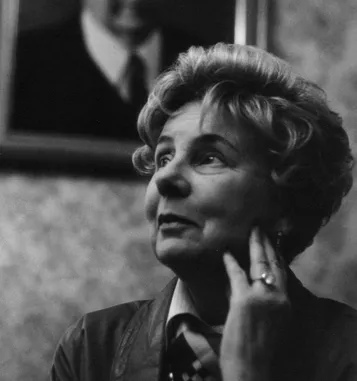
Uta Ranke-Heinemann
Human Design Chart
Biography
Ranke-Heinemann was active in the peace movement. During the Vietnam War, she supported the ban on napalm bombs. She traveled to the Communist North Vietnam. In 1979, she organized food for Cambodia suffering a famine. She taught from 1980 in Duisburg, and from 1985 in Essen. In 1987 Bishop of Essen Franz Hengsbach withdrew her license to teach Catholic theology for disputing the virgin birth of Jesus. This effectively disqualified her from the post she had held for three years. The University of Essen created a new chair for her, for History of Religion. Her principal book dealing critically with sexuality in the Catholic Church, in English Eunuchs for the Kingdom of Heaven: Women, sexuality, and the Catholic Church, appeared first in 1988, and in many subsequent editions. It was translated to 12 languages.
In 1999, Ranke-Heinemann was a candidate for President of Germany, without party membership, but lost to Johannes Rau, the husband of her niece Christina.
She died on 25 March 2021 in Essen.
Uta Ranke-Heinemann — Projector with Profile 5/1
Projector 5/1 — Design at a Glance
Uta Ranke-Heinemann's design shows a tendency towards precise system analysis. As a projector, she did not have an intrinsic source of life energy through her undefined Sacral Center but rather acted like a focused flashlight that cast light into dark corners of her surroundings. This mechanism allowed her to immediately identify flaws in other people’s systems – whether in relationships or structures. However, directly addressing these issues would often provoke resistance, similar to shining a bright light in someone's face. Instead, her strength lay in attracting others through her own harmony and clarity, so that they sought out her insights on their own. Her strategy was to wait for an honest invitation to gain the necessary authority without acting against the will of others. If she followed this pattern, she would be rewarded with success; deviating from it often led to the non-self theme of bitterness surfacing. Additionally, her energy level fluctuated naturally: phases of high productivity alternated with essential rest periods to prevent burnout – a rhythm that conventional work structures often ignored.
No Inner Authority
Uta Ranke-Heinemann did not have inner authority – a rare configuration that fundamentally shaped her decision-making process. Instead of relying on physical impulses or a defined emotional center, she oriented herself through external resonance processes. As a projector with open centers below the Throat Collector, she was dependent on exchanges with other people to make decisions. Through these dialogues, latent potentials in her unmanifested areas were activated, allowing her to view issues from multiple perspectives and express them differentiated.
This high resonance capability served not only for information gathering but also helped her identify suitable environments and trustworthy conversation partners. However, the actual evaluation of this complex data required withdrawal and time. Only in solitude could she discern the red thread, filter out what was essential from a mass of impressions, and structure it meaningfully. This ability to organize information formed her specific capital for success. Crucial was always choosing an environment where she felt comfortable; only there with the right people did her sense deepen as to what truly belonged to her and what purpose her paths had.
The 5/1 Profile — Heretic / Investigator
Uta Ranke-Heinemann appeared as someone who used deep knowledge to offer solutions to others. Her design as a 5/1er
Single Definition — Defined & Open Centers
Uta Ranke-Heinemann's Human Design indicated a tendency towards consequent, conceptual clarity. Her defined Ajna Center ensured consistent mental function; she processed data and creativity in the same way regardless of external influences. This internal stability directly fed into her defined Throat Center. With mind and communication linked, Uta Ranke-Heinemann spoke reliably about what she thought. Her voice served as a focal point to transform conceptual ideas into reality – not impulsively but with the honesty of a firmly anchored inner logic.
This stable center contrasted sharply with her openness in other areas. Her open Head Center made her susceptible to mental pressure and confusion from others. She tended to wonder if she was missing important inspirations or needed answers that weren't hers. Instead of fulfilling this compulsion, her design was set up to act as a mirror for the mental field around her without identifying with others' doubts.
Similarly, her open G Center worked without a fixed identity; she often adapted to those around her and sought direction through external initiations. She tended to wonder who she really was or where she would find love rather than carrying these questions as personal burdens. Her open Heart Center lacked consistent willpower; she avoided making promises to prove her worth, as this led to cycles of disappointment and self-doubt.
Her open Solar Plexus absorbed emotions from the environment, making her vulnerable to foreign moods. She learned not to personalize these feelings. The open Sacral Center meant no constant energy flow; Uta Ranke-Heinemann had to learn how to protect herself from exhaustion caused by borrowed energy and set boundaries. Finally, her open Root Center took on external stress she did not generate herself. Her wisdom lay in observing this pressure without falling into hyperactivity and recognizing that the urge for acceleration was often just conditioning from others.
Channels for insatiable seeking and new perspectives.
Uta Ranke-Heinemann's Human Design indicated a tendency towards analytical sharpness and the ability to translate complex connections into tangible narratives. This configuration shaped her way of interacting with the collective: she did not only seek answers but created spaces for others' reflection.
Central was Channel Curiosity 11-56, connecting Ajna Center with Throat Center and driving an insatiable search. Uta Ranke-Heinemann used this energy primarily to share discoveries rather than find them herself. She transformed abstract information into stories and parables that engaged imagination and emotions. Her role was that of a storyteller who helped others evaluate new ideas or beliefs through shared experiences. It was less about dry facts and more about how these insights could change life.
This narrative power was reinforced by additional energies. Gate 18 in the Cross emphasized correcting collective processes and fighting for human rights, often with healthy skepticism towards authorities. Parallel to this, Gate 17 organized logical teaching and succession while doubts served as an integral part of understanding. The emancipatory force of these gates promoted individual freedom within societal structures.
Emotionally and energetically, this was fueled by Gate 39, which released adrenaline through provocation and analysis to induce mutations. This stood in tension with Gate 38, which resisted harmful forces and set boundaries to preserve individual integrity. Uta Ranke-Heinemann thus appeared as someone who built up pressure through critical distance and provocative analysis to defend identity and truth.
On a personality level, Gate 45 with its tribal energy and hierarchy worked alongside Gate 12 in her design, promoting restraint and mutative creativity. This combination allowed her to translate emotional moods into communicative actions that resonated both individually and collectively. Her approach was always aimed at creating space for authentic dialogue through weaving stories and setting clear boundaries.
Collective Circuitry — Circuit Signature
Uta Ranke-Heinemann's Human Design indicated a tendency towards emotional reflection driven by curiosity. Her design was simply defined, suggesting a focused, coherent energy flow. The only active connection was between Ajna Center (thought processing) and Throat Center (expression), forming the 'Purpose-Finding Circuit'.
Unlike purely logical processes, this configuration revolved around emotions and experiences from the past. Energy flowed in wave-like patterns: each cycle had a clear beginning, middle, and end. Uta Ranke-Heinemann used this channel ('Curiosity') to share felt insights. The goal was not cold logic but finding meaning behind past events. By connecting Ajna and Throat, she could articulate inner visual images and emotional waves in words. This served to learn collectively from the past with the group. Energy was cyclic and descending in nature, meaning that insights only became clear after passing through emotional phases. With no other centers connected, this focus remained isolated on the right chart side (past) from other energetic groups. There was no direct flow to logical future planning or physical authority. Instead, this specific connection shaped her way of communication: deep, emotionally colored and always directed towards understanding historical contexts.
Left Angle Cross of Upheaval 2
Uta Ranke-Heinemann's design carried the signature of the left cross of revolution, a configuration that created a profound inner dissonance between her true nature and established societal norms. This archetypal pressure drove her not only to question her own identity but also to examine the taken-for-granted structures of her environment for their validity. It was an ongoing impulse toward transformation fueled by the conflict between personal self-understanding and external expectations.
This mechanical tension acted as a catalytic force: it compelled her to deconstruct existing dogmas and conventional truths, making way for a more authentic yet often disruptive truth. The energy of this cross did not foster harmonious adaptation but rather a necessary break with the status quo. Uta Ranke-Heinemann lived in this dynamic tension that enabled her to act as an agent of change by challenging old paradigms and forcing new perspectives. Her focus was always on dissolving illusions and creating clarity through critical distance from prevailing opinion. This process was less a conscious choice than an inevitable consequence of her energetic constellation, which propelled change through questioning the established order.
Saturn Return · Uranus Opposition · Chiron Return · 2nd Saturn Return — Life Cycles
Uta Ranke-Heinemann's design shaped an attitude that used structural breaks as catalysts for new orders. This dynamic became evident in 1970 at age 43 when Uranus was in opposition and she became the first woman to hold a chair of Catholic Theology – a moment breaking through old hierarchies.
Her incarnation purpose deepened during her Chiron return. This cycle does not mark healing in a medical sense but rather a flowering phase where one's true nature fully unfolds and meaning becomes experiential. In 1973 at age 46, she lived this alignment concretely: she brought medicine and aid to India. This was no act of pity but the effective realization of her inner truth in external action.
The second Saturn return around age 60 demands a revision of one's authority and structure. For Uta Ranke-Heinemann, this process culminated in 1987 with the withdrawal of her ecclesiastical teaching license. In Human Design, this is not failure but rather the necessary separation from structures that should give more space to the true self. The crisis served to clarify the foundation of her work and free it from external expectations.
Projector · No Inner Authority — Synthesis
Uta Ranke-Heinemann's life was marked by a deep drive to recognize patterns and convey them in concepts and stories (Channel of Curiosity). As a mental projector with defined Ajna Center, she continuously developed her own ways of thinking and shared these willingly – an ability that attracted others while also creating challenges since clear boundaries were necessary. Her profile as Hero/Researcher underscored this process of exploration and knowledge transmission, always focusing on understanding deeper connections (5/1 line). This tendency to uncover systemic flaws (Projector design) seemed to manifest in recurring turning points bringing both professional success and crises.
A central paradox in her design lay between the need for recognition of her knowledge and a lack of inner authority. As a projector, she was dependent on others' energy to validate her concepts, yet without defined centers below the throat center, she had to open herself up to other perspectives and await their resonance. This led to tension between the desire for independent thinking (Ajna Center) and the necessity of finding her truth through exchange with others – a process intensified by cyclical experiences that brought both professional peaks and moments of upheaval.
1 Defined Channel
Incarnation Cross - Left Angle Cross of Upheaval 2
Solar Return
The Solar Return shows the moment when the sun returns to its exact birth position - your personal solar year.
Life Cycles
Discover the life cycles with a detailed triple view (birth chart, cycle chart, composite).
Human Design Profile
- Type
- Projector
- Strategy
- Wait for the respectful invitation
- Authority
- No inner authority - learn more
- Profile
- 5/1 - Heretic / Investigator
- Definition
- Single Definition
- Incarnation Cross
- Left Angle Cross of Upheaval 2
- Date of Birth
- 02.10.1927 08:05
- Place of Birth
- Essen, GER
Frequently Asked Questions
What was Uta Ranke-Heinemann's Human Design type?
What Profile did Uta Ranke-Heinemann have?
What Authority did Uta Ranke-Heinemann possess?
Which incarnation cross was active for Uta Ranke-Heinemann?
When was Uta Ranke-Heinemann born?
Discover your own Human Design
Are you also a Projector? Find out in a personal reading how to unfold your leadership qualities and recognize the right invitations.
More Personalities
Back to overviewSissy Spacek

Alain-Fournier

Anémone

Angeli
Ann-Margret

Bourvil