
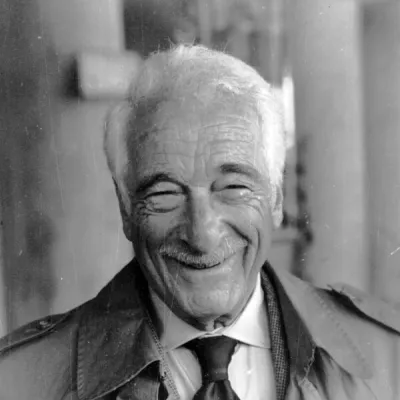
Victor Borge
Human Design Chart
Biography
Borge was the youngest of five boys born to a dad who was first violinist with Copenhagen's Royal Theatre. Introduced to the piano at three, Borge made his concert debut at ten in his native Denmark. He played seriously, though his friends knew him as a parlour comedian. In 1931 a new career opened up when he substituted for the star of an amateur show for which he had already written the music. His flair for comedy had began to surface at 14, becoming an irreverent wit that evolved into a talent for satirizing the Nazi party. By 1940, this was not a commercially viable talent, so Borge, by then a star of Danish movies and musical comedies, found himself emigrating to the U.S. with his wife.
Penniless when he arrived, Borge later remarked that he was born again in 1940. He learned English at age 31 by going to movies, and found a job as a warm-up comedian for Bing Crosby's radio show. After 56 weeks, he had his own show. Since then, he also has become an author and parlayed a poultry ranch into a million-dollar business.
Borge felt that it had all come easily. He had always been his own promoter and his own doer, and as a self-made man, he accumulated a great fortune. His only regret was that his parents were never able to participate in his American life as his dad was 60 when Victor was born. He had a simple recipe for his music and comedy.
Victor Borge as a Manifesting Generator 4/6 in Human Design
Manifesting Generator 4/6 — Design at a Glance
Victor Borge revealed himself as a Hybrid being that combined the lightning-fast effect of a Manifestor with the constant energy source of a Generator. His design allowed him to skip steps when implementing ideas and quickly draw results into his life. However, this speed was a double-edged sword: Often he acted too hastily and skipped necessary intermediate steps, which forced him later to backtrack and fill in gaps. Such detours easily led to frustration, the specific non-self theme of this type.
Moreover, Victor Borge tended to pursue multiple projects simultaneously, driven by reactions to various impulses. Without disciplined alignment, this multitasking parallelism threatened to turn into dissatisfaction. The key to his effectiveness lay in not initiating himself but reacting to life. He had to wait until his sacral center gave a clear "yes" – an inner confirmation that the activity was right. Only then should he proceed.
If he followed this strategy and regularly checked whether his authority still approved of the paths he had started, he could use his speed without overextending himself. Under these conditions, Victor Borge found deep satisfaction in his work. For him, the advice to finish one thing before starting another was counterproductive. Instead, he thrived in "play mode," where variety and fun from different parallel tasks fed his energy and prevented frustration.
Emotional Authority
Victor Borge exhibited an internal structure that compelled him to never make decisions immediately. His inner authority lay in the defined Emotional Center, meaning he was subject to a constant wave of emotional ups and downs. This configuration ensured that his perception of the world was always colored by his current mood; something could inspire him at one moment and appear negative the next. Since this feeling only represented a fleeting snapshot and not necessarily the deeper truth, spontaneous reactions would have been unreliable for his design.
The mechanics of his emotional authority required patience as a central strategy. Victor Borge had to take time to let decisions mature. The process of "sleeping on it" was essential: Only when intense feelings subsided and emotional distance emerged did clarity and calmness set in. This priority rule applied regardless of other defined centers in his chart; the Emotional Center dictated the rhythm of his inner guidance. By hesitating and asking more than once, rather than reacting to passing enthusiasm or negativity, he could make long-term life decisions that were stable. Thus, his design marked him as someone who only reached true insight through traversing the emotional cycle, rather than acting on initial impulse.
The 4/6 Profile — Opportunist / Role Model
Victor Borge showed a development line that was characterized by experimental behavior in relationships early in life. His design as Profile 4/6, the Networker and Role Model, determined that he was strongly influenced by the dynamics of Line 3 during his first thirty years, before Saturn's return. During this phase, he actively sought connection and experimented with various social roles, driven by the natural need of the fourth line for community and belonging.
With the onset of the second half of life, his focus fundamentally shifted. The activation of Line 6 brought an inner tension: the heart’s desire for close intimacy now conflicted with the head's need for analytical distance and a high intellectual position. This contradiction between wanting to be part of a network and feeling compelled to withdraw to contemplate the meaning of life shaped his later attitude.
His design expected him to integrate this polarity. He was meant to act as a wise role model who shares deep inspiration through cooperation. His heart remained cautious, opening up only to those who proved themselves trustworthy in order to avoid being hurt. The mechanics of his Line 6 allowed him to pass on his individual depth and intuitive clarity to others, thereby affirming his value within the community without compromising his own integrity.
Single Definition — Defined & Open Centers
Victor Borge revealed himself as someone with a stable inner foundation marked by four defined centers: Throat, G Center, Sacral, and Solar Plexus. This configuration endowed him with a reliable way of expression and identity. His voice did not stem from impulsive thoughts but rather from his deep self-assurance and vital energy. He possessed a clear sense of direction and the ability for unconditional love without being dependent on others.
However, his decision-making did not follow mental or willful compulsion as Head Center, Ajna Center, and Heart Center were open. Instead, he was designed to react to what came his way. His defined Sacral Motor generated a constant vital energy that could only be correctly available through reaction – not initiation. This protected him from exhaustion and frustration by learning to trust the tones of his sacral response rather than chasing mental plans.
At the same time, his defined Solar Plexus served as an emotional authority. Truth revealed itself for him not in the “now,” but after going through the emotional wave. He tended to practice patience and delay decisions until emotional clarity was achieved. This prevented impulsive actions at the peaks or lows of his feeling waves.
The open centers shaped his vulnerabilities: The open Head Center left him free from constant mental inspiration, open to new ideas without the pressure to provide answers. The open Ajna Center allowed a flexible mind that could take in concepts without holding them as personal truth. The open Heart Center freed him from the compulsion to prove willpower or give promises he couldn’t keep. He was not designed to be competitive but rather to live his value through correct reactions.
Together, these elements formed a reactor with strong inner structure: A constant energy source coupled with clear identity and emotional depth that showed itself through reliable expression. His mechanics required waiting for emotional clarity and trusting the sacral response to find satisfaction and authenticity.
Channels for rhythm, presence, emotional openness and determination.
Victor Borge displayed a fundamental disposition marked by the struggle for individual integrity and life meaning. His design laid out a tendency towards firm resistance against harmful forces; he accepted only reinforcement and showed necessary aggression in defense of his identity. This energy, concentrated at Gate 38 (Line 4), formed the core of his personality: pressure and tension without awareness, which became active according to the type strategy.
This defensive strength worked together with his inner timing. The Rhythm Channel 5-15 connected his Sacral Center with G Center. Gate 5 held onto fixed habits while Gate 15 integrated the diversity of society into life flow. This gave him a unique sense of timing determined by his internal rhythm, magnetically attracting others without conscious control.
His expression occurred through the Awakening Channel 10-20, linking G Center with Throat Center. Here individual knowledge transformed into correct action (Gate 20), guided by a behavioral code for successful interaction (Gate 10). He spoke from the essence of being: “I am and live now.” This promoted self-love and trust, inspiring others to be themselves.
Emotionally, he acted through the Openness Channel 22-12 between Solar Plexus and Throat Center. His articulation depended on ebb and flow of his emotional wave. Gate 22 expressed passion and drama while Gate 12 maintained a cautious restraint that limited openness to people with great mutative potential. He used the quality of his voice to move others, but only when he felt like it.
Long-term, the Discovery Channel 29-46 drove him between Sacral and G Center. Gate 29 offered the wellspring of endurance through positive saying yes while Gate 46 established a connection with the direction of Higher Self. He had to let go of expectations and lose himself in experiences to ultimately make his discoveries and change the collective.
Individual Circuitry — Circuit Signature
Victor Borge revealed himself as someone who lived his unique identity through emotional waves and rhythmic structure. In him, the design was simply defined; all four centers – Sacral, G-, Throat- and Solar Plexus – formed a single, continuous energetic flow. This allowed a direct connection between his power source, his emotional center, his expression organ, and his perception of presence.
In the Knowledge Circuit, he connected Throat Center with Solar Plexus through the Openness Channel. This shaped his ability to directly translate emotional impulses into acoustic expression driven by pulsing, creative energy. Parallelly, in the Understanding Circuit, the Rhythm Channel between Identity and Sacral Centers worked. Here he found a focused rational structure oriented towards future, helping him share logical insights with others free from emotional distortion.
Similarly, the Meaning Circuit connected Victor Borge’s Identity with his Sacral Center through the Discovery Channel. This created a cyclical energy dealing with past events and finding meaning behind them. The emotional wave here was more downward-directed, promoting reflection. Finally, he integrated these aspects in the Integration Circuit through the Awakening Channel between Throat and Identity Centers. This anchored his highest individuality in the present moment by intuitively channeling power from life’s reactions and immediately manifesting it. All four circuits worked together in him not isolated but as an integrated system of expression, logic, reflection, and immediate effect.
Right Angle Cross of Tension 4
Victor Borge was marked in his design by the archetypal structure of the Right Cross, characterized by tension four. This configuration defined a specific energetic dynamic that did not depend on individual activation centers or channels but rather worked as a fundamental pattern. It was a pure tension structure that set a certain type of energy movement and pressure within his system.
This cross described no concrete actions or biographical events but the underlying mechanical reality of his existence. The tension four in the right cross created a background of inner tension, manifesting as a constant force. Victor Borge lived with this energetic architecture, which influenced his reactions and being on a deep structural level. It was a matter of pure mechanics: How does this specific cross form work? It generated a tension that could not be resolved but existed as a defining element.
This structure conveyed no emotional story or personal development but a static truth about his energetic nature. Victor Borge embodied the principle of a dynamic defined by this cross. It was about the pure presence of this tension, independent of external circumstances. His design carried this burden of structure as an unchangeable given fact. The analysis remained on the level of archetypal form without drifting into individual details like defined centers. Victor Borge thus served as an example for the workings of this specific cross, whose energy flow and tension patterns determined his inner fabric.
Saturn Return · Uranus Opposition · Chiron Return · 2nd Saturn Return — Life Cycles
Victor Borges design showed a tendency towards structural reorganization in his early thirties, followed by a clear detachment and new orientation in the later third of his life. These cycles marked not only biographical milestones but archetypal phases of maturation and liberation.
In 1940, at age 31, he experienced his first Saturn return. This transit often demands a hard confrontation with one's foundations. For Victor Borge, this manifested as a crisis: He emigrated to the USA and changed his name to Victor Borge. It was a moment of necessary condensation, where old structures were dismantled to lay a solid new foundation stone. The Saturn energy worked here stabilizing through the compulsion to adapt to an entirely new environment.
Eight years later in 1948 at age 39, the Uranus opposition reached its peak. This cycle stands for liberation from established patterns and often unexpected turns or the desire for autonomy. Victor Borge obtained American citizenship that year. This was not just an administrative act but a career-relevant step of reorientation. The Uranus energy promoted detachment from his past identity and allowed him to establish himself as an independent personality in the new land. The shift from crisis-driven adaptation (Saturn) to active self-determination (Uranus) illustrates how planetary transits in his design created necessary conditions for his professional and personal development.
Manifesting Generator · Emotional Authority — Synthesis
Victor Borges life was marked by a deep inner dynamic arising from the interplay of his manifesting Generator energy, emotional authority, and open Root Center. He responded to life with quick energy (Sacral), processed experiences intensely through his emotional wave, and remained open to external influences, making him a mirror of societal currents. This combination led to an ability to draw creative impulses from the flow of life, which he then expressed authentically through his defined Throat Center – often with unexpected turns and a penchant for improvisation. The Channel of Openness (12/22) points to a natural talent for expressing emotions and touching others as long as he acted in harmony with his inner mood.
The central paradox in Victor Borges design is the tension between the need for deep emotional processing (Solar Plexus Authority) and the tendency towards quick reaction and versatility (Manifesting Generator). He was thus both an explorer who needed time to gain clarity and an artist who acted in the moment. The open Root Center amplified this ambivalence by making him susceptible to external influences and emphasizing the necessity of setting clear boundaries not to be overwhelmed by others' needs.
4 Defined Channels
Incarnation Cross - Right Angle Cross of Tension 4
Solar Return
The Solar Return shows the moment when the sun returns to its exact birth position - your personal solar year.
Life Cycles
Discover the life cycles with a detailed triple view (birth chart, cycle chart, composite).
Human Design Profile
- Strategy
- To respond - wait for something to respond to
- Authority
- Emotional Authority
- Profile
- 4/6 - Opportunist / Role Model
- Definition
- Single Definition
- Incarnation Cross
- Right Angle Cross of Tension 4
- Date of Birth
- 03.01.1909 10:30
- Place of Birth
- Copenhagen, Denmark
Frequently Asked Questions
What was Victor Borge's Human Design type?
What Profiles did Victor Borge have in Human Design?
Which Authority guided Victor Borge's decisions?
What incarnation cross did Victor Borge have?
When was Victor Borge born?
Discover your own Human Design
Are you also a Manifesting Generator? Find out in a personal reading how to unfold your multi-talents and direct your energy wisely.
More Personalities
Back to overviewSissy Spacek

Aldair

Alizée

Anémone

Angeli

Ann-Margret
