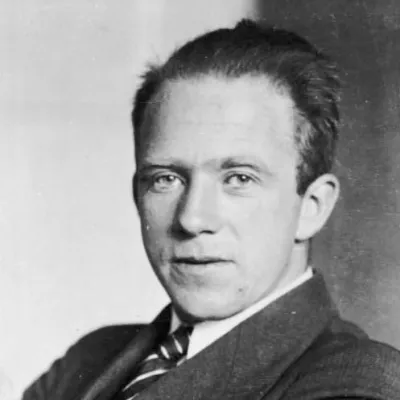
Werner Heisenberg
Human Design Chart
Biography
Human Design Analysis: Werner Heisenberg as Generator 2/4
Generator 2/4 — Design at a Glance
Werner Heisenberg's Human Design profile indicated a tendency towards great endurance and inner drive when responding to impulses from his environment. As a Generator, he had abundant sacral energy that made him extremely strong—like a workhorse—but only if this power was used for tasks that received his intrinsic approval. His life task did not involve initiating projects but rather reacting to signals from life. When his sacral center sent the clear signal 'Yes! Let's get started!', he responded with decisive action. This was the key to his effectiveness: Not pushing forward against resistance, but waiting for the right moment and then acting powerfully from the gut.
If he did not live by this strategy—such as doing things that he had no interest in or that kept him away from his heart project—it quickly led to energy loss and burnout. The greatest danger for him was wasting his strength or letting himself be hindered in the implementation of his passion. Conversely, the design rewarded him with a deep sense of fulfillment when applied correctly. Persistent frustration or energy deficiency mainly occurred when he tried to initiate against his natural rhythm instead of reacting. His strength lay in the ability to pick up life impulses and transform them into concrete results using his enduring energy, thereby experiencing profound satisfaction.
Sacral Authority
Werner Heisenberg's decision-making followed a clear, body-based logic. As a Generator, his strategy was identical with his inner authority: Sacral Authority. This simplified his process significantly as he did not need to switch between different levels of decision-making but could directly trust the reaction of his body.
This authority manifested as an immediate gut feeling or surge of energy triggered by an external stimulus. Instead of planning or analyzing, he reacted with physical signals like a soft grunt, hum, or 'Mhm'. These sounds were not mere reflexes but precise indicators whether something brought energy into him. When his sacral motor kicked in, he felt vital and alive; the available energy was virtually inexhaustible. He tackled his tasks with great enthusiasm and immersed himself entirely without needing an external goal or purpose. The joy of the activity itself drove him forward.
Furthermore, his activated Spleen Center acted as a supporting instance to Sacral Authority. This configuration allowed him particularly quick and spontaneous reactions. He had immediate access to his physical well-being and instinctive perception. Werner Heisenberg could reliably trust this inner voice as it provided him with a direct connection to his deepest needs and resources, independent of external expectations or rational considerations.
The 2/4 Profile — Hermit / Opportunist
Werner Heisenberg's design created a constant tension between the deep desire for withdrawal and the simultaneous attraction of his personal network. He was someone who swung between two poles: the wish for solitary reflection and the urge to spend time with familiar people. This dynamic of Profile 2/4 requires clear communication of these needs—when company is desired and when solitude is necessary—to avoid internal conflicts.
Line 2, the Natural Talent, provided him a foundation of inner peace, calmness, and self-control. It helped maintain a steady rhythm and energy conservation, serving as a secure 'cave'. During this alone time, he could rest and deepen internal processes. Once this need for recovery was satisfied, Line 4, the Networker, became active. It drove him to re-engage with his environment to gain clarity from experiences with friends.
This interaction functioned as a creative engine: The initial confusion or lack of clarity often at the beginning of processes dissolved through network interactions. In subsequent solitude, he could reflect and evaluate these insights. Thus, out of the interplay between isolated processing and social validation emerged a unique ability to understand complex connections and develop brilliant ideas. Line 4 brought him into contact with inspiring partners while Line 2 ensured that these impulses were not overwhelming but condensed at his own pace.
Single Definition — Defined & Open Centers
Werner Heisenberg was characterized by an internal stability: defined G-, Sacral-, Spleen- and Root Centers gave him a firm identity, constant vital energy, moment-to-moment intuitive authority, and specific stress management. These definitions formed the foundation of his design. In contrast, his open Head-, Ajna-, Throat-, Heart-, and Solar Plexus Centers required deconditioning. He was vulnerable to mental identification, had to wait rather than initiate in communication and willpower, and not personalize absorbed emotions.
His defined G-Center gave him a sense of direction and self-love; he could show others new paths without becoming dependent. The Sacral Center generated daily energy available through reaction – not initiation. His Spleen authority provided spontaneous intuition in the present moment while his Root Center controlled the pressure for material existence and survival. These defined centers created a reliable internal structure.
At the same time, his undefined centers revealed his challenges. His open Head- and Ajna Centers allowed him to take on mental inspirations without identifying them as personal truth; he tended to be distracted by doubts or the need to find answers when not trusting his authority. The open Throat Center meant that he did not have consistent control over communication, had to wait for invitations to speak rather than forcing attention. His open Heart Center lacked a constant willpower; he was not designed to give promises or prove worth through competition but should learn not to need proof of anything. Finally, his open Solar Plexus absorbed emotions from the environment; he needed to recognize these as foreign and not personalize them to avoid emotional decisions.
The tension between his internal stability and the necessity not to take external influences in open centers as personal responsibility shaped his mechanics. His strategy was to wait and listen to his inner authority (Spleen/Sacral) rather than mentally agitate or ride emotional waves. Thus, he could use his energy correctly and free himself from conditioned reactions.
Channel 2-14: The Beat — Channels & Gates
Werner Heisenberg's design tended towards creative mutation and maintaining an internal rhythm. His chart shows the ability to participate in life through intuitive adaptation while opening new directions without disturbing the natural flow.
The Beat Channel 14-2 connects the Sacral Center with the G-Center. Gate 14 focuses on making material resources available as driving force for mutation, while Gate 2 serves as driver of movement through space and time. This configuration allows Werner Heisenberg to take innovative new directions by trusting his generative energy even without foreseeing the final outcome. In doing so, he encourages others who find their own direction.
Parallel to this, the Rhythm Channel 5-15 shapes his timing. Gate 5 holds on to fixed habits and rituals while Gate 15 integrates the diversity of society into life's flow. This channel binds Werner Heisenberg closely to the biological flow of nature. His inner magnetism draws others into a continuous energy flow based on repeating but evolving patterns, promoting a safe future.
The Perfect Form Channel 10-57 connects the Spleen Center with the G-Center. Gate 57 offers intuitive insight through acoustic sensitivity while Gate 10 controls self-behavior. This gives Werner Heisenberg the ability to act spontaneously and appropriately to secure his survival in the present moment. Through this intuitive behavior, he creates something healthy and beautiful that invites others to live life as themselves.
Furthermore, the Life Struggle Channel 38-28 drives him forward. Gate 38 exerts pressure to maintain individual integrity against external forces while Gate 28 recognizes which struggles have value. Werner Heisenberg finds meaning in the conflicts of his path and serves as a model for others' individuation through stubborn determination.
Individual Gates like Gate 1 (unique creativity) or Gate 35 (change through interaction) complement this picture, emphasizing especially readiness to experience and focus on here and now.
Individual Circuitry — Circuit Signature
Werner Heisenberg's design tended towards structured rational analysis driven by emotional impulses and the will for change. As a Simple Defined, he had a coherent energetic flow between Identity-, Sacral-, Spleen- and Root Centers, indicating a coherent yet complex internal dynamics.
The Understanding Circuit worked through him via Channel 15-5 (Rhythm), connecting the Identity with the Sacral Center. This promoted the ability to strategically organize and share logical insights free from disruptive emotion – a purely rational structuring force for future developments.
Parallel to this, the Knowledge Circuit showed separate activity: The Beat Channel 2-14 connected Identity and Sacral Centers again, this time with pulsing creative energy for self-expression of individuality. Separately, the Life Struggle Channel 28-38 linked Spleen and Root Centers. This generated an instinctive survival drive for transformation of knowledge independent of rational mind.
The Integration Circuit rounded this through Perfect Form Channel 10-57, connecting Identity with Spleen Center. Here it was about uniting intuitive wisdom and proper behavior in the present to draw strength from reacting to life. These three circuits shaped Werner Heisenberg's essence as someone who combined rational structures with deep instinct and drive for individual transformative statement – always driven by an internal rhythm between thinking, feeling, and survival instinct.
Right Angle Cross of Consciousness 4
Werner Heisenberg's Human Design profile suggests a tendency to view consciousness not as an isolated internal state but rather as something that emerges through exchange and connection with others. This fundamental orientation shapes the way perception is set in the world: it is relational, dependent on dialogue and resonance.
In Human Design terms, this configuration describes a process where clarity is not found in a vacuum but only arises through contact with the outside world. Consciousness seeks confirmation or refutation in interaction. It's about testing ideas, sharing them with others to sharpen them further. Truth here is not a static object that is discovered but rather a dynamic process that comes alive in conversation.
This orientation means insights often reach their full power only when they are communicated. The focus lies on networking thoughts and the ability to make complex connections understandable through exchange. It's an energy that urges itself not to remain silent, but to engage relationally to deepen one's own understanding while simultaneously enriching that of others. Thus, the strategic orientation lies in openness for dialogue as a means of consciousness formation.
Saturn Return · Uranus Opposition · Chiron Return · 2nd Saturn Return — Life Cycles
Werner Heisenberg's life was marked by two significant astrological turning points that brought structure and change into his work. In 1927, at age 26, he began teaching at the University of Leipzig. This coincided with his first Saturn return cycle, which acts as a phase of consolidation: years of groundwork condense into a solid foundation anchoring professional and personal structures. Heisenberg's entry into academic teaching thus marked the moment when his intellectual development took on a stable form.
Another crucial chapter opened in 1941 when he ended his teaching career at Leipzig at age 40. This corresponds to the Uranus opposition, a cycle often initiating radical changes or dissolving existing frameworks. While Saturn builds and stabilizes, Uranus calls for release to make way for new developments. The end of his Leipzig period thus signaled not only a place or task change but also a profound transformation of his life context. These two cycles – consolidation in young adulthood and disruptive opening in midlife – underscore how external astrological influences can interact with individual decision points to shape the life path.
Generator · Sacral Authority — Synthesis
He was a Generator whose life was marked by a deep drive for activity and endurance. The sacral authority guided him through life, where decisions came from the body – an internal 'yes' or 'no', manifesting in physical reactions (Sacral Center). This principle of reacting to external impulses and the energy associated with it formed the core of his lifestyle. His profile as a natural talent and networker revealed an inner dynamic between the need for withdrawal for internal clarification (Line 2) and the desire for exchange and connection with others (Line 4). This interplay shaped his ability to think deeply while also sharing knowledge.
A central paradox lay in the tension between his defined G-Center – a clear sense of direction and identity – and the Beat Channel (Gate 14/2), which propelled mutation and novelty. He thus lived a life guided both by an inner compass as well as a constant search for innovation and change. This led to phases of intense creative power, followed by the need to withdraw and integrate gained insights (Cross 4). A notable event at age 26 when he began teaching, along with the end of this career at 40, pointed towards a cycle of engagement followed by reorientation.
4 Defined Channels
Incarnation Cross - Right Angle Cross of Consciousness 4
Solar Return
The Solar Return shows the moment when the sun returns to its exact birth position - your personal solar year.
Life Cycles
Discover the life cycles with a detailed triple view (birth chart, cycle chart, composite).
Human Design Profile
- Type
- Generator
- Strategy
- To respond - wait for something to respond to
- Authority
- Sacral Authority
- Profile
- 2/4 - Hermit / Opportunist
- Definition
- Single Definition
- Incarnation Cross
- Right Angle Cross of Consciousness 4
- Date of Birth
- 05.12.1901 16:45
- Place of Birth
- Würzburg, Germany
Frequently Asked Questions
What is Werner Heisenberg's Human Design type?
Which Profile does Werner Heisenberg have in Human Design?
What Authority guides Werner Heisenberg?
What is Werner Heisenberg's incarnation cross?
When was Werner Heisenberg born?
Discover your own Human Design
Are you also a Generator? Find out in a personal reading how to use your sacral energy correctly and discover deep satisfaction.
More Personalities
Back to overviewAaliyah

Alexia

Angèle

Anne-Marie

Arcángel

Arno