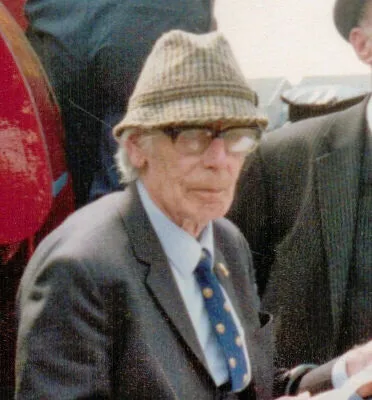
Wilbert Awdry
Human Design Chart
Biography
He died peacefully in his sleep in Stroud, Gloucestershire on 21 March 1997 at the age of 85.
The Human Design of Wilbert Awdry: Manifesting Generator 1/4
Manifesting Generator 1/4 — Design at a Glance
Wilbert Awdry's design leans towards lightning-fast activity based on specific internal confirmation. As an Manifesting Generator, he had constant sacral energy, allowing him to quickly draw things into his life while skipping steps. However, this ability for parallel action came with a risk: without inner approval, he tended to neglect important stages or start multiple projects simultaneously, leading to frustration – his Non-Self theme.
The mechanics of his design required him not to initiate himself but to react to impulses from his environment. Only when his sacral center gave a clear 'Yes!', it was advisable to proceed. This reactive strategy protected him from rushing and the feeling of having to catch up on steps. By heeding this inner authority, Wilbert Awdry could use his natural speed without falling into frustration.
In this state of deep trust in his impulse, a 'Play Mode' emerged. Here, he found deep satisfaction and fulfillment in his work. The need to complete one thing before starting another was more hindering than helpful for him. Instead, his creativity flourished in variety and the simultaneous pursuit of various interests as long as each activity was blessed by the inner 'Yes'. This balance between quick execution and conscious reaction shaped his creative process.
Emotional Authority
Wilbert Awdry's decision-making followed a rhythmic pattern of emotional waves. His design carried Emotional Authority, meaning that his defined Emotional Center formed his internal compass – independent of other defined centers in his chart. This configuration shaped a lifestyle where feelings fluctuated permanently; he saw the world through the filter of his current mood. What excited him for a moment could appear negative in the next.
These fluctuations were only snapshots, not ultimate truth. Spontaneous reactions or decisions based on emotional impulse carried the risk of proving wrong later. His design's strategy thus lay in waiting and patience. Wilbert Awdry used time to let decisions mature by reviewing them multiple times and letting them rest overnight. Through this hesitation, intense feelings gradually subsided. Only with this emotional distance did deep clarity and calmness set in. This process of riding the waves was essential for him to take long-term steps that would sustainably influence his life path. Only after going through this emotional phase could he recognize his true inner knowledge and act without being guided by fleeting moods.
The 1/4 Profile — Investigator / Opportunist
Wilbert Awdry's design leans towards deep, isolated research aimed at social validation in familiar circles. As a 1/4 (Researcher/Networker), he first sought hidden truth and profound knowledge driven by the Monk Ideal of Line 1. This withdrawal served not for final isolation but to prepare for the social context. Line 4 connected this individual research drive with an instinct for a network of trusted people.
This configuration generated a specific psychological tension: Wilbert Awdry often felt driven by fear of being exposed as unknowledgeable in front of his inner group. This fear of social rejection and associated heart pain led him to only unfold his authority and networking power in environments with deep trust. Without this security, withdrawal tendencies dominated. Only when the basis of trust was secured could he share his profound knowledge and influence through his networking ability. The mechanics thus described a path from isolated depth to shared authority, where the quality of relationships determined whether he appeared competent and connected or insecure and withdrawn.
Split Definition — Defined & Open Centers
Wilbert Awdry had a constant inner energy source that was activated by reacting to external impulses. His defined Sacral Center served as the motor for vital force and satisfaction; he acted effectively only when asked and gave an affirmative response. This energy flowed into his defined Throat Center, which determined his expression and manifestation power. He did not communicate out of mental planning but spoke or acted directly from his sacral answer or emotional state.
His inner authority lay in the defined Solar Plexus Center. Here: There was no truth in the „now“. Wilbert Awdry needed time to wait for emotional waves before clarity emerged. Impulsive decisions at the peak or depth of this wave led to chaos; patience revealed only the correct direction. A defined Root Center also provided a constant life pressure that propelled him forward and helped him deal with stress as long as he did not act against his strategy.
In contrast, his G Center (Identity/Direction) and Heart Center (Willpower) were open. He had no fixed identity or consistent will. Instead, he tended to orient himself towards direction in relationships and tried not to prove his worth through promises, since he lacked the energy for it. His open Head and Ajna Centers meant that inspiration and concepts were situationally taken from the environment; he was vulnerable to mental confusion or pressure to deliver answers that weren't his own. Also, his Spleen Center (Intuition/Health) was open. He absorbed intuitive signals from others rather than generating them himself and had to learn to avoid spontaneous decisions to prevent dependencies or false security. His strength lay in reacting to life, spreading emotions, and clearly acting from this depth instead of taking initiative or forcing mental certainty.
Channels for emotional depth and lifelong growth.
Wilbert Awdry showed as someone whose social impact was strictly bound to his emotional wave. His ability to touch or transform others through voice and timing depended on whether he felt like it; forced interactions often led to misunderstandings. This resulted from the Openness Channel 22-12, which connected Solar Plexus with Throat. Gate 22 brought in individual mood while Gate 12 regulated through caution and ensured that this openness only affected people with high mutative potential. His communicative power thus unfolded only at the right moment of emotional resonance.
Parallel to this, the Maturity Channel 53-42 shaped his life through a cyclical process of experiencing and reflecting. This channel connected Root with Sacral Center and dictated that wisdom was only gained by completing cycles fully. Premature ending led to repetition; Wilbert Awdry had to make experiences for their own sake without premature expectations to avoid frustration. The tension between the moody social openness and the disciplined necessity of maturity determined his actions: authenticity in communication required patience with his emotional rhythm, while personal growth depended on trusting each cycle until its end.
Additional facets were provided by Gate 11 with its visual memory and analytical curiosity as well as Gate 36, which understood crises as impersonal, cyclical movements for development. Gate 6 steered the biological limit for emotional opening or closing. On a personality level, Gate 20 focused on authentic action in the here and now while Gate 31 represented energetic transmission and leadership. In the design, Gate 27 played a genetic role of care for kin and self-preservation. Gate 41 propelled evolutionary development through specific experiences, while Gate 60 conveyed acceptance of limitations as a prerequisite for transcendence. These configurations formed a life based on deep listening, cyclical maturation, and emotional authenticity.
Individual Circuitry — Circuit Signature
Wilbert Awdry's design laid a tendency to a pulsating, creative identity that found its expression in emotional waves in the Throat Center. The Knowledge Circuit connected his Throat with Solar Plexus Centers. This direct connection allowed inner feelings and transformations to be carried outward acoustically. It was about the unique path and creation of new knowledge through creativity. Energy flowed wave-like from the emotional source to the voice, bringing change into the world.
Parallel to this existed a separate energetic area: The Meaning Circuit connected Sacral with Root Centers. As Wilbert Awdry had a Split Definition, these two circuits were not directly connected but worked as coexisting forces. This second stream focused on cyclical reflection of the past and emotional maturation. Energy here was more repelling and visually marked, aiming to draw meaning from past experiences and share this learned knowledge with the collective. While the Throat-Solar Plexus formation stood for immediate creative expression, the Sacral-Root connection ensured that past events were processed and embedded into a shared learning history. Both systems shaped his essence: on one hand, the pressing impulse towards individual transformation through voice and creativity, on the other hand, the need for emotional depth and sharing life wisdom from the past.
Right Angle Cross of Eden 2
Wilbert Awdry's design indicated a tendency towards a deep, often unconscious strategy that significantly shaped his actions. It was less about conscious planning in the everyday sense and more about an inner orientation that determined how he deployed his energy within his environment. This configuration meant that he pursued long-term goals without always having them explicitly in mind or actively striving for them.
The mechanics of Eden 2's right cross describe exactly this dynamic undercurrent. It points to a way in which energy is not arbitrary but unfolds according to a specific pattern that extends beyond the immediate moment. For Wilbert Awdry, this meant that his actions were driven by an underlying vision, even if it was not always transparent to others or even himself. The focus was on integrating his power into a larger whole, with emphasis on sustainable impact rather than short-term results. This structure ensured that his strategic orientation organically emerged from his inner nature and manifested in a consistent yet subtle form over extended periods of time.
Saturn Return · Uranus Opposition · Chiron Return · 2nd Saturn Return — Life Cycles
Wilbert Awdry's life followed two significant structural turning points that redefined his identity and living space. In 1940, at the age of 29, he moved to Birmingham and began working as a pastor there. This fell into his first Saturn Return, a phase where years of inner groundwork often condenses into a tangible external structure. For Wilbert Awdry, this cycle marked the establishment in a clear professional role and new social environment that stabilized his authority.
A second crucial step occurred in 1965 when he moved to Stroud at the age of 54. This corresponded with his second Saturn Return, typically requiring further deepening or correction of life structure. This move was less career-driven than an adaptation of his personal environment, possibly driven by relationship aspects or a need for new peace. Both events show how Wilbert Awdry took concrete steps during these maturation phases to carry his inner development outward and adjust his living framework accordingly.
Manifesting Generator · Emotional Authority — Synthesis
Wilbert Awdry lived a life marked by a profound interaction between internal experience and external expression. The combination of manifesting generator energy and emotional authority points to someone who possessed the ability to quickly respond to impulses as well as the necessity to filter these impulses through careful emotional scrutiny. This interplay was evident in a dynamic tension between the urge for rapid realization and an inner need for maturation and cyclical experience – a process amplified by his open Root and Sacral Centers. The openness of these centers indicated high sensitivity to others' energy, leading him to accumulate experiences and transform them into creative forms.
A central paradox in Awdry's design lies in the tension between his ability for quick reaction (manifesting generator) and the need for emotional clarity (emotional authority). He was a person driven both to act and feel the necessity of letting decisions mature over longer periods. This dynamic likely led to an internal struggle between the desire for immediate implementation and the need to fully experience and transform experiences into creative energy – a cycle of action, reflection, and renewed action.
2 Defined Channels
Incarnation Cross - Right Angle Cross of Eden 2
Solar Return
The Solar Return shows the moment when the sun returns to its exact birth position - your personal solar year.
Life Cycles
Discover the life cycles with a detailed triple view (birth chart, cycle chart, composite).
Human Design Profile
- Strategy
- To respond - wait for something to respond to
- Authority
- Emotional Authority
- Profile
- 1/4 - Investigator / Opportunist
- Definition
- Split Definition
- Incarnation Cross
- Right Angle Cross of Eden 2
- Date of Birth
- 15.06.1911 17:22
- Place of Birth
- Romsey, United Kingdom
Frequently Asked Questions
What is Wilbert Awdry's Human Design type?
What Profile did Wilbert Awdry have in Human Design?
What Authority did Wilbert Awdry possess?
Which incarnation cross was active for Wilbert Awdry?
When was Wilbert Awdry born?
Discover your own Human Design
Are you also a Manifesting Generator? Find out in a personal reading how to unfold your multi-talents and direct your energy wisely.
More Personalities
Back to overviewAlain-Fournier

Aldair

Alizée

Angeli

Arletty

Artus