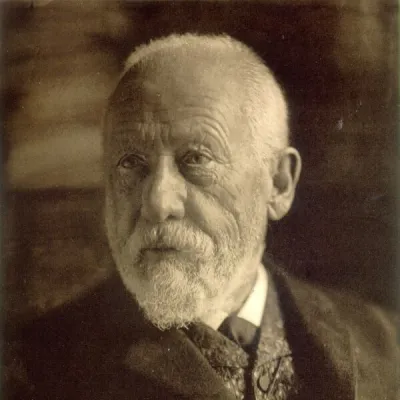
Wilhelm Dilthey
Human Design Chart
Biography
Dilthey has often been considered an empiricist, in contrast to the idealism prevalent in Germany at the time, but his account of what constitutes the empirical and experiential differs from British empiricism and positivism in its central epistemological and ontological assumptions, which are drawn from German literary and philosophical traditions.
The Human Design of Wilhelm Dilthey: Generator 3/6
Generator 3/6 — Design at a Glance
Wilhelm Dilthey possessed immense endurance and served as a powerful engine for his intellectual endeavors. His design suggested that he worked like a workhorse: extremely strong and durable, so long as he had energy for his tasks. This strength came from his sacral center, which provided him with abundant life force energy. Crucial was the nature of activation: his energy became primarily free when responding to impulses from his environment, not through self-initiated actions. The strategy 'react rather than initiate' shaped his work rhythm. When his inner self gave a clear signal - an intuition of 'Yes! Let's get started!' - he responded with full action. In these moments, his creative power was inexhaustible and led to profound feelings of fulfillment. Conversely, frustration or energy loss threatened when he acted against this internal resonance or completed tasks that did not stir intrinsic interest. Likewise, holding back from his heart project while still brimming with power counted among his stumbling blocks. Wilhelm Dilthey thus emerged as someone who ignited his greatest effectiveness through gut-reaction actions and generated deep satisfaction if he followed this natural flow.
Emotional Authority
Wilhelm Diltheys design indicated a tendency towards emotional depth and delayed clarity. His inner authority was Emotional Authority, carried by the defined Solar Plexus Center. In Human Design mechanics: If the Solar Plexus is filled, it always takes on the role of internal leadership, regardless of how many other centers are also defined. This priority rule is central; it means that no rational analysis or external opinion could replace this emotional process.
Dilthey was subject to a natural wave of emotional ups and downs. The world appeared colored by his current mood state: A topic might be filled with great enthusiasm in one moment, then felt as negative the next. These immediate reactions formed only first impressions, not yet the final truth. Spontaneous decisions made directly from such an emotional peak often proved problematic or misleading.
The mechanics required patience and conscious delay. Dilthey had to take time for decisions to ripen - ideally over several nights. Only with time did intense feelings subside, emotional distance gained strength, and a deep, comprehensive clarity emerged. This process was especially crucial for long-term life decisions. Only through this waiting period could he recognize the essential core of a situation beyond transient mood fluctuations.
The 3/6 Profile — Martyr / Role Model
Wilhelm Diltheys design indicated a tendency towards experimental action that was later shaped by reflective wisdom in his later years. As Profile 3/6, he primarily acted according to Line 3 patterns during the first half of his life: seeking material power and individuality through trial and error. This phase was characterized by playful exploration, where selfless service for others contributed to preserving his own identity.
Only after Saturn returned around age thirty did Line 6 activate. This fundamentally changed his basic attitude: The earlier urge to experiment now received wise guidance. Dilthey increasingly became reflective, drawing on past experiences and gaining an overview of what he had seen. Line 6 brought the process of meaning-making; he tested commitments for their developmental effectiveness and cautiously withdrew when confused before saying yes.
Internally, he often carried a sense of being torn: The desire for further play or reflection stood against the outward appearance of control. This tension between the childlike curiosity of Line 3 and the old wisdom of Line 6 shaped his inner experience. In his later years, around age fifty, this connection of charm and reflective experience made him a great role model for others as he shared his accumulated insights as a teacher.
Single Definition — Defined & Open Centers
Wilhelm Diltheys Design indicates a tendency towards deep, time-bound emotional clarity paired with powerful reactive life energy. As a Generator, he had a defined Sacral Center, which provided him with a constant source of vital energy. However, this power was not activated through initiating actions but rather by reacting to external stimuli; his satisfaction depended on whether he could respond to offers with an inner "yes." Simultaneously, his defined Solar Plexus acted as internal authority: truth revealed itself to him not at the moment of decision but only after navigating an emotional wave. He demonstrated patience in filtering emotional impulses and then acted once clarity had set in.
This mechanism was complemented by his defined Spleen Center, which gave him intuitive existential awareness in "the now." His instincts served as a reliable compass for health and well-being independent of rational analysis. The also defined Root Center provided the necessary pressure to move forward and connected this with his emotional and intuitive structure.
In contrast, his open centers marked specific vulnerabilities. His open Head and Ajna Centers meant he did not have constant mental inspiration; instead, he tended to be influenced by others' confusion or questions rather than holding onto his own conceptual truths. His open G Center lacked a fixed identity or direction; he relied on the environment and relationships to initiate him in finding his place. Additionally, his open Heart Center struggled with the pressure to prove itself despite lacking consistent willpower for doing so. His open Throat Center led to feeling compelled to force attention rather than waiting for natural invitations to speak. This configuration described a person who found strength in patient reaction and emotional depth while needing protection against mental overload and the need for external validation.
Channels for clear logic, change, care and emotion.
Wilhelm Dilthey was marked by a pulsating, often melancholic energy that triggered evolutionary change in his environment. This dynamic resulted from the Channel of Mutation 60-3, which connected the Root Center with the Sacral Center. Gate 60 (Limitation) and Gate 3 (Ordering) generated an on/off energy that could not be rationalized but required patient waiting for the right impulse to form new orders out of chaos.
Parallel to this, the Channel of Judgment 58-18 between Root and Spleen Center was at work. Through Gate 58 (Vivacity) and Gate 18 (Correction), there existed an insatiable urge to question and perfect patterns. This gave him the ability to logically assess what promoted or hindered life, but only effectively when he was asked for advice rather than being critical.
His actions were supported by the Channel of Preservation 27-50 between Sacral and Spleen Center. Gate 27 (Care) and Gate 50 (Values) created an instinctive reaction to protect and provide for the tribe. This energy attracted trust but required clear boundaries to avoid being overwhelmed; he only provided for those who explicitly asked for support.
Emotionally, Wilhelm Dilthey moved within the wave of the Channel Release Emotions 39-55 (Root-Solar Plexus). Gate 39 (Provocation) and Gate 55 (Mind) generated a mood swing between joy and sadness. This emotional alchemy allowed him to sense others' minds and evoke deep resonance through authentic moods—whether passionate or melancholic—rather than rationalizing his feelings away.
Additionally, prioritized gates like Gate 14 (Power/Resourcefulness) and Gate 8 (Contribution/Leadership) contributed to his individual expression form, while gates such as 29 (Yes-Saying/Persistence) and 30 (Feelings/Fate) shaped inner attitudes. The combination of these channels formed a person who brought about change through waiting for impulses, correction through questioning, and connection through emotional authenticity.
Individual Circuitry — Circuit Signature
Wilhelm Diltheys Design showed a coherent, interconnected energy structure. As a simply defined type, he had an uninterrupted flow between the Sacral, Root, Spleen, and Solar Plexus Centers. This connection marked him as someone who linked instinctive intelligence with emotional depth.
The Knowledge Circuit connected his Sacral to his Root and Solar Plexus Center through Channel "Mutation" (3-60), driving a force for deviation from the known, paired with the ability to release emotions (55-39). This fostered the development of a unique identity and the expression of new insights through emotional waves.
Parallel to this, the Understanding Circuit linked his Spleen and Root Centers. Channel "Judgment" (18-58) allowed focused, logical analysis. Since the Solar Plexus Center was not involved here, it was a sober, emotionless ratio that developed strategies for improving the future.
The Protector Circuit finally connected his Sacral and Spleen Centers. The channel "Conservation" (27-50) emphasized ancient themes of protection, care, and preservation. This primal energy served to secure survival and nurture one's genetics.
Overall, these three circuits did not work in isolation but as an integrated system: instincts (Spleen), life force (Sacral), emotional resonance (Solar Plexus), and logical structure (Root) flowed into each other. This created a person who combined deeply rooted intuition with clear intellect to foster both individual identity and collective protection.
Right Angle Cross of Contagion 4
Wilhelm Diltheys Human-Design profile featured the right cross of infection. This configuration described a specific psychological mechanism: He was predisposed to absorb unconscious impulses and emotional currents from his environment internally process them. Instead of actively projecting outward or initiating actions, his system functioned as a receiver. Energy flowed into him from outside, resulting in a high sensitivity to what transpired in his social field.
This mechanism did not mean that Wilhelm Dilthey was passive but rather that his strength lay in resonance with others. He mirrored the mood and underlying energies of his environment. Through this absorption, he gained deep insights by perceiving the hidden and unspoken aspects of interactions. The challenge was to distinguish these absorbed impulses from his own essence clearly. His design called upon him to consciously integrate these received energies to enable an authentic response. This capacity for deep empathy and understanding of interpersonal dynamics shaped how he experienced and navigated the world.
Saturn Return · Uranus Opposition · Chiron Return · 2nd Saturn Return — Life Cycles
Wilhelm Diltheys Human-Design profile indicated a tendency towards profound structural reorientations often coinciding with institutional or biographical turning points. This configuration describes a life rhythm in which inner maturity and external recognition condensed into specific cycles. In 1864, at age 31, he earned his doctorate and habilitation at the Berlin Friedrich-Wilhelms-University – a classic first Saturn Return moment where years of groundwork culminated in a solid professional foundation. The opposition with Uranus was evident in 1874 when he married Katharina Püttmann; here the search for change met the need for partnership and stability.
Especially pivotal was his Chiron Return in 1882, when Dilthey at age 49 received a call to Berlin as Hermann Lotzes successor. This cycle marked not healing of old wounds but the blossoming of his incarnation purpose: His life mission unfolded increasingly in public and became meaningful through experience. The second Saturn Return in 1887 brought another deepening; Dilthey found himself amidst the ruins of philosophy, hinting at a necessary yet painful revision of intellectual foundations. His path was marked by these recurring phases of consolidation and renewal where his inner authority manifested more strongly in external life – not merely as an event but as a structural necessity of his design.
Generator · Emotional Authority — Synthesis
He lived as a Generator whose sacral energy provided constant power for work and expression. This vitality, however, was inseparable from an emotional wave that allowed decisions only after thorough deliberation – a process requiring patience to recognize one's own truth. The profile as an experimenter, which evolved into a role model over time, reflected a continuous dynamic between testing new paths and reflecting on accumulated experiences. Through the Channel of Mutation (3-60), this capacity for change was strengthened, with acceptance of limitations being a crucial component of the creative process.
A central paradox lay in the interplay between his vital energy and the need for emotional clarity. While the Sacral Center urged constant activity, emotional authority required slowing down to make decisions from deep inner conviction. This tension manifested in pivotal cycles of his life: Career steps (1864, 1882) and personal commitments (1874) were accompanied by phases of reflection and upheaval (1887), a constant oscillation between exploring new possibilities and finding stable internal guidance.
4 Defined Channels
Incarnation Cross - Right Angle Cross of Contagion 4
Solar Return
The Solar Return shows the moment when the sun returns to its exact birth position - your personal solar year.
Life Cycles
Discover the life cycles with a detailed triple view (birth chart, cycle chart, composite).
Human Design Profile
- Type
- Generator
- Strategy
- To respond - wait for something to respond to
- Authority
- Emotional Authority
- Profile
- 3/6 - Martyr / Role Model
- Definition
- Single Definition
- Incarnation Cross
- Right Angle Cross of Contagion 4
- Date of Birth
- 19.11.1833 20:00
- Place of Birth
- Wiesbaden, Germany
Frequently Asked Questions
What was Wilhelm Dilthey's Human Design type?
What did Wilhelm Dilthey's Profile look like in Human Design?
What authority did Wilhelm Dilthey have in his design?
What incarnation cross characterized Wilhelm Dilthey?
When was Wilhelm Dilthey born?
Discover your own Human Design
Are you also a Generator? Find out in a personal reading how to use your sacral energy correctly and discover deep satisfaction.
More Personalities
Back to overviewAaliyah

Alexia

Angèle

Anne-Marie

Arcángel

Arno