
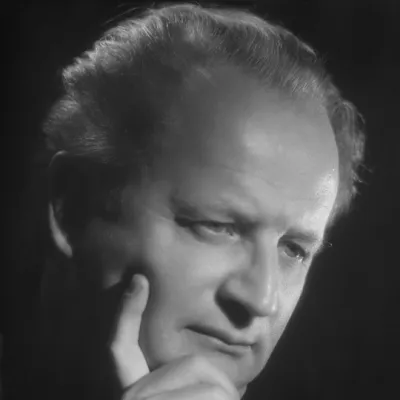
Wilhelm Kempff
Human Design Chart
Biography
Born into a family of distinguished church musicians, he studied with his dad, then formally from age nine. He began his career in 1916 as a pianist and organist and made many tours, worldwide. He was close to 70 when he made his U.S. debut, world known through his recordings.
Kempff married Baroness Helen Hiller von Gaertringen in 1926; seven kids; widowed 1986. He himself died on 23 May 1991, Positano, Italy after suffering from Parkinson's for ten years.
Human Design Analysis: Wilhelm Kempff as Manifesting Generator 4/6
Manifesting Generator 4/6 — Design at a Glance
Wilhelm Kempff's design featured a tendency towards hybrid energy: As an Manifesting Generator, he possessed the constant power of the sacral center, combined with the ability to skip steps and achieve results quickly. This configuration marked him as someone who ideally worked in a "play mode," where variety and parallel projects served not as distractions but as sources of deep satisfaction.
However, his type's mechanics required a specific strategy: Instead of initiating himself, he responded to impulses from his environment. Only when the sacral center gave a clear "yes" did he invest his energy. This protected him from the typical trap of his design, which was moving too quickly and skipping important stages, otherwise leading to frustration. Additionally, he tended to tackle several things at once; this was not a mistake but a natural expression of his speed, provided he listened to his inner authority.
His life task consisted in channeling this fast manifestation power through reaction rather than initiation. When strategy and authority aligned, the potential danger of rushing turned into efficient creative force. Thus, Wilhelm Kempff appeared as someone who did not build up energy linearly but worked in leaps – assuming he remained true to the rhythm of his inner confirmation and regularly checked whether his projects still resonated.
Emotional Authority
Wilhelm Kempff's inner authority was emotional, carried by his defined Emotional Center. This configuration had absolute priority in Human Design: independent of other defined centers or type characteristics, it always determined the emotional wave of his decision-making process. His perception of the world was marked by these constant mood swings; enthusiasm could quickly turn into rejection without this being a final evaluation.
For Wilhelm Kempff, this meant that spontaneous judgments were often just momentary snapshots and not deeper truths. Quick decisions based on transient moods proved risky and frequently led to misjudgments. The mechanics of his authority required patience: he had to let decisions rest so the emotional wave could subside. Only through "sleeping on dilemmas" did he gain the necessary distance. When the initial intensity faded, clarity and calmness set in. This process was essential for long-term life decisions. Thus, Wilhelm Kempff showed himself as someone who did not find his deeper truth in the first impulse but rather in the subsequent resting phase after the emotional wave had lost its power. This strategy of waiting and observing his own mood state was the key to authentic and sustainable decisions in his life.
The 4/6 Profile — Opportunist / Role Model
Wilhelm Kempff's design indicated a tendency towards a tension-filled alternation between social engagement and withdrawn reflection. As a 4/6 profile, he exhibited an experimental behavior in the first three decades of his life, before Saturn returned, which structurally resembled Line 3. This was particularly evident in the intensive exploration of various relationship and friendship configurations.
With the activation of Line 6, a characteristic conflict emerged: the desire for community belonging (Line 4) clashed with the need to withdraw to contemplate the meaning of life (Line 6). This internal discord between heart and head shaped his later development. He was expected to take on the role of a wise role model through cooperation with others.
At the same time, Gate 34 in Line 4 exerted an intuitive power in the present moment along with a strong focus on trust and implications of power. Success depended on using this power respectfully; abuse led to mistrust. Simultaneously, Gate 59 in Line 6 developed a process of openness until age thirty. After that, he recognized deeper consequences of unions and commitments, where Venus influences promoted completed relationships. His heart remained cautious throughout, to avoid opening up to false people and getting hurt.
Split Definition — Defined & Open Centers
Wilhelm Kempff's design indicated a tendency towards constant mental pressure to ask questions and seek answers. This configuration between the Head Center and Ajna Center created an ongoing internal stimulus for inspiration and understanding, but lacked direct energy for implementation. Instead, his mind was used to inspire or put others under pressure to think, while he himself had to wait for the right moment to make ideas effective.
His defined Throat Center allowed him to reliably express these mental processes and concepts. Communication was a central channel through which his inner thoughts entered the world. Simultaneously, his defined Heart Center shaped a clear willpower; he controlled his resources independently and kept promises, helping him build trust and maintain his own value.
As a Generator with a defined Sacral Center, Wilhelm Kempff had an enormous source of vitality. His strategy was not to initiate but to respond to external requests to use his energy correctly. This was complemented by his defined Solar Plexus Center, which functioned as an emotional authority. He learned to wait for the emotional wave before making decisions to gain clarity rather than impulsive reactions. His defined Spleen Center also provided spontaneous intuition and a strong body awareness in the present moment.
In contrast, his G Center was open. This meant that Wilhelm Kempff did not have a fixed identity or direction but blended with his environment. He tended to seek lost love or missing meaning rather than waiting to be initiated by others. His Root Center was also open, making him vulnerable to external stress. He absorbed the pressure from the environment instead of generating it himself and had to learn not to misinterpret this adrenalized influence as his own drive to avoid overloading.
Channels for intuitive power, community and curious abstraction.
Wilhelm Kempff's design indicated a tendency towards charismatic, intuitive expressive strength. The Charisma Channel 34-20 connected sacral life force with the Throat Center, guiding his actions through inner reactions. This energy required self-reinforcement; it worked best when he focused on satisfying activities and was not led by external expectations. Simultaneously, the Brainwave Channel 57-20 gave a clear voice to his intuition from the Spleen Center in the present moment. This allowed spontaneous, penetrating insights that he could communicate directly – knowledge based on deep survival instinct making him action-ready in the moment.
Additionally, the Power Channel 34-57 shaped his individual vitality. It connected sacral energy with intuitive awareness, helping him assert himself through spontaneous reactions to his environment and protect his well-being. This combination of charisma and intuitive power created a person who not only acted but whose actions were steered by deep bodily intelligence.
On an ideational level, Wilhelm Kempff was a storyteller. The Curiosity Channel 11-56 connected Ajna with the Throat Center, driving him to constantly seek new inspiration. His creativity lay in transforming abstract ideas into captivating stories that taught or entertained others. He was less interested in dry facts than in how these experiences could be illustrated. This was supported by the Abstraction Channel 64-47 connecting Head and Ajna. This channel urged him to mentally penetrate every experience to discover hidden connections and perspectives behind the surface. His mind tirelessly worked on possibilities until a clear picture emerged, which he then communicated as an inspiring story or new perspective. Thus, his design united the ability to think deeply, act intuitively, and tell his insights magically.
Individual Circuitry — Circuit Signature
Wilhelm Kempff's design indicated a tendency towards impulsive, creative flashes of insight that directly translated into expression. This was shown through the Knowledge Circuit: The Channel 20-57 connected Throat with Spleen. Here intuitive acoustic perception (Spleen) flowed immediately into language (Throat), fostering pulsating individual creativity. Simultaneously, two separate segments of the Integration Circuit worked: The Channel 20-34 linked Throat and Sacral Center, translating spontaneous life energy directly into charisma; the Channel 34-57 channeled this power further to Spleen for intuitive strength. These connections created a direct flow from physical energy through expression to intuition.
Another independent stream formed in the Meaning Circuit. Here, a continuous path of Channels 64-47 and 11-56 connected Head Center, Ajna, and Throat. This allowed abstract ideas (Head-Ajna) to be structured through curious reflection and then clearly communicated. It was a visual cyclical processing of past events separate from the impulsive Spleen channels.
Finally, the Ego Circuit worked isolated: The Channel 37-40 connected Heart and Solar Plexus. This created an emotional wave of giving and taking based on mutual support in the collective. Since this group was not connected to others, it existed as a separate force of emotional cooperation independent from creative or intuitive energy. Thus, Wilhelm Kempff lived in several parallel non-directly communicating energetic fields: impulsive creativity, structured communication, and emotional exchange.
Right Angle Cross of the Sleeping Phoenix 4
Wilhelm Kempff's design carried the signature of the right cross of the sleeping phoenix. This configuration combined a deep, often unspoken intuition with the ability to organize complex connections in a way that became accessible to others. It was not about forcefully pushing ideas but rather working more subtly: Wilhelm Kempff revealed himself as someone who translated inner truths into clear structures without losing the original core.
The mechanics of this cross describe an energy that initially rests—as suggested by the name "sleeping phoenix"—but brings transformative clarity when activated. Wilhelm Kempff lived with an inner authority that did not need to be sought from outside. His way of being or acting was marked by this calm certainty. He conveyed insights not through aggressive persuasion but by presenting them in a form that proved itself true on its own.
This approach required patience and trust in his own process. Wilhelm Kempff's design suggested that his greatest strength lay in making the invisible visible without distorting it. The connection between deep understanding and clear presentation was his natural expression. In a world full of noise, his approach offered an oasis of precision and calm. His impact rested on showing things as they truly were, free from unnecessary embellishment or dramatic staging. This quality defined his entire presence and way of engaging.
Saturn Return · Uranus Opposition · Chiron Return · 2nd Saturn Return — Life Cycles
Wilhelm Kempff showed a development line where structural consolidation and creative bloom clearly distinguished themselves from each other. His design indicated a tendency to differentiate phases of consolidation from phases of intense self-expression, which is reflected in his life stations.
The first Saturn return marked the transition into adulthood with the establishment of stable structures. In 1923, at the age of 28, Kempff composed "Three Songs" (op. 8) and "Four Songs" (op. 16). This corresponds to the mechanics of the Saturn return: years of groundwork condensed into a stable career-relevant result that served as a foundation.
Decades later, with the Chiron return, the phase of fulfillment began. This cycle brings the incarnation cross to bloom if strategy and authority have been lived; it is not about healing old wounds but rather experiencing meaning and purpose. In 1946, at the age of 51, this unfolding was evident in remarkable creative power: Kempff composed "Greek Songs" (op. 49a) as well as several song cycles (op. 50 to op. 56b). Here, the essence of his design became effective by translating inner insights into concrete artistic forms.
The second Saturn return around age 60 brought structure and calm once again. In 1955, Kempff moved with his family to Ammerland on Starnberg Lake. This step underscored the recurring dynamics of the Saturn influence: after an intensive self-expression phase came a search for a protected, stable framework for further life.
Manifesting Generator · Emotional Authority — Synthesis
Wilhelm Kempff's life was marked by a deep inner dynamism arising from the interplay of sacral energy and mental pressure (defined Sacral Center & defined Head Center). He had a constant source of power for engagement, reacting to his environment while simultaneously being driven by an unceasing urge to question and understand. This combination led to a continuous search for stimulation and new perspectives (Channel of Curiosity), which he then shared – a pattern evident in the creative cycles as works emerged (documented events). Thus, he lived a lifestyle where action and inspiration were inseparable.
Central to Wilhelm Kempff was the tension between the desire for connection and the need for individuality (Profile 4/6). This profile points to someone who, on one hand, had a strong heart for community, while on the other hand felt compelled to distance themselves from others and reflect on deeper questions of life. This inner conflict was amplified by emotional authority, as decisions required time to mature within the emotional wave – a process that further illuminated the conflict between heart and mind.
6 Defined Channels
Incarnation Cross - Right Angle Cross of the Sleeping Phoenix 4
Solar Return
The Solar Return shows the moment when the sun returns to its exact birth position - your personal solar year.
Life Cycles
Discover the life cycles with a detailed triple view (birth chart, cycle chart, composite).
Human Design Profile
- Strategy
- To respond - wait for something to respond to
- Authority
- Emotional Authority
- Profile
- 4/6 - Opportunist / Role Model
- Definition
- Split Definition
- Incarnation Cross
- Right Angle Cross of the Sleeping Phoenix 4
- Date of Birth
- 25.11.1895 19:00
- Place of Birth
- Jüterbog, Germany
Frequently Asked Questions
What was Wilhelm Kempff's Human Design type?
Which Profile did Wilhelm Kempff have?
What Authority did Wilhelm Kempff have?
Which incarnation cross was active for Wilhelm Kempff?
When was Wilhelm Kempff born?
Discover your own Human Design
Are you also a Manifesting Generator? Find out in a personal reading how to unfold your multi-talents and direct your energy wisely.
More Personalities
Back to overviewAaliyah

Aldair

Alexia

Alizée

Angèle

Angeli
