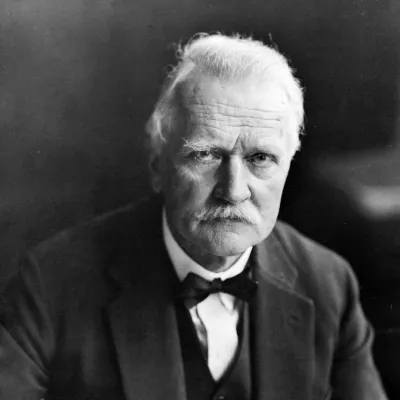
Wilhelm Schüffner
Human Design Chart
Biography
Schüffner worked from 1897 to 1923 in the Dutch East Indies, where he researched malaria. He was the chief physician of the Senembah-Maatschappij and campaigned for better living and working conditions for the plantation workers.
With these improvements on plantations in Deli on North Sumatra, he showed that improved hygiene contained the spread of malaria. During his investigations on the malaria pathogen, he observed that the pathogen increased the red blood cells and abbasste and thus coined the term "Schüffner-Tüpfelung."
In 1916 he became a hygienic adviser to the colonial government of Dutch India.
On 18 May 1926, he was inducted into the Royal Dutch Academy of Sciences. In 1935 Schüffner became a member of the Leopoldina.
He died on 24 December 1949 in Hilversum, aged 82.
Human Design Analysis: Wilhelm Schüffner as Generator 3/5
Generator 3/5 — Design at a Glance
Wilhelm Schüffner's design indicated a tendency towards great endurance and inner strength, comparable to a workhorse that generates energy as long as it is fueled by its task. As a Generator, he had a lot of sacral energy, which was released not through self-initiation but by responding to impulses from life. His strategy was to wait for signals and then, when the sacral center gave a clear "yes", to respond with action.
This gut reaction was the key to his effectiveness. When he lived in harmony with this principle, his design rewarded him with deep satisfaction and a sense of fulfillment. If he, however, continuously initiated things he had no inner desire for, or was prevented from pursuing his heart project while still full of power, he was in danger. Such actions led to frustration, energy loss, or burnout, as he wasted his strength instead of directing it towards what truly motivated him. His success thus depended on whether he used his energy for tasks that resonated with him internally, rather than fighting against the current of his own nature.
Sacral Authority
Wilhelm Schüffner's decision-making was characterized by a direct physical resonance. As a Generator, he possessed the sacral authority, an inner guidance unique to this type. This configuration simplified his process, as strategy and authority were identical: he reacted to external stimuli.
His inner voice did not manifest as intellectual analysis but as physical signals. Wilhelm Schüffner felt responses as gut feelings, bursts of energy, or short sounds like grunts or a nodding "Mhm". These reactions were the key to his energy. When his sacral motor kicked in, he felt vital and alive. He then had an inexhaustible energy source and tackled his tasks with great enthusiasm. His design promoted a life of joy and satisfaction, where he fully immersed himself in his work without the need for external purpose.
Additionally, his activated spleen center acted as a supportive authority. This gave him the ability to react particularly quickly and spontaneously. He had immediate access to his physical well-being and instinctive perception. Wilhelm Schüffner could rely on this intuitive assessment, which shaped and accelerated his decisions at the moment of reaction.
The 3/5 Profile — Martyr / Heretic
Wilhelm Schüffner's design indicated a tendency towards experimental action, paired with the need to inspire others through his own experiences. As a 3/5 profile, the "Experimentator" and "Hero", he primarily learned through trial and error. He initially believed little in given truths and had to try things himself to understand them. These practical experiences formed the treasure he later presented to others.
Line 3 emphasized this process of learning from mistakes. Alliances he entered often served short-term conflicts or the preservation of his own vitality, but frequently dissolved after the crisis. This could appear selfish, as the energy of partners sometimes weakened while his own life force was preserved.
At the same time, Line 5, the Hero Line, gave him a certain charm to mobilize resources for his experiments and offer practical solutions in times of crisis. Wilhelm Schüffner was someone who actively brought deep processes to the outside. However, uncertainty about his own depth or fear of inadequacy could hinder his actions. If he failed in front of others while experimenting, this was painful for him, as the flattering Hero role then wavered. His design thus marked him as someone who generated knowledge through his own, often risky practice and then used this as an example for others.
Single Definition — Defined & Open Centers
Wilhelm Schüfner revealed himself through a fixed, reliable self-identity and a clear sense of direction in life. His defined G Center gave him the ability to love others without becoming dependent on them, and he radiated a natural authority that could show others new paths. This inner security was strengthened by his defined Heart Center, which gave him willpower and control over his resources. He enjoyed working as his own boss, kept his promises, and sought recognition for his contribution, consciously using his ego strength to provide for family and community.
His ability to act was based on his defined Sacral Center, a huge source of vital energy. Wilhelm Schüfner reacted to life rather than initiating; his immediate yes or no answers from the gut determined whether energy was available for a task. Through this reaction, he found deep satisfaction and avoided exhaustion. This was complemented by his defined Spleen Center, which gave him sharp body awareness and intuition in the here and now. He trusted his spontaneous warning signals and immune system, which allowed him a deep sense of well-being and protection.
In contrast, he was vulnerable to external influences through his open centers. His open Head Center tended to absorb mental pressure and questions from others, which could easily lead him into confusion if he did not trust his inner authority. The open Ajna Center made him receptive to foreign concepts and opinions, which he sometimes mistakenly took as his own truth. His open Throat Center led him to seek attention or feel the pressure to speak rather than waiting to be invited. Additionally, his open Solar Plexus absorbed the emotions of his environment, making him emotionally vulnerable and tending to personalize others' moods. Finally, his open Root Center absorbed the stress and adrenalized pressure from the environment, which could push him into a cycle of hyperactivity and trying to shed this non-self pressure.
Channels for rhythm, devotion and intuitive power.
Wilhelm Schüfner's design tended towards innovative direction-finding, paired with instinctive vigilance and life-critical intuition. He was someone who blazed new trails, not just through theory, but through a powerful, material realization of visions that were deeply rooted in biological reality.
This dynamic was shaped by the Beat Channel 14-2. It connected sacral energy with the G Center, giving him the ability to translate mutation and innovation into a concrete life direction. Wilhelm Schüfner had the resources to promote the unusual and unique by trusting his inner response rather than following the status quo. This created an aura that encouraged others in their own search for meaning.
Parallel to this, the Channel of Devotion 44-26 worked. As a connection between Spleen and Heart, it allowed him to use historical memories and instinctive awareness to offer improvements to the tribe. Wilhelm Schüfner had a fine sense of what others needed, often before they knew it themselves, and could communicate these insights persuasively. This channel fostered an entrepreneurial attitude, where he waited until the market recognized his gifts before acting effectively.
Additionally, the Channel of Power 34-57 shaped his existence. It connected the intuitive insight of the Spleen with the generative power of the Sacral. This gave Wilhelm Schüfner a sharp vigilance towards danger and the ability to react in fractions of a second to protect his survival and integrity. He learned to trust this spontaneous, bodily intelligence, which kept him independent and vital.
Further facets were shown in Gate 38, which sets resistance and boundaries to preserve individual integrity, and in Gate 48, which promotes pattern recognition and deep understanding, though this sometimes led to frustration. Gate 39 brought selective analysis and provocation for mutation, while Gate 21 directed material life and required control. Gate 5 emphasized the fundamental rhythm and the importance of habits for energy building. Gate 46 promoted devotion and presence in the here and now, and Gate 25 brought a mystical attitude of innocence and self-love.
Individual Circuitry — Circuit Signature
Wilhelm Schüfner's design tended towards a pulsating, individual expression based on the 'Beat' between identity and life force. This Channel 2-14 connected his identity with the Sacral Center, thereby supporting his unique identity through the rhythmic energy of the Sacral Center. It was about expressing one's individuality, supported by emotional waves and creativity.
Parallel to this, the Ego Circuit worked through Channel 26-44, connecting Heart and Spleen. This promoted cooperation and the joint creation of resources through devotion and mediation. Since there was no connection to the Sacral Center, pauses for resource generation for the tribe were necessary. The relationship between giving and taking was central.
A third aspect was shown in the Integration Circuit through Channel 34-57, connecting Sacral and Spleen Centers. This allowed drawing power from the reaction to life and guiding it through intuitive knowledge. Wilhelm Schüfner could thus draw power from the life reaction and act in the present.
Since Wilhelm Schüfner had a Simple Definition, these centers - Identity, Sacral, Heart, Spleen - formed a single, cohesive energetic group. The forces flowed directly into each other without separate segments. His mechanics were thus a unity of individual expression strength, cooperative resource formation, and intuitive life force, which worked as a whole.
Right Angle Cross of Tension 4
Wilhelm Schüffner's design indicated a tendency towards intense internal tension, which proved to be a driving force for profound changes. This configuration, known as the right tension cross 4, described a life dynamics where external circumstances and internal urges converged to enforce a necessary transformation. It was not a passive experience, but a process where pressure built up until a solution or a new state became inevitable.
For Wilhelm Schüffner, this meant that he went through periods of high tension, which were not to be understood merely as suffering, but as catalytic moments. The mechanics of this cross showed that stability was often achieved by going through crises. The tension served to break down old structures that were no longer sustainable, making way for new developments. Wilhelm Schüffner responded to these internal and external stimuli with an attitude that accepted change, as he recognized it as an integral part of his path. The energy of this design urged him not to remain in comfort zones but to muster the necessary strength to overcome obstacles. Thus, the tension became the motor that propelled him forward, even though the path was arduous. It was a dynamic of becoming, where the pain of change served the gain of development. Wilhelm Schüffner lived these principles by facing the challenges his design laid out for him and derived his direction from them.
Saturn Return · Uranus Opposition · Chiron Return · 2nd Saturn Return — Life Cycles
Wilhelm Schüffner's life followed a clear structure of professional consolidation and recognition, driven by the cycles of Saturn and Chiron. His design showed a tendency to establish himself in defined roles, with external validation and institutional integration being central factors.
In 1897, at the age of 30, Schüffner began his work in Dutch-Indonesia. This marked his first Saturn return, a time when inner maturity often translates into concrete, long-term life decisions. Here, his groundwork solidified into a stable professional foundation in a new environment.
A decade later, in 1916, the Chiron return occurred. At 49 years old, he became a hygiene advisor to the colonial government. This cycle, often seen as a phase of bloom and fulfillment of personal purpose, confirmed his expertise and anchored him in a position of high responsibility and influence. It was the moment when his specific knowledge became socially relevant.
The second Saturn return in 1926, at the age of 59, crowned this development with his admission to the Royal Dutch Academy of Sciences. This cycle cemented the status that had been built over years. Schüffner's path demonstrates how these mechanical phases – from foundation through bloom to final recognition – shaped and structured his professional life.
Generator · Sacral Authority — Synthesis
Wilhelm Schüffner primarily lived from his sacral energy (Generator type), with a strong pattern of experimentation and the insights gained from it (3/5 Profile) clearly visible. He tried things out, gathered practical experiences, and shared these with others. This energy was amplified by the Beat channel (14/2), which promoted innovation and the search for new directions, and fueled his ability to lead and influence others (defined G Center). The repeated professional recognitions (Saturn returns and Chiron return) attest to a continuous development and the successful application of this knowledge in his work.
A central paradox in his design lay in the combination of his powerful, enduring sacral energy and the need to constantly test new things. He was a Generator who generated energy through activity and work on his heart project, yet the profile of the experimenter challenged him to continually explore new paths and not get lost in established patterns. This tension between the need for deep immersion in a task and the drive for constant change shaped his life path.
3 Defined Channels
Incarnation Cross - Right Angle Cross of Tension 4
Solar Return
The Solar Return shows the moment when the sun returns to its exact birth position - your personal solar year.
Life Cycles
Discover the life cycles with a detailed triple view (birth chart, cycle chart, composite).
Human Design Profile
- Type
- Generator
- Strategy
- To respond - wait for something to respond to
- Authority
- Sacral Authority
- Profile
- 3/5 - Martyr / Heretic
- Definition
- Single Definition
- Incarnation Cross
- Right Angle Cross of Tension 4
- Date of Birth
- 02.01.1867 08:30
- Place of Birth
- Gernsheim, GER
Frequently Asked Questions
What was Wilhelm Schüffner's Human Design type?
What Profile did Wilhelm Schüffner have?
What Authority guided Wilhelm Schüffner?
What incarnation cross did Wilhelm Schüfner have?
When was Wilhelm Schüfner born?
Discover your own Human Design
Are you also a Generator? Find out in a personal reading how to use your sacral energy correctly and discover deep satisfaction.
More Personalities
Back to overviewAaliyah

Alexia

Angèle

Anne-Marie

Arcángel

Arno