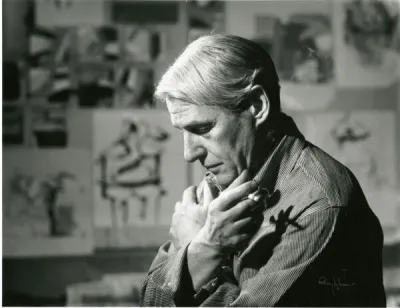
Willem De Kooning
Human Design Chart
Biography
In the years after World War II, De Kooning painted in a style that came to be referred to as abstract expressionism or "action painting", and was part of a group of artists that came to be known as the New York School. Other painters in this group included Jackson Pollock, Elaine de Kooning, Lee Krasner, Franz Kline, Arshile Gorky, Mark Rothko, Hans Hofmann, John Ferren, Nell Blaine, Conrad Marca-Relli, James Brooks, Adolph Gottlieb, Jack Tworkov, Norman Lewis, Anne Ryan, Robert Motherwell, Philip Guston, Clyfford Still, and Richard Pousette-Dart. De Kooning's retrospective held at MoMA in 2011–2012 rendered him one of the best-known artists of the 20th century.
Human Design Analysis: Willem De Kooning as Manifestor 2/4
Manifestor 2/4 — Design at a Glance
Willem De Kooning's design established the foundational structure of a pioneer: someone destined to initiate new directions and lead others. As a Manifestor, he had his own vision that he did not implement in detail himself but rather influenced through his environment. Similar to a ruler who devises strategies while others act, his approach often polarized people: some followed him enthusiastically, while others rejected him because they didn't share his perspective. This split effect was due to his thinking frequently exceeding the understanding of those around him, leading to misunderstandings. The strategy of his design involved clearly and timely communicating these visions before acting. By informing others, he could attract the right people for himself and minimize resistance. When he followed this strategy, he experienced a sense of inner peace as confirmation of his alignment. Acting against his design without informing or respecting his authority often resulted in deep, lasting anger. This emotional reaction served as a signal that he had deviated from his natural path and lost connection to his true power.
Emotional Authority
Willem De Kooning's design exhibited a tendency towards intense emotions and fluctuating moods. He perceived the world through the filter of his current feelings – sometimes enthusiastically, other times negatively inclined. This configuration stemmed from Emotional Authority rooted in the defined Solar Plexus Center. In Human-Design, this authority is always active when the Solar Plexus Center is filled, regardless of other definitions in the chart.
His inner truth did not reveal itself immediately. Quick decisions based on transient emotions often risked negative consequences as they only reflected a momentary snapshot. Instead, his system required patience and time. By repeatedly “sleeping on” questions, he allowed intense feelings to subside. Only with emotional distance did the necessary clarity and calmness emerge. This process was essential for long-term life decisions that profoundly shaped his path. Willem De Kooning had to learn to properly pace himself and repeatedly question, in order to navigate through the emotional waves to reach deep insight. His strategy involved not following the first wave but waiting for the deeper, comprehensive understanding that came with time.
The 2/4 Profile — Hermit / Opportunist
Willem De Kooning appeared as someone whose inner world was marked by a constant tension between the urge towards isolation and the need for community. His design inclined him to constantly oscillate between two poles: Line 2, which demanded solitude and self-sufficiency, and Line 4, which required social exchange processes and embedding in a network.
This configuration did not create a static personality but rather a rhythmic alternation. During his “Me-Time,” Willem De Kooning immersed himself in internal processes to find peace and clarity. This phase of withdrawal was essential for regulating the projected care-giving radiation of Line 2 – often strongly outwardly expressed unconsciously – and setting boundaries. Once this inner need was satisfied, its opposite emerged: he actively sought contact with his “favorite people.”
The fourth line of his design externalized fantasies in a fixed way; experiences only gained value when shared and integrated into collective experience. Friendships were thus not just accompanying phenomena but crucial for his success. Knowledge from his network he reflected upon during the subsequent alone time, evaluated it, and developed new ideas from it. This dynamic required clear communication outwardly: “Now I want company” or “Now I need quiet.” Only through this transparent signaling could Willem De Kooning maintain balance without being overwhelmed by dependence on care (Line 2) or pressure of collective processes (Line 4). His design allowed him to condense what was learned in the cave and then bring it back into the community.
Split Definition — Defined & Open Centers
Willem de Kooning's Human Design profile suggests a tendency towards a constant, internally driven expression. His defined G Center gave him a firm sense of self-identity and clarity about his direction; he knew who he was and could convey this inner security to others. This identity was reinforced by his defined Heart Center, which provided him with willpower and the ability to keep promises as well as to use resources autonomously. He demonstrated his authority in the material world without being dependent on external expectations.
This structural stability contrasted with his emotional and communicative dynamics. His defined Solar Plexus acted as an inner authority: he was designed to wait out the waves of his emotions before acting or deciding. This emotional depth colored his environment, as he shared responsibility for the emotional climate in his surroundings. His voice, guided by the defined Throat Center, served as a pivot point to carry these internal processes – whether from the heart, emotion, or identity – outward. The connection between these centers shaped an expression that was consistent but accompanied by a complex emotional undercurrent.
At the same time, his design revealed specific vulnerabilities. His open Head Center made him susceptible to mental pressure and confusion; he tended to get entangled in questions that were not his own or sought external inspiration to fill mental gaps. The open Ajna Center amplified this: he was open to foreign concepts and opinions but risked interpreting them as his own truth or felt compelled to provide logical answers to problems he hadn't solved himself.
His open Sacral Center also meant he did not have a constant energy flow. He was susceptible to absorbing the energy of his environment, which could lead to overexertion if he tried to work continuously like those with defined Sacral Centers. Instead, he needed breaks to release absorbed energy. Similarly, his open Spleen Center was a source of existential fears and uncertainties about health and survival; he tended to cling to people or situations that gave him a sense of security, even when they were not healthy for him, in order to ease his inner fear of failure or abandonment.
Channels for logical leadership, mystical pressure and proud striving.
Willem de Kooning's design suggests a tendency towards logical, collective leadership. He demonstrated competence through tested patterns and needed to be invited by the majority to lead effectively. This dynamic came from Channel 7-31 (Alpha Animal), connecting G Center with Throat Center. Gate 7 provided the logical role behind the throne, while Gate 31 spoke as a collective leader; together they enabled leadership based on trust and understanding of current trends rather than absolute authority.
Parallel to this was Channel 19-49 (Synthesis) between Root and Solar Plexus Centers. This channel connected human basic needs pressure (Gate 19) with emotional principles of belonging (Gate 49). It created a sensitive awareness of one's position in the tribe, where loyalty and emotional waves determined who belonged to the community. Willem de Kooning sought balance between feasibility and fairness, driven by the need to be needed and secure the cohesion of the "tribe".
Another defining factor was Channel 21-45 (Money Line), connecting Heart with Throat Center. Gate 21 (Hunter) brought in the will for control and responsibility, while Gate 45 (Voice of the Tribe) represented authoritative decisions over resources. This configuration required mastering the material plane and earning money through one's own will; the key to success lay in independence: self-determining what was done and when.
Additionally, Gates like 27 (Care), 28 (Risk Now), and 41 (Evolutionary Change) contributed to his inner landscape, while Gates 6 (Friction/Fertility), 36 (Crisis/Downturn), 23 (Amorality/Explain), 10 (Complexity/Integration), 46 (Devotion/Bodily Love), 25 (Innocence/Mysticism), 2 (Sensitivity/Direction), 54 (Ambition/Spirituality), 55 (Emotional Awakening), 22 (Openness), and 15 (Collective Behavior) drove emotional cycles. These Gates rounded out his profile by bringing aspects of individualization, social adaptation, and mystical or worldly development.
Tribal Circuitry — Circuit Signature
Willem de Kooning's design suggests a tendency towards structured, rational communication free from emotional coloring. The Understanding Circuit connected his Throat with Identity Centers through the Alpha Animal Channel. This promoted clear visual thinking and sharing logical insights to improve the future without being filtered by conditioning. Parallel to this was the Ego Circuit, featuring separate energy: the connection between Heart and Throat Centers over the Money Line supported material resources and mutual aid ("Today I give you, tomorrow you give me"). As Willem de Kooning had a Split Definition, these systems were not directly merged. Instead, two independent blocks operated: one block from G-, Throat- and Heart Centers for identity and resources, and another separate block from Solar Plexus and Root Centers (connected by Synthesis), translating emotional waves into physical impulses. This separation meant that rational strategies and emotional drives coexisted without forming an automated flow. The mechanics required pauses for recovery as there was no constant life force from the Sacral Center. Willem de Kooning thus navigated between clear, future-oriented logic and rhythmic fluctuations of emotion and material cooperation, with both areas functioning independently.
Right Angle Cross of the Unexpected 1
Willem de Kooning's design indicated a tendency towards unpredictable turning points that often came out of nowhere. This configuration, the right cross of the unexpected, described a life dynamic in which sudden insights or external circumstances abruptly interrupted and redirected his previous path. It was not chaotic happenings but rather a specific mechanism: The energy of this cross acted as a catalyst for spontaneous changes requiring profound adaptations. Willem de Kooning showed himself to be someone who embraced these unexpected impulses and integrated them into his actions, rather than passively succumbing to them. The structure of his design combined the ability to handle surprises with an inner readiness to quickly abandon old patterns when new, unforeseen possibilities emerged. This shaped a stance of flexibility and quick responsiveness to changing circumstances. The mechanics of this cross did not foster slow linear development but rather leaps forward triggered by external or internal shocks. Willem de Kooning lived out this dynamic by opening himself up to unexpected moments and using them as driving forces for his further development, instead of fighting against them.
Saturn Return · Uranus Opposition · Chiron Return · 2nd Saturn Return — Life Cycles
Willem de Kooning's design indicated a tendency towards cyclical turning points where inner maturation met outer recognition. This structure was evident in 1964 when he received the Presidential Medal of Freedom at age 60. For his Human Design, this marked the second Saturn return, a time when years of groundwork often lead to stable and socially visible confirmation.
Prior to this, his development had been shaped by intense relationship dynamics. In 1943, at age 39, he married Elaine Fried. This fell during the phase of Uranus opposition, a mechanism that often triggers unexpected changes or breaks in personal surroundings and forces new structures.
The deepest point was however his Chiron return in 1953. At 49 years old, he presented the provocative figurative cycle 'Woman' at the Sidney Janis Gallery, leading to a public scandal. In Human Design, this return does not mark a healing process in a psychological sense but rather a blooming phase of his incarnation purpose. Here, the meaning of his life became tangible: The confrontation with the scandal was not a failure but an effective unfolding of his true mission, challenging established boundaries artistically and socially.
Manifestor · Emotional Authority — Synthesis
He was a Manifestor whose life was marked by a constant shift between the need for isolation and the search for community. This inner dynamic (Profile 2/4) reflected in his work style: he withdrew to gain internal clarity but always returned to interact with the world. His defined Throat Center, connected with the G Center and the Gate of Leading (Channel 'The Alpha Animal'), pointed towards a natural authority manifesting through logical patterns and a vision for the future – a voice he could not suppress.
A central paradox lay in the combination of his emotional authority with the Manifestor type. While he acted as a pioneer and initiated projects, he needed time to let his emotions mature before acting. This likely led to internal tension, as his impulse to set things in motion clashed with the necessity of not rushing decisions. The cycles showed that both successes and crises (such as the scandal around the 'Woman' images) were connected to relationships – evidence for the importance of interaction and recognition for his inner balance.
3 Defined Channels
Incarnation Cross - Right Angle Cross of the Unexpected 1
Solar Return
The Solar Return shows the moment when the sun returns to its exact birth position - your personal solar year.
Life Cycles
Discover the life cycles with a detailed triple view (birth chart, cycle chart, composite).
Human Design Profile
- Type
- Manifestor
- Strategy
- To inform others before acting
- Authority
- Emotional Authority
- Profile
- 2/4 - Hermit / Opportunist
- Definition
- Split Definition
- Incarnation Cross
- Right Angle Cross of the Unexpected 1
- Date of Birth
- 24.04.1904 01:00
- Place of Birth
- Rotterdam, Netherlands
Frequently Asked Questions
What was Willem De Kooning's Human Design type?
What Profile did Willem De Kooning have in Human Design?
What Authority did Willem De Kooning have?
What incarnation cross did Willem de Kooning have?
When was Willem De Kooning born?
Discover your own Human Design
Are you also a Manifestor? Find out in a personal reading how to use your initiation power peacefully and dissolve resistance.
More Personalities
Back to overviewBaekhyun

Balthus
Beyoncé

Christian-Jaque
Fergie
Halston