
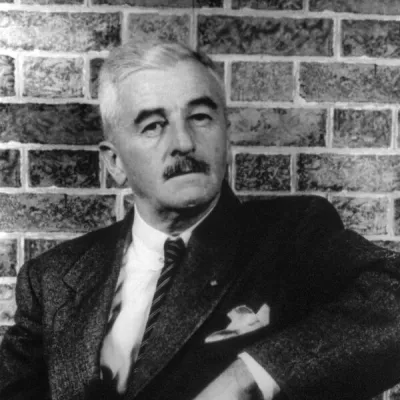
William Faulkner
Human Design Chart
Biography
Faulkner was born in New Albany, Mississippi, and raised in Oxford, Mississippi. During World War I, he joined the Royal Canadian Air Force, but did not serve in combat. Returning to Oxford, he attended the University of Mississippi for three semesters before dropping out. He moved to New Orleans, where he wrote his first novel Soldiers' Pay (1925). He went back to Oxford and wrote Sartoris (1927), his first work set in Yoknapatawpha County. In 1929, he published The Sound and the Fury. The following year, he wrote As I Lay Dying. Later that decade, he wrote Light in August; Absalom, Absalom!; and The Wild Palms. He also worked as a screenwriter, contributing to Howard Hawks's To Have and Have Not and The Big Sleep, adapted from Raymond Chandler's novel. The former film, adapted from Ernest Hemingway's novel, is the only film with contributions by two Nobel laureates.
William Faulkner — Generator with Profile 6/2
Generator 6/2 — Design at a Glance
William Faulkner had a massive sacral energy base, which gave him immense endurance. His design marked him as someone who seemed like a workhorse: extremely strong and resilient if he had the energy for his task. This strength was not shown through spontaneous initiation but rather by reacting to internal impulses. The central life strategy involved waiting for signals from the environment and acting on them to find deep fulfillment.
If he ignored this principle, it either led to burnout due to wasted energy on unwanted tasks or frustration and a lack of energy from forced initiation. His sacral center's energy was most free when reacting to impulses. The motto was not initiating but responding. When he responded to a signal in life and his center said, “Yes! Let’s get started!”, he acted accordingly.
If William Faulkner lived in harmony with this design, nothing could stop him. He was then rewarded with a feeling of deep satisfaction. If he did not live according to his design, however, he likely encountered persistent frustration and an energy shortage sooner or later. His success thus depended directly on whether he reacted from the gut or initiated against his nature.
Emotional Authority
William Faulkner's design established a specific decision-making strategy: He needed time for emotional waves to subside before clarity emerged. His inner authority was Emotional Authority, carried by the defined Emotional Center. This center ensured that his perception of the world was always colored by his current mood. In one moment, he could be enthusiastic about something, in the next see the same situation negatively. However, his immediate feeling was only a snapshot and not necessarily the truth.
Spontaneous decisions made from this emotional heat were risky and could have negative consequences. Instead, his mechanism required patience. William Faulkner had to let decisions mature, often through multiple nights of reflection. Only when intense feelings subsided and an emotional distance was gained did calmness set in. This process was crucial for long-term life decisions with significant influence on his life path. The emotional wave from the up-and-down of his feelings required this cyclical distance to see deeper and more comprehensively. Only through this hesitation and waiting could he find his true inner truth beyond transient moods.
The 6/2 Profile — Role Model / Hermit
William Faulkner's design tended towards a two-phase life path: initially an experimental search through trial and error, later withdrawal for reflection. Before the age of 30, Line 6 as a 3-line dominated him. This meant that in his youth he focused primarily on accumulating many personal experiences. Mistakes were part of the learning process; after a mistake often came a short retreat to start anew. This early phase was characterized by the need to learn through direct life experience and explore boundaries.
Around age 30, this dynamic fundamentally changed. Line 6 became active, prompting William Faulkner to withdraw deeply into a metaphorical “Cave on the Mountain”. In this phase, he sought distance from earlier experiments to look back at his life with great perspective. This period of intense introspection served both healing and gaining deeper self-awareness. He learned through this distance to find his true integrity and separate himself from unnecessary commitments.
In later life, he emerged from this withdrawal again. Others were then drawn to him for the wisdom that arose from this long phase of self-reflection. They sought to partake in his life lessons and learn the ability for deep introspection. William Faulkner acted as a role model in this late phase, smoothing the path for others through his experience and clarity. His development from an experimental seeker to a wise teacher was a central feature of his design.
Single Definition — Defined & Open Centers
William Faulkner was characterized by a defined G Center, which gave him a reliable sense of self-identity and a clear direction in life. This inner security allowed him to operate independently without relying on others and to show other people new perspectives. However, his design presented the challenge not to try to direct others into his path unless explicitly invited; his way was individual and could not be controlled.
This stable identity was linked to his defined Sacral Center, which provided a constant source of vital energy. This power manifested as an ongoing buzz within him that required activity. However, the proper use of this energy depended on responding to questions rather than initiating them. Only through patient waiting could his Sacral Center respond with a clear yes or no, ensuring that the energy was indeed available for the chosen task and avoiding frustration.
His defined Solar Plexus served as another inner authority. He was designed to wait out emotional waves before making decisions. Truth revealed itself to him only over time; spontaneous actions in emotional highs or lows often led to chaos. By enduring until emotional clarity, he could use the depth and sensitivity of his design without acting impulsively.
In contrast, Head, Ajna, and Heart Centers were open. This made him vulnerable to mental pressure and the need to seek answers or proof for his worth from sources outside himself. His open Throat Center tended to feel pressured to force attention through speaking rather than waiting on invitations. Furthermore, his open Root Center absorbed external stress from the environment, making him prone to overexertion when trying to stand against this foreign pressure or rid it through hyperactivity.
Channels for endurance, persistence and deep intimacy.
William Faulkner was marked by a deep need for merging and persistent search for inner direction. His design established that intimacy was not only interpersonal but also served as core energy for his personal development. The Channel of Union 59-6 connected his Sacral Center with the Solar Plexus. This created a drive for close connection, where Gate 59 merged sexual energy with the emotional wave of Gate 6. For William Faulkner, this meant he needed patience to gain clarity. He had to wait until the emotional wave completed its cycles before making decisions or entering relationships. Only then could he avoid confusion and effectively use his ability to quickly establish trust.
Parallel to this, the Channel of Discovery 29-46 between Sacral Center and G Center was at work. Here Gate 29 determined persistence through correct yes-saying, while Gate 46 established connection with life direction and self-love. William Faulkner had to let go of expectations and fully immerse himself in experiences without immediately understanding their meaning. His satisfaction arose only at the end of long processes when discovery made sense. This mechanism required him not to mentally plan but to trust his inner reaction. Through this combination of intense intimacy and patient endurance, he was poised to gain significant insights both in relationships and in his own development through authentic, time-intensive paths.
Collective Circuitry — Circuit Signature
William Faulkner's design linked emotional reflection with instinctive protection. His energy flowed in waves driven by the Solar Plexus Center, circulating feelings and past experiences. These emotions served not only for individual processing but also streamed into two clearly distinct directions: towards meaning-making through sharing and to biological family preservation.
In the Meaning-Making Circuit, Channel 46-29 ("Discovery") connected Identity with Sacral Centers. This connection allowed learning from the past and visually as well as cyclically sharing emotional insights with others. It was about finding meaning behind past events and passing these perceptions on to the collective for mutual benefit.
Parallel to this, the Archer Circuit worked through Channel 59-6 ("Union"), directly connecting Sacral Center with Solar Plexus. Here an ancient power showed itself: instinctive defense and preservation of one's genetics as well as family unity. Union was inseparably connected with this emotional protective impulse.
Although both circuits use the Sacral Center and work energetically in a coherent system due to simple definition, their functions fundamentally differed: One transformed emotions into shared insight, the other used them as a motor for protecting biological stock. William Faulkner lived this synthesis of reflective sharing and instinctive care.
Left Angle Cross of Healing 2
William Faulkner's Human Design profile established an archetypal dynamic characterized by the left Healing 2 Cross. This configuration fundamentally determined his energetic alignment. The left Healing 2 Cross described a specific life task: recognizing and processing wounds or fractures in human experience, not to hide them but to develop a deeper understanding of the healing process from them. It was an attitude that saw pain as a necessary starting point for transformation. William Faulkner revealed through this structure someone who engaged with the darker, often painful aspects of existence to derive healing potentials from it. The mechanics of this cross type emphasized the necessity of integrating personal and collective injuries rather than ignoring them. This created an inner strength based on the ability to transform suffering into knowledge. William Faulkner's chart did not show specific events that would illustrate this process; therefore, the description is limited to his pure energetic alignment. The left Healing 2 Cross acted as a constant background factor shaping his perception and reaction to challenges. It was not about superficial solutions but a deep engagement with what was broken in order to reconnect it anew. This dynamic profoundly shaped his inner experience.
Saturn Return · Uranus Opposition · Chiron Return · 2nd Saturn Return — Life Cycles
William Faulkner's professional development followed a clear cyclical structure marked by planetary return phases. In 1925, at the age of 28, he met Sherwood Anderson and published early works in New Orleans. This first Saturn Return served as a critical threshold for entering the literary scene where years of groundwork condensed into tangible achievements. Ten years later, in 1936 at the age of 39, the screenplay for “The Road to Glory” was created. The Uranus Opposition signaled a necessary shift in expression and transition into the film industry from pure prose to visual storytelling.
At the age of 49 in 1946, the anthology “Portable Faulkner” appeared. This Chiron Return marked not a healing phase but a bloom period: his literary identity was canonized through anthologies and his life's work received public recognition. The second Saturn Return closed this arc in 1953 when Faulkner completed “A Fable,” a work about French soldiers in World War I at the age of 56. This cycle stood for the final condensation of his creative output before he could enter new phases. Thus, the four cycles formed the framework of his career: entry, transformation, recognition, and completion.
Generator · Emotional Authority — Synthesis
William Faulkner was a Generator whose life was marked by a deep inner tension between creative energy and emotional maturity. The sacral energy (Design) seemed to propel him relentlessly, yet emotional authority demanded constant reflection and sleeping on decisions. This back-and-forth pattern showed in a cycle of engagement with projects he threw himself into wholeheartedly – until exhaustion – followed by phases of intense inner retreat (Profile 6/2) to process the gained experiences and draw wisdom from them. The recurring cycles, particularly in the career domain, illustrate a life where creative outbursts were followed by periods of deep reflection.
The central paradox lay in the connection between profound feeling and a drive towards pairing (Channel 59-6) with an acute need to find his own direction (defined G Center). He lived an experience of intimacy and connectedness, yet always under the condition that emotional waves brought clarity only after time and maturation. This tension between spontaneous engagement and cautious waiting shaped his creative process and created a work that is as passionate as it is profound.
2 Defined Channels
Incarnation Cross - Left Angle Cross of Healing 2
Solar Return
The Solar Return shows the moment when the sun returns to its exact birth position - your personal solar year.
Life Cycles
Discover the life cycles with a detailed triple view (birth chart, cycle chart, composite).
Human Design Profile
- Type
- Generator
- Strategy
- To respond - wait for something to respond to
- Authority
- Emotional Authority
- Profile
- 6/2 - Role Model / Hermit
- Definition
- Single Definition
- Incarnation Cross
- Left Angle Cross of Healing 2
- Date of Birth
- 25.09.1897 23:00
- Place of Birth
- New Albany, United States
Frequently Asked Questions
What was William Faulkner's Human Design type?
What Profile did William Faulkner have?
What Authority did William Faulkner have?
What incarnation cross did William Faulkner have?
When was William Faulkner born?
Discover your own Human Design
Are you also a Generator? Find out in a personal reading how to use your sacral energy correctly and discover deep satisfaction.
More Personalities
Back to overviewAaliyah

Alain-Fournier

Alexia

Angèle

Angeli

Anne-Marie
