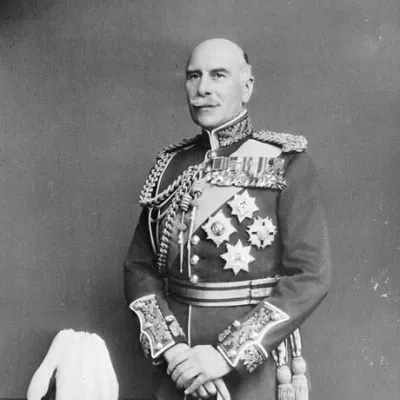
1st Earl of Athlone Alexander Cambridge
Human Design Chart
Biography
Prince Alexander was born to the Duke and Duchess of Teck and was educated at Eton College and the Royal Military College, Sandhurst. In 1904, he married Princess Alice and rose in the military ranks through his service in African campaigns of the First World War, receiving numerous honours and decorations.
A cousin and also brother-in-law of King George V, he in 1917 relinquished his German titles, including that of Prince of Teck in the kingdom of Württemberg, and was elevated to the peerage as the Earl of Athlone. He was in 1923 appointed as South Africa's governor-general by the King, on the recommendation of Prime Minister of the United Kingdom Stanley Baldwin, to replace Prince Arthur of Connaught, and he occupied the viceregal post until succeeded by the Earl of Clarendon in 1930. Athlone then served as Chancellor of the University of London until, in 1940, he was appointed as Canada's governor general by King George VI, on the recommendation of Prime Minister of Canada William Lyon Mackenzie King, to replace the Lord Tweedsmuir, and he occupied the post until succeeded by Viscount Alexander of Tunis in 1946. Athlone helped galvanise the Canadian war effort and was a host to British and American statesmen during the Second World War.
After returning to the United Kingdom, Athlone sat on the organising committee for the coronation of Queen Elizabeth II. He died at Kensington Palace on 16 January 1957, aged 82.
The Human Design of 1st Earl of Athlone Alexander Cambridge: Generator 4/1
Generator 4/1 — Design at a Glance
Alexander Cambridge's design indicated a tendency towards great endurance if he responded to inner impulses. As a Generator, he had plenty of sacral energy driving him like a strong workhorse – but only effectively when he did not initiate himself but instead answered signals from life. This mechanism required him to wait until his inner self gave a clear "Yes! Let's get started!", in order to use energy without becoming exhausted.
Two main pitfalls characterized this pattern: First, the danger of doing things that he had no interest in, which wasted his energy and led towards burnout. Second, the obstacle of being prevented from working on his heart project even though he wanted to continue with full power. Unlike Manifesting through initiatives, his work functioned through responding. If he followed this strategy, he was rewarded with deep satisfaction and a sense of fulfillment. Not living according to this design – for example by constantly initiating – led him to persistent frustration and energy loss. His path towards effectiveness therefore lay in answering life impulses from the gut rather than fighting against the current or stopping prematurely when there was still power left.
Sacral Authority
Alexander Cambridge's decision-making structure was based solely on physical resonance. His design saw his sacral authority as the primary instance – a mechanism unique to the Generator type. This simplified his process: strategy and inner guidance merged. He did not act out of initiative planning but reacted to external stimuli.
His inner voice manifested as a physical signal: a grunting, humming or a noticeable surge of power in the abdominal area. This reaction was an indicator for correct alignment. When his sacral motor kicked in, he entered a state of high vitality and inexhaustible energy. He then tackled his tasks with great enthusiasm and immersed himself fully into activities, free from compulsive purposefulness. In contrast, misalignment left him without any motivation; the energy remained absent.
Central to this was an open emotional center as a prerequisite for sacral guidance. Additionally, an activated spleen center supported him by giving him quick, spontaneous access to instinctual perception and physical well-being. This allowed him to make immediate decisions guided by reliable inner intuition that came directly from his body. His life energy ignited only where he responded to something that triggered this specific vital resonance in him.
The 4/1 Profile — Opportunist / Investigator
Alexander Cambridge exhibited a deep rooting of his essence. His design as Profile 4/1 (Networker/Researcher) marks the transition from "I" to "You", with his traits being so firmly anchored that he barely deviated from his individual path. This fixation meant that he neither wanted nor could change his inherent self.
This led to a specific dynamic in dealing with others: His big heart protected itself from injuries by quickly excluding people who gave "well-meaning impulses towards change" or did not fully accept him. Externally, this often appeared as stubbornness or lack of critical thinking, which could undermine his self-confidence. The fourth line promoted collective processes and mediation but required pragmatism and maturity to enable growth.
At the same time, Line 1, represented by Gate 60, fostered an attitude of accepting limitations. These limitations were given from birth and formed the foundation of his inner harmony. Despite external boundaries, he maintained his stability. Once he recognized himself and his life theme, he acted like a "rock in the surf". In this internal security, he could teach others magnificently and serve as a stabilizing force by making the unchangeability of his character the basis of his interactions.
Single Definition — Defined & Open Centers
1st Earl of Athlone Alexander Cambridge was characterized by a constant, vital energy source in his defined Sacral Center. His design indicated that he functioned best when waiting for external stimuli and responding with an inner yes or no, rather than initiating himself. This mechanism ensured the strength needed for sustained tasks; ignoring this response risked frustration and exhaustion. Complementing this was his defined Spleen Center, which provided him with a momentary intuition for health and well-being. His instinct was his reliable compass in the present, protecting him from danger and promoting a strong immune system. Additionally, he had a defined Root Center, generating a persistent pressure to maintain life force; driven by his inner authority, this stress factor propelled him to assert himself in the material world and correct problems.
In contrast to these stable pillars stood six open centers: Head, Ajna, G, Heart, Solar Plexus, and Throat. This openness made him receptive to the environment. In his open Head and Ajna Centers, he tended to engage with foreign questions or concepts rather than having his own mental certainties. His open G Center meant that his identity and direction were not fixed; reflecting the energy of those around him fostered adaptability but could also cause confusion about himself. In his open Heart Center, he lacked consistent willpower; he was vulnerable to the pressure to prove himself or make promises he couldn't keep if he didn't listen to his inner authority. His open Solar Plexus Center absorbed emotions from the environment, potentially leading him to feel others' moods as his own. Finally, his open Throat Center attracted attention without active promotion; it was important to wait for an invitation to speak to avoid energy waste.
Channels for change, finding meaning and persistent ambition.
1st Earl of Athlone Alexander Cambridge exhibited an energy that allowed evolutionary change not through constant action but by patiently waiting for the right pulse. This attitude rooted in Channel 60-3, connecting the Root Center with the Sacral. Here, it was about accepting limitations and enduring inner melancholy during pauses until a new idea clarified itself. This process was unpredictable; it required time alone to allow the subconscious to work before innovation entered the world.
Parallel to this, Channel 38-28 shaped his way of finding meaning by connecting Root and Spleen Centers. Developing an obstinate determination to follow his individual path against external resistance, he did not engage in blind struggle but, driven by Gate 28 (The Player), precisely identified which battles were worth fighting. This energy served individuation: He resisted expectations to preserve his own integrity and set an example for others regarding life's purpose.
Social dynamics were determined by Channel 54-32 of Transformation. Connecting ambition with constant effort, motivated by the need for recognition and support from the tribe, he instinctively sought talents and allies through Gate 32 (Continuity) to secure his position and rise. Success depended on being recognized as valuable to the community; in return, he offered loyalty and hard work. This dynamic created a mutual dependency where personal advancement was closely tied to collective well-being. Together, these channels formed a profile that united change through patience, individuation through conscious resistance, and social success through tribal connection.
Individual Circuitry — Circuit Signature
1st Earl of Athlone Alexander Cambridge exhibited an underlying disposition marked by pulsating acoustic energy. His design suggested he followed his unique path and produced new identities through mutation. This resulted from the Knowledge Circuit connecting his Sacral, Root, and Spleen Centers. Channels 3-60 (Mutation) and 28-38 (Life Struggle) created a direct flow between these centers. This configuration promoted the expression of unique knowledge through the Throat Center, supported by emotional waves from the Solar Plexus. It was about transformation and the development of an individual identity that diverged from existing norms.
Parallel to this, there existed an open dynamic in the Ego Circuit. Here, Channel 32-54 (Transformation) connected his Spleen and Root Centers. Since this circuit did not connect to the Sacral Center, constant life force was lacking; cooperative resource building only occurred situationally with pauses for regeneration needed. The energy here was timeless and conservative, focused on mutual support without the constant pressure of sacral energy.
Overall, his design featured a tension between active expression of individual transformation in the Knowledge Circuit and situational, pause-oriented cooperation in the Ego Circuit. The combined group of Sacral, Root, and Spleen formed the driving force for new impulses, while the separate connection of Spleen and Root in an ego context enabled flexible but not constant resource utilization.
Juxtaposition Cross of Completion
1st Earl of Athlone Alexander Cambridge had the Juxtaposition Completion Cross configuration in his Human Design. This structure establishes a specific inner dynamic: The ability to experience disparate elements or seemingly contradictory requirements not as obstacles but as necessary building blocks for an ultimate whole. It is an energetic alignment towards completion through the integration of opposites.
In Human Design, this cross describes a complex interaction between different centers and channels aimed at bringing processes to their end. The term 'Juxtaposition' refers to the direct confrontation of differing forces or information. Rather than smoothing over these differences or diluting them, the design uses them as tension fields that are only resolved through final synthesis. It is not about merely accumulating experiences but rather structurally fusing them into a complete result.
For 1st Earl of Athlone Alexander Cambridge, this meant a natural inclination to view situations or tasks such that their value becomes visible only in their completed form. The energy of this configuration supports perseverance until the end by interpreting each new piece of information or obstacle as part of an incomplete puzzle. It is an architecture of conclusions designed for complexity and transformed into clarity once all pieces are in place.
Saturn Return · Uranus Opposition · Chiron Return · 2nd Saturn Return — Life Cycles
Alexander Cambridge, 1st Earl of Athlone, exhibited a life structure where planetary cycles marked clear turning points. His marriage to Princess Alice in 1904 fell during his first Saturn Return cycle, which condensed long-term commitments and laid the foundation for stable relationships.
At age 43 in 1917, the Uranus Opposition became active. It often demands abrupt breaks with the past. Cambridge relinquished his German titles and was appointed Earl of Athlone. This step aligned with the pressure to break free from old structures in favor of new identities.
The year 1923 marked his Chiron Return at around age 49, a fulfillment cycle. Here, the incarnation cross increasingly unfolds; meaning and purpose become experiential. Cambridge was appointed Governor-General of South Africa. This position reflects the bloom phase where one's life mission fully comes into effect.
In 1930, his second Saturn Return concluded this phase. At age 56, he ended his term as Governor-General. This cycle demands consolidation and letting go of roles that have served their purpose. The sequence of these events shows how Cambridge not only endured structural changes but also translated them into concrete positions. Each cycle shift brought new responsibility or necessary departures, shaping his development.
Generator · Sacral Authority — Synthesis
The central red thread in this design is a dynamic balance between inner strength and adaptability. A strongly defined Sacral Center signals an immense, enduring energy source that, however, tends to adapt to external circumstances through the open G-Center and derive identity from interaction with others. This combination creates a person deeply rooted in their own vitality yet flexible enough to respond to the needs of their environment – a constant exchange between inner drive and outer influence. The life path seems marked by a search for authentic connections and finding a place where one's energy can flow harmoniously (as shown by open centers and the 4/1 profile type).
The central paradox lies in the tension between the need for self-realization and the ability to engage with others. The Sacral Center demands a gut reaction, a 'Yes' or 'No', while open centers signal an ongoing intake of information and influence. This creates an internal conflict: The energy is there but must be activated by external impulses, which in turn carries the risk of losing oneself in others' expectations. The Channel of Mutation (Gate 60/3) reinforces this aspect by adding an unpredictable force that requires constant change and adaptation.
3 Defined Channels
Incarnation Cross - Juxtaposition Cross of Completion
Solar Return
The Solar Return shows the moment when the sun returns to its exact birth position - your personal solar year.
Life Cycles
Discover the life cycles with a detailed triple view (birth chart, cycle chart, composite).
Human Design Profile
- Type
- Generator
- Strategy
- To respond - wait for something to respond to
- Authority
- Sacral Authority
- Profile
- 4/1 - Opportunist / Investigator
- Definition
- Single Definition
- Incarnation Cross
- Juxtaposition Cross of Completion
- Date of Birth
- 14.04.1874 13:15
- Place of Birth
- London, United Kingdom
Frequently Asked Questions
What is the Human Design type of Alexander Cambridge, 1st Earl of Athlone?
What Profile does Alexander Cambridge, 1st Earl of Athlone have in Human Design?
What Authority guides the decisions of Alexander Cambridge, 1st Earl of Athlone?
What incarnation cross determines the 1st Earl of Athlone, Alexander Cambridge?
When was the 1st Earl of Athlone, Alexander Cambridge born?
Discover your own Human Design
Are you also a Generator? Find out in a personal reading how to use your sacral energy correctly and discover deep satisfaction.
More Personalities
Back to overviewAaliyah

Alexia

Angèle

Anne-Marie

Arcángel

Arno