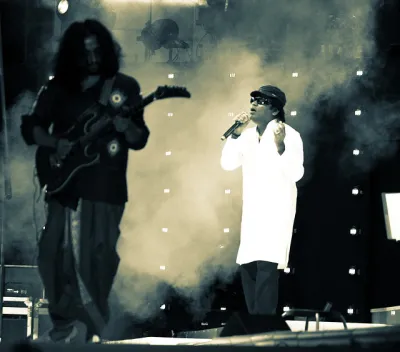
Photo: Wikimedia Commons
A. R. Rahman
Human Design Chart
Biography
In 2009, Time included Rahman on its list of the world's most influential people. The UK-based world-music magazine Songlines named him one of "Tomorrow's World Music Icons" in August 2011.
With an in-house studio (Panchathan Record Inn in Chennai) Rahman's film-scoring career began during the early 1990s with the Tamil film Roja. Working in India's film industries, international cinema and theatre, Rahman is one of the world's all-time best-selling recording artists. In a notable two-decade career, he has been acclaimed for redefining contemporary Indian film music and contributing to the success of several films. Rahman has become a notable humanitarian and philanthropist, donating and raising money for a number of causes and charities.
What does Projector 6/2 mean for A. R. Rahman?
Projector 6/2 — Design at a Glance
A. R. Rahmans design points towards focused perception: He is someone who immediately recognizes systemic errors and guides others accordingly. As a projector, he does not have the constant internal energy source that motor types possess but rather acts through a dense, radiant aura – comparable to a bright flashlight shining directly into dark corners. This ability to identify weaknesses in his environment was only effective when it wasn't perceived as direct criticism.
The mechanics of his design require patience: Instead of actively demanding or imposing his observations, he must wait for an honest invitation. Only when others consciously seek his advice can he contribute his knowledge without causing resistance. If he shines solely through his own harmonious actions, he attracts others automatically.
This cycle of intense impact and necessary regeneration shapes his energy balance. Since the sacral center is undefined, he lacks continuous reserves; phases of high productivity must be followed by rest periods to avoid exhaustion. Ignoring this need for recovery or acting without invitation leads to bitterness – his specific non-self theme. If A. R. Rahman lives according to the strategy of waiting and selective guidance, his path is rewarded with success. His strength lies not in constant action but in precise, inviting direction.
Splenic Authority
A. R. Rahmans design points towards spontaneous, intuitive decision-making: He trusted subtle inner signals to determine whether a situation or environment was healthy for him. This ability stems from his authority in the spleen center. For this center to take over as an internal guide, both emotional and sacral centers must be open; this configuration is possible only for projectors or manifestors. The spleen functions here as a health and alarm system with pronounced survival intelligence. Its instinct and physical well-being served as reliable indicators of whether he was in the right company. Decisions had to be made immediately: The first spontaneous impulse was correct and directly beneficial to his health. This allowed A. R. Rahman to effectively care for himself and rigorously protect against harmful influences. Since this spleen impulse is very subtle and occurs only once at a moment, there was a risk that it could be drowned out by other voices. This required high vigilance; a temporary retreat could be helpful in decision-making. Because the right thing was always known only in the present, plans could change suddenly. Long-term commitments were therefore difficult; instead, A. R. Rahman needed much freedom and flexibility to avoid unnecessary binding and act spontaneously.
The 6/2 Profile — Role Model / Hermit
A. R. Rahmans design points towards a lifelong learning process that unfolds in two distinct phases. In early years, the 3-line of his profile dominated: Experimentation, trial and error, as well as withdrawal after failure characterized this period. It was about learning through personal experience without immediate confirmation.
With the entry of the 6-line, typically around age 30, the attitude fundamentally changed. A. R. Rahman then showed a need for distance and deep reflection on accumulated experiences. This phase served healing and profound self-awareness before he re-entered exchange as an example with gained wisdom.
This development is supported by line 6 between Gate 38 and Gate 57, which goes through three phases: trial and error, distancing, and finally working as a role model. Misunderstandings are not seen as mistakes but as necessary steps towards transformation and unyielding stance. At the same time, line 2 (Gate 57) brings intuitive clarity regarding values and survival. These values serve for internal cleansing and resolve, yet they are based on intuition rather than moral dogma. A. R. Rahman learned to purify his ideals through inner insight and assert them with resolute stance.
Single Definition — Defined & Open Centers
A. R. Rahman's design inclines towards intuitive, momentary perception, supported by a defined Spleen Center. This gives him a reliable instinct for health and well-being that operates in the 'now'. Complementing this is the defined Root Center, which provides constant adrenalized pressure – not as stress but as existential energy to maintain life force and material progress.
At the same time, his chart reveals high susceptibility to external influences in several areas. The open Head Center means mental inspiration fluctuates; A. R. Rahman tended to engage with questions that were not his own or be distracted by mental pressure rather than trusting inner clarity. Similarly, the open Ajna Center: concepts and theories were taken on board but not held as personal truth, making the mind flexible yet prone to confusion.
The open Throat Center showed an absence of a fixed identity or direction; A. R. Rahman relied on initiating through interaction with his environment and other people to find his path; seeking a static 'I' definition would have been counterproductive here. The open Heart Center lacked consistent willpower; there was the risk of making promises or getting entangled in competitive dynamics just to prove personal worth – a classic conditioning error for this center.
Additionally, the open Sacral and Solar Plexus Centers were present. The Sacral Center had no constant energy flow; A. R. Rahman needed to learn not to work on 'borrowed' energy from others to avoid exhaustion. The open Solar Plexus absorbed emotions from the environment, making him prone to personalizing foreign moods or fearing confrontation. The wisdom of this design lay in using defined instincts and root pressure as a compass while viewing open centers as mirrors for the world without identifying with their contents.
Channel 18-58: Judgment — Channels & Gates
A. R. Rahman's design inclines towards tireless perfectionism paired with the determination to resist external forces to preserve individual integrity. This attitude was shaped by the Judgment Channel 58-18: it linked the vibrant energy of Gate 58 with the corrective impulse of Gate 18, triggering a logical drive to constantly question and improve patterns. This process served to keep life in balance and identify errors before they burdened the collective.
Parallel to this, the Life Struggle Channel 38-28 acted: it connected the combative resistance of Gate 38 with the conscious valuation of Gate 28. This created a stubborn resolve to only engage in struggles that had deep meaning and served individual development. It was not about blind conflict but protecting one's unique identity through resistance against distraction, serving as an example for others' own individuation process.
Additionally, specific Gates contributed to inner dynamics: Gate 39 prepared the ground for mutation through provocative analysis and adrenaline; Gate 51 brought strong willpower with the ability to adapt to shocks; Gate 57 promoted intuitive clarity in the here and now; and Gate 60 demanded acceptance of limitations as a prerequisite for creative transformation. Together, these elements formed a profile defined by critical scrutiny, meaningful resistance, and adaptive willpower.
Individual Circuitry — Circuit Signature
A. R. Rahman's design inclines towards a pulsating, acoustic expression power based on his own path. This unique identity is not an abstract idea but concrete life energy shaped by the Knowledge Circuit. In him, this circuit specifically linked the Spleen and Root Centers through the Life Struggle Channel (Gates 28–38). This meant a direct connection between intuitive perception and survival or assertive energy. The Spleen provided spontaneous intuition for the right moment while the Root Center supplied the necessary power to translate these impulses into reality.
Parallel to this, the Understanding Circuit also linked the Spleen and Root Centers but through another channel: Judgment (Gates 18–58). Here it was about focused visual strategies and the ability to share logical insights. Although both circuits used the same centers, they formed distinct segments within his simple definition. There was no direct energetic flow between the themes of the two circuits; instead, there existed two parallel forces: on one side, the intuitive, pulsating expression of self and on the other, rational strategic analysis for structural improvement. A. R. Rahman thus relied both on deep intuition and wise judgment, with both skills drawing from the same energetic base – the interplay of Spleen and Root – but fulfilling different functions: one for individual expression, the other for strategic future planning.
Left Angle Cross of Individualism 2
A. R. Rahman's design revealed a profound, almost fated connection to his true essence. He defined his identity not primarily through external recognition or social roles but rather through an inner, unchanging core feeling. This attitude stems from the configuration of the "left cross of individualism." It describes an energy that compels one to live and protect their unique self, often independent of environmental expectations.
For A. R. Rahman, this meant that authenticity was not a choice but a necessity. The design promoted a strong boundary against conformity; he tended to choose paths that resonated personally with him, even if they appeared unconventional. The underlying mechanics work like an inner compass always pulling towards true self-expression. This created a life dynamic in which the question "Who am I really?" had to be continuously answered—not through thinking but by actually living this truth. A. R. Rahman carried this burden and gift of individualism as a central theme of his existence, making him a figure whose actions always sprang from this deep inner place rather than reacting to external impulses.
Saturn Return · Uranus Opposition · Chiron Return · 2nd Saturn Return — Life Cycles
A. R. Rahman's design indicates a tendency towards sudden, disruptive breakthroughs that challenge and reorder established structures. This dynamic was concretely demonstrated in 2009, at the age of 42, when he received two Academy Awards, two Grammy Awards, and one BAFTA Award for his film score to "Slumdog Millionaire." This success marked the peak of the Uranus opposition, an astrological transit that typically comes with profound upheavals and breaking old patterns.
In the context of Human Design, this configuration signals a phase in which the individual no longer fits into old roles or expectations. The pressure to break free and redefine oneself often leads to an explosive unfolding of true potential. For A. R. Rahman, this was not a gradual ascent but rather a moment of radical transformation when his creative vision gained international recognition. Uranus energy acts like an electric shock that shatters the status quo and makes room for innovation. This cycle confirms that his design is geared towards making a unique contribution through unexpected events and rapid changes, rather than slowly integrating into existing systems. The success of 2009 was thus a visible confirmation of this inner need for renewal and breaking away from the known.
Projector · Splenic Authority — Synthesis
A central red thread runs through the design: a deep ability to perceive patterns and imbalances (Channel 58-18), combined with an instinctive health awareness (defined Spleen Center). This combination creates a sharp eye for what is not working, paired with inner wisdom to recognize what is nourishing. The projection style aimed at bringing light into the dark is reinforced by the role of being a role model – a figure who gains wisdom from personal experience and shares it. This process of observation, correction, and sharing of insights seems to represent a life pattern that repeats in cycles.
The design reveals a central paradox between the drive for correction and the need for withdrawal. Channel 58-18 propels an insatiable search for improvement, while Line 6 in Profile requires a phase of intense reflection and healing. Before the age of 30, the focus is on experiments, followed by a need to withdraw and digest experiences. This points to an inner conflict between the desire to actively intervene and improve the world and the simultaneous need for distance and deeper self-awareness.
2 Defined Channels
Incarnation Cross - Left Angle Cross of Individualism 2
Solar Return
The Solar Return shows the moment when the sun returns to its exact birth position - your personal solar year.
Life Cycles
Discover the life cycles with a detailed triple view (birth chart, cycle chart, composite).
Human Design Profile
- Type
- Projector
- Strategy
- Wait for the respectful invitation
- Authority
- Splenic Authority
- Profile
- 6/2 - Role Model / Hermit
- Definition
- Single Definition
- Incarnation Cross
- Left Angle Cross of Individualism 2
- Date of Birth
- 06.01.1967 05:50
- Place of Birth
- Chennai, India
Frequently Asked Questions
What is A. R. Rahman's Human Design type?
What Profile does A. R. Rahman have in Human Design?
What Authority does A. R. Rahman possess?
What is A. R. Rahman's Incarnation Cross?
When was A. R. Rahman born?
Discover your own Human Design
Are you also a Projector? Find out in a personal reading how to unfold your leadership qualities and recognize the right invitations.
More Personalities
Back to overviewSissy Spacek

Aaliyah

Alain-Fournier
Alexia

Alizée

Anémone