
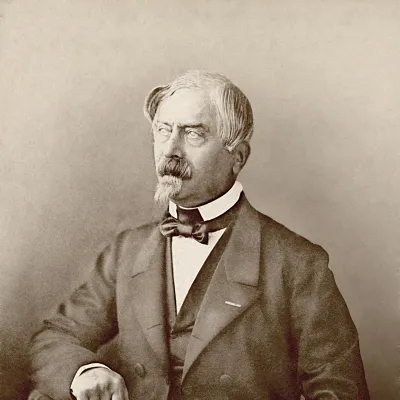
Abel Niépce de Saint-Victor
Human Design Chart
Biography
Abel Niépce de Saint-Victor — Generator with Profile 1/3
Generator 1/3 — Design at a Glance
Abel Niépce de Saint-Victor had a design characterized by immense endurance and an inexhaustible inner source of strength. As a Generator, he possessed abundant sacral energy that distinguished him as a strong workhorse - provided he utilized these reserves for tasks that truly resonated with him. His life force did not ignite through spontaneous initiative but responded to signals from his environment. The motto of his design was: Not start, but respond.
When life presented him with an opportunity and his inner self signaled a clear 'yes', he acted effectively in response. This reactive strategy was the key to his productivity. Living in harmony with this principle rewarded him with deep feelings of satisfaction and fulfillment. However, when he tried to fight against his natural flow - for instance by forcing himself into initiatives or exhausting himself on unsuitable projects - it inevitably led to frustration and a noticeable energy drain. His greatest challenge lay in not being distracted from his true heart project by external expectations but waiting for inner confirmation before deploying his considerable strength.
Sacral Authority
Abel Niépce de Saint-Victor exhibited a decision-making approach rooted in immediate physical resonance. As a Generator, his strategy was identical to his inner authority: sacral authority. This fundamentally simplified his decision-making process as he did not need to oscillate between external tactics and an internal compass. His inner guidance stemmed directly from the defined Sacral Center, which functioned as the engine.
This mechanism manifested in the form of a 'gut feeling' or a sudden surge of energy that always arose as a reaction to an external stimulus. Abel Niépce de Saint-Victor learned to read these physical signals - whether it was a loud grunt at rejection or a confirming 'mm-hm' at approval. When his sacral engine revved up, he felt vital and alive; an almost inexhaustible energy became available to him. He tackled his tasks with great enthusiasm and immersed himself in them without the need for a compelling purpose. Joy and satisfaction characterized his path through life.
Additionally, the activated Spleen Center supported this sacral guidance. This connection enabled him particularly quick and spontaneous reactions. He had an immediate access to his physical well-being and instinctive perception, which he relied on reliably. His authority was thus a synchronous blend of deep energetic drive and sharp, protective instinct.
The 1/3 Profile — Investigator / Martyr
Abel Niépce de Saint-Victor emerged as a researcher and experimenter whose life was marked by a constant alternation between theoretical learning and practical application. His design inclined towards testing knowledge not just through passive absorption but also direct trial and error. This configuration described someone who combined the curiosity of a scientist with the urge of an adventurer.
Line 1 of his Profile emphasized the need for thorough planning and quality in stimulation. Abel Niépce de Saint-Victor often had to seek feedback to understand if his stimuli were effective. Simultaneously, Line 3 challenged him to go through biological processes of survival and mutation. This meant he was exposed to extremes to distinguish the fruitful from the unfruitful. His judgments only formed after he had tested a matter both theoretically and practically on heart and gut level. Only then could he gain trustworthy insights. The tension between the desire for security through knowledge (Line 1) and the impulse to act despite possible errors (Line 3) shaped his path. He learned that self-earned insights were the only stable ground upon which he could stand.
Single Definition — Defined & Open Centers
Abel Niepce de Saint-Victor revealed himself through a reliable inner identity and a clear sense of direction, shaped by his defined G Center. This firm self-love allowed him to lead others without being dependent on their approval. His actions were also driven by a strong, generative vitality; his defined Sacral Center provided the necessary energy for endurance and satisfaction if he responded to internal impulses rather than initiating them. This was complemented by the intuitive, momentary awareness of his defined Spleen Center as well as the stable existential pressure of his defined Root Center, which anchored him in the present.
In contrast, Abel Niepce de Saint-Victor was open to external influences in mental and emotional realms. His open Head and Ajna Centers meant that he did not possess a constant personal truth but rather absorbed inspirations and concepts from his environment. He tended to identify with foreign questions or doubts instead of seeing them as transient stimuli. Similarly, his open Solar Plexus acted as a barometer for the emotional climate of his surroundings; he absorbed and amplified others' feelings, making him susceptible to interpreting non-personal emotions as personal states. His open Heart Center lacked consistent willpower in terms of competition or promises; he did not need to prove himself but learned to let go of pressure to perform. Finally, his open Throat Center naturally attracted attention without him actively seeking it – so long as he waited for the invitation to speak.
Channels for intuitive power, change and selfless care.
Abel Niepce de Saint-Victor's design inclined towards deep, often melancholic innovation paired with an instinctive ability for self-assertion and care. He was someone who not only conceived new directions mentally but also brought them into the world through concrete material resources and intuitive reactions.
The Beat channel 14-2 connected his Gate of Power Competence (14) with the Gate of Higher Knowledge (2). This gave him the strength to drive mutations and guide innovative perspectives by responding to his inner energy. This was complemented by the Mutation channel 60-3, which linked the Gate of Limitation (60) with the Gate of Order (3). Here a pulsating on/off energy forced evolutionary change but also brought periods of silence and melancholy as new things matured in the background.
His personal integrity came from the Research channel 34-10. Through the Gate of Power (34) and the Gate of Self Behavior (10), he learned to follow his own convictions and love himself, serving as an encouraging example for others. Parallel to this, the Perfect Form channel 57-10 provided intuitive adaptability. The Gate of Intuitive Insight (57) in the Spleen connected here with the Gate of Self Behavior (10), allowing him to react spontaneously and appropriately to his environment to secure physical well-being and survival.
For the community, Abel Niepce de Saint-Victor was marked by the Preservation channel 27-50. The Gate of Care (27) connected with the Gate of Values (50), making him a natural caregiver who took responsibility and protected tribal values. Finally, the Power channel 34-57 gave him acute awareness. The combination of sacral reaction and spleen-based intuition allowed him to recognize dangers immediately and secure his individual survival through quick, instinctive decisions.
Additionally, isolated Gates like the Gate of Inspiration (56) with its ability for abstract storytelling as well as the Gate of Ambition (54), which linked worldly success with spiritual development, were influential. The Gate of Freedom (53) drove him as a pioneer to begin new cycles while the Gate of Depth (48) helped him recognize and correct complex patterns in the collective.
Individual Circuitry — Circuit Signature
Abel Niepce de Saint-Victor's design inclined towards pulsating, acoustic creativity. As a Simple Defined, he had a continuous energetic flow between Identity, Sacral, and Root Centers as well as the Spleen. This connection enabled a direct interplay of instinct, life force, and self-image.
The Knowledge Circuit connected his Identity with the Sacral and Root Centers through the channel 'Mutation' (3-60), producing an energy of deviation from the known while the channel 'Beat' (2-14) provided rhythmic impulses. This fostered the development of a unique individuality through new insights.
Parallel to this, the Centering Circuit connected his Identity with the Sacral Center via the channel 'Research' (10-34). This configuration strengthened inner convictions and self-worth without directly expressing them in the Throat Center. The personality thus appeared solidified and brave in its uniqueness.
The Protector Circuit linked Sacral with Spleen Centers through the channel 'Preservation' (27-50). Here, the focus was on primordial protection, care, and preservation of one's genetics as well as family environment.
Finally, the Integration Circuit integrated Identity, Spleen, and Sacral Centers. The channels 'Perfect Form' (10-57) and 'Power' (34-57) channeled intuitive power and proper behavior to act in the present moment. These mechanisms shaped Abel Niepce de Saint-Victor's life as a search for hidden truth and its transmission to others.
Right Angle Cross of Laws 2
Abel Niépce de Saint-Victor carried the 'Right Law Cross' in his Human Design. This specific configuration shaped his inner orientation towards a profound, often painful confrontation with the structures and boundaries that defined his life. It was not about passive acceptance but an active process of understanding: The laws - whether societal norms or personal constraints - served as raw material for an internal transformation.
In the design, this cross means that external limitations or suffering did not function as an end but rather as a catalyst. Abel Niépce de Saint-Victor used these friction points to sharpen and integrate his own truth. The focus was on the right side of the system, suggesting a tendency towards inner reflection and private, often unobtrusive growth. Instead of fighting against circumstances, he learned to draw from them.
This mechanism is evident in how difficulties or feelings of isolation in his biography must be understood not as failures but as necessary steps on a path of self-discovery. The 'Right Cross' demands patience and the willingness to accept pain as a teacher. For Abel Niépce de Saint-Victor, this was a lifelong process: He transformed what limited him into a source of inner strength and clarity. His energy was directed towards penetrating the laws of his own existence and finding personal freedom that was independent of external recognition.
Saturn Return · Uranus Opposition · Chiron Return · 2nd Saturn Return — Life Cycles
Abel Niépce de Saint-Victors design indicated a tendency toward groundbreaking, structural breakthroughs often linked with a deep sense for historical cycles. His Uranus return around age 42 marked a turning point where long-held visions transformed into concrete innovations. This was clearly seen in 1847 when he invented the albumin process to create photographs on glass. This success was no coincidence but aligned with the mechanical dynamics of the Uranus return, breaking old structures and opening new, more efficient pathways for perception.
Later came his Chiron return at age 51, a cycle of fulfillment and bloom. During this phase, his life's work coalesced into a coherent teaching that carried his inner purpose outward. In 1856, he published his method of heliogravure in the 'Traite pratique de gravure héliographique'. This publication was the visible expression of what the design carried as an incarnation purpose: not only to create technical innovations but to fix them in a form that was usable and understandable for others. Both events underscore a pattern where inner developmental steps directly culminated in groundbreaking, documented achievements.
Generator · Sacral Authority — Synthesis
Abel Niépce de Saint-Victor lived deeply rooted in his sacral drive (Generator), always seeking new experiences and insights (Researcher/Experimenter). This urge to learn through trial and error fueled his ability to generate energy for what truly fulfilled him - a process that unfolded particularly when he responded to external stimuli with an inner surge of power (sacral authority). The connection between sacral energy and the quest for knowledge formed a red thread throughout his life, as he constantly strove to use his abilities to advance innovations.
Simultaneously, his design showed a paradox between the need for free experimentation and deep commitment to his own direction (defined G-Center). He was destined to tread new paths and transform knowledge (Knowledge Circuit), yet at the same time, his identity required clear inner alignment. This led to a tension between the desire for unbound exploration and the necessity of channeling gained insights into concrete, transformative results - an interplay that manifested in successes like inventing new methods (documented events 1847 & 1856).
6 Defined Channels
Incarnation Cross - Right Angle Cross of Laws 2
Solar Return
The Solar Return shows the moment when the sun returns to its exact birth position - your personal solar year.
Life Cycles
Discover the life cycles with a detailed triple view (birth chart, cycle chart, composite).
Human Design Profile
- Type
- Generator
- Strategy
- To respond - wait for something to respond to
- Authority
- Sacral Authority
- Profile
- 1/3 - Investigator / Martyr
- Definition
- Single Definition
- Incarnation Cross
- Right Angle Cross of Laws 2
- Date of Birth
- 20.07.1805 08:00
- Place of Birth
- Saint-Cyr, France
Frequently Asked Questions
What was Abel Niépce de Saint-Victor's Human Design type?
What profile did Abel Niépce de Saint-Victor have?
What authority did Abel Niépce de Saint-Victor have?
What incarnation cross did Abel Niepce de Saint-Victor have?
When was Abel Niepce de Saint-Victor born?
Discover your own Human Design
Are you also a Generator? Find out in a personal reading how to use your sacral energy correctly and discover deep satisfaction.
More Personalities
Back to overviewAaliyah

Alain-Fournier

Alexia

Angèle

Angeli

Anne-Marie
