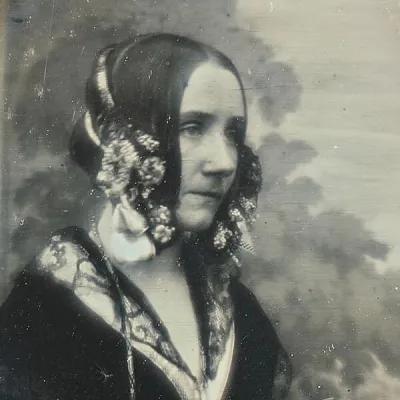
Ada Lovelace
Human Design Chart
Biography
Lovelace was the only legitimate child of poet Lord Byron and reformer Anne Isabella Milbanke. Lord Byron separated from his wife a month after Ada was born, and died when she was eight. Although often ill in childhood, Lovelace pursued her studies assiduously. She married William King in 1835. King was a Baron, and was created Viscount Ockham and 1st Earl of Lovelace in 1838. The name Lovelace was chosen because Ada was descended from the extinct Baron Lovelaces. The title given to her husband thus made Ada the Countess of Lovelace.
Lovelace's educational and social exploits brought her into contact with scientists such as Andrew Crosse, Charles Babbage, David Brewster, Charles Wheatstone and Michael Faraday, and the author Charles Dickens, contacts which she used to further her education. Lovelace described her approach as "poetical science" and herself as an "Analyst (& Metaphysician)". When she was eighteen, Lovelace's mathematical talents led her to a long working relationship and friendship with fellow British mathematician Charles Babbage.
Ada Lovelace — Manifesting Generator with Profile 1/3
Manifesting Generator 1/3 — Design at a Glance
Ada Lovelace was revealed as a Hybrid being that combined the constant energy of a Generator with the lightning-fast execution capability of a Manifestor. Her design inclined towards high speed and parallel action, enabling her to skip steps and achieve results rapidly. However, this configuration described a tension field: The ability to tackle many things simultaneously could easily lead to frustration if important intermediate steps were neglected or inner approval was lacking.
Her defined Sacral Center provided a steady energy source that was optimally utilized not through initiative but by reacting to external impulses. Only with clear internal confirmation – that 'yes' of the Sacral – did her creative power operate without friction. When this strategy was followed, a state of deep well-being emerged, described as the 'Play-Mode'. In this mode, parallel processing of various projects was not a source of stress but an expression of her natural joy and efficiency in life. The danger always lay in haste; without this reflective response to life, her design tended to block itself rather than use its immense power for satisfaction.
Emotional Authority
Ada Lovelace exhibited an internal decision-making structure that required patience and temporal distance. Her design carried emotional authority in the defined Solar Plexus Center. This meant that her feelings flowed in waves – a constant up and down that colored her perception of the world. What she felt as absolutely right or inspiring at one moment could appear negative or irrelevant the next. Her immediate feeling was always just a snapshot, not the final truth.
This mechanism required her to avoid spontaneous reactions. Quick decisions from an emotional peak risked negative consequences since the first impression had not yet matured. Instead, she needed time. The process of 'sleeping on it' was essential for Ada Lovelace: She needed distance so that intense feelings could subside and make way for emotional clarity. Only when this calmness set in could she authentically decide. This approach was particularly important for long-term decisions in her life, which significantly influenced her life path. By waiting for the waves to flatten, she secured a deeper, more comprehensive understanding, free from the distortion of acute moods.
The 1/3 Profile — Investigator / Martyr
Ada Lovelace lived in a constant interplay between the deep need for theoretical understanding and the necessity to validate insights through practical application. Her design as Profile 1/3 shaped a life task that consisted of two phases: intensive learning on Line 1 and experimental testing on Line 3. Often, she felt an internal conflict between the urge to know everything in advance to avoid mistakes and the unavoidable reality that true understanding only arises through trial and error.
This dynamic led her not to express herself lightly. When Ada Lovelace made a judgment or deemed an idea correct, she had thoroughly examined it both intellectually and practically. For her design, self-discovered insights were the sole measure of truth; mere theory without practical confirmation was insufficient. Line 1 drove her to pursue goals and find ownership over what was achieved, while Line 3 taught her to learn from mistakes and reduce self-blame. She recognized that her own experience was the key to validation. Only what she herself had tested could she trust. This process ensured that her conclusions were robust and reliable, as they bridged the gap between abstract knowledge and concrete reality through personal action.
Split Definition — Defined & Open Centers
Ada Lovelace's design established a tendency towards inner stability while simultaneously being vulnerable to external influences. Her defined centers – Sacral, G Center, Solar Plexus, and Throat – formed the constant self with reliable vitality, firm identity, and emotional depth. The defined Sacral Center provided the base frequency: energy was only available upon correct reaction (Yes/No Tone), not through initiation. The defined G Center set a firm direction while the Solar Plexus Center dictated as an inner authority that decisions could only be made after experiencing the emotional wave. The defined Throat consistently imprinted these internal states into the world.
At the same time, six centers were open: Head, Ajna, Heart, Spleen, and Root. These mirrors for external influences activated situationally and did not belong to their own truth. The open Head Center tended to experience mental pressure or be overwhelmed by doubts that actually belonged to others. The open Ajna Center could take on concepts without identifying them as personal truths. The open Heart Center was vulnerable to the urge to prove itself through promises, even though it wasn't designed for willpower. The open Spleen Center sought security from others and tended to cling to unhealthy things to simulate well-being. The open Root Center absorbed stress from the environment and amplified adrenalized pressure that it did not generate.
The challenge lay in not overriding her reliable processes – Sacral reaction, G direction, emotional clarity – with the pressure of the open centers. Mental questions, willpower proof, spontaneity, and stress could overlay her inner authorities if they were not recognized as non-self themes.
Channels for self-acceptance and emotional openness.
Ada Lovelace exhibited a fundamental stance of authentic self-assertion paired with an emotional expressiveness that was strongly dependent on her internal rhythm. Her design suggested she did not prove her strength through constant social presence but rather through deeply rooted inner convictions and moments of communication that only became effective when the mood was right.
This profile was significantly influenced by Channel 34-10, connecting Sacral with G Center. This pathway between Tor 34 (Power) and Tor 10 (Self Behavior) served to accept oneself and adhere to individual beliefs. For Ada Lovelace, however, this self-affirmation was not a rigid demand but responded to external impulses. She lived her uniqueness by patiently waiting for stimuli before responding with inner strength. This allowed her to act independently while leading others through her authentic reaction on how to honor oneself without breaking social cohesion.
Simultaneously, Channel 22-12, connecting Solar Plexus Center with Throat Center, regulated her emotional expression through Tor 22 (Openness) and Tor 12 (Caution). Her ability to articulate and socially interact depended on the ebb and flow of her emotional wave. She was not consistently communicative but sought specific moments when her mood allowed for transformative words. Tor 12 provided necessary restraint; she shared deep insights only with those who had the potential to make something new from them. When the emotional wave did not match, she withdrew to avoid misunderstandings and frustration.
Additionally, Gates like 9 (Detail Work), 15 (Collective Rhythm), or 47 (Purpose from Past) contributed to the complexity of her experience but remained subordinate to the dominant channels. Ada Lovelace thus lived in a tension between the need for individual affirmation and the dependency of her social impact on her emotional timing.
Individual Circuitry — Circuit Signature
Ada Lovelace exhibited a split definition, showing two parallel, not directly connected energetic poles. One pole consisted of the Centering Circuit connecting Identity with Sacral Center, creating inner firmness and strong individuality; her convictions were deeply rooted but often remained unspoken as this circuit did not connect to Throat Center. The other pole was the Knowledge Circuit linking Throat with Solar Plexus Center, where pulsating acoustic energy promoted emotional expression of new knowledge and innovations. Since these two systems were separate, a tension existed: the inner, firm identity could not directly flow into the innovative expression. Instead, the firm conviction only indirectly channeled through the emotional wave of the Knowledge Circuit. This resulted in dynamics where 'lightbulb moments' and transformative ideas could become vocal but always driven by emotional intuition rather than rational identity. The energy was creative yet sometimes melancholic as the deep self-assurance of one pole did not support the external expression of the other. Ada Lovelace thus lived in balance between the need for individual affirmation and the impulse towards communicative transformation, with these two forces existing side-by-side but not merging.
Right Angle Cross of Rulership 4
Ada Lovelace's design established an archetypal structure of governance and responsibility. Her inner compass was oriented not only towards making individual decisions but also guiding the energy for the collective or her immediate environment. This aligned with the pattern of the Right Authority Cross (Cross 4), which defines leadership as a fundamental natural force.
In this Human Design context, this cross means that authority is not an external position one takes on, but rather an inherent character trait. The driving force behind her actions was the necessity to provide order and direction. She did not act out of passive adaptation but from a deep conviction to take responsibility for the space around her.
This configuration shaped her way of handling energy: she was designed to stabilize others through clear guidance. The mechanics of Cross 4 are evident in how the person becomes the source of orientation themselves. For Ada Lovelace, this was not an optional behavior but the fundamental pattern of her life purpose. Her energy thus always served a larger structure or community, taking on the role of leader and stabilizer. This distinguished her essence fundamentally from designs primarily oriented towards individual freedom or purely analytical distance.
Saturn Return — Life Cycles
Ada Lovelace appeared in 1843 at age 28 during an intense phase of structuring. She worked with Charles Babbage on the Analytical Engine and wrote notes twice as extensive as the original text. This marked her first Saturn Return, a life phase aimed at establishing authority and long-term responsibility. During this period, it's about defining one's role in the collective context and creating solid foundations for future work. The massive expansion of material by Lovelace illustrates this process: she did not just take on a task but profoundly shaped it through her intellectual labor. The first Saturn Return often demands that years of groundwork be condensed into concrete, stable results. Here exactly that happened: from collaboration emerged an independent, weighty work that solidified her position. It was not mere participation but the active shaping of structure and content. This ability to take responsibility for complex issues and expand them through personal contributions is characteristic of this maturation phase. Lovelace used the moment to clearly define and sustainably anchor her voice and contribution in the larger whole.
Manifesting Generator · Emotional Authority — Synthesis
Ada Lovelace lived a lifestyle deeply marked by an inner dynamism. Her defined sacral knot (from the design perspective) provided a constant energy source, which gained a special quality through its connection to the Throat Center: the ability to rapidly develop and express ideas. This interplay of reactive sacral power and manifesting impulses formed the red thread of her actions – an ongoing oscillation between receiving inspiration and implementing it in concrete forms. The profile as researcher and experimenter (profile role) reinforced this process by adding an insatiable drive for testing and verifying new insights.
Simultaneously, a central paradox revealed itself: her emotional authority required time for decision maturation, while her Manifesting Generator type tended towards quick action. This tension between the need for emotional clarity and the ability to initiate rapidly shaped her approach – weighing deep reflection against experimental implementation, which was evident in her work (cross/cycles).
2 Defined Channels
Incarnation Cross - Right Angle Cross of Rulership 4
Solar Return
The Solar Return shows the moment when the sun returns to its exact birth position - your personal solar year.
Life Cycles
Discover the life cycles with a detailed triple view (birth chart, cycle chart, composite).
Human Design Profile
- Strategy
- To respond - wait for something to respond to
- Authority
- Emotional Authority
- Profile
- 1/3 - Investigator / Martyr
- Definition
- Split Definition
- Incarnation Cross
- Right Angle Cross of Rulership 4
- Date of Birth
- 10.12.1815 13:00
- Place of Birth
- London, England, United Kingdom
Frequently Asked Questions
What is Ada Lovelace's Human Design type?
What were Ada Lovelace's Profiles in Human Design?
What authority did Ada Lovelace have?
What incarnation cross did Ada Lovelace have?
When was Ada Lovelace born?
Discover your own Human Design
Are you also a Manifesting Generator? Find out in a personal reading how to unfold your multi-talents and direct your energy wisely.
More Personalities
Back to overviewAldair

Alizée

Angeli

Arletty

Artus

Balthus